
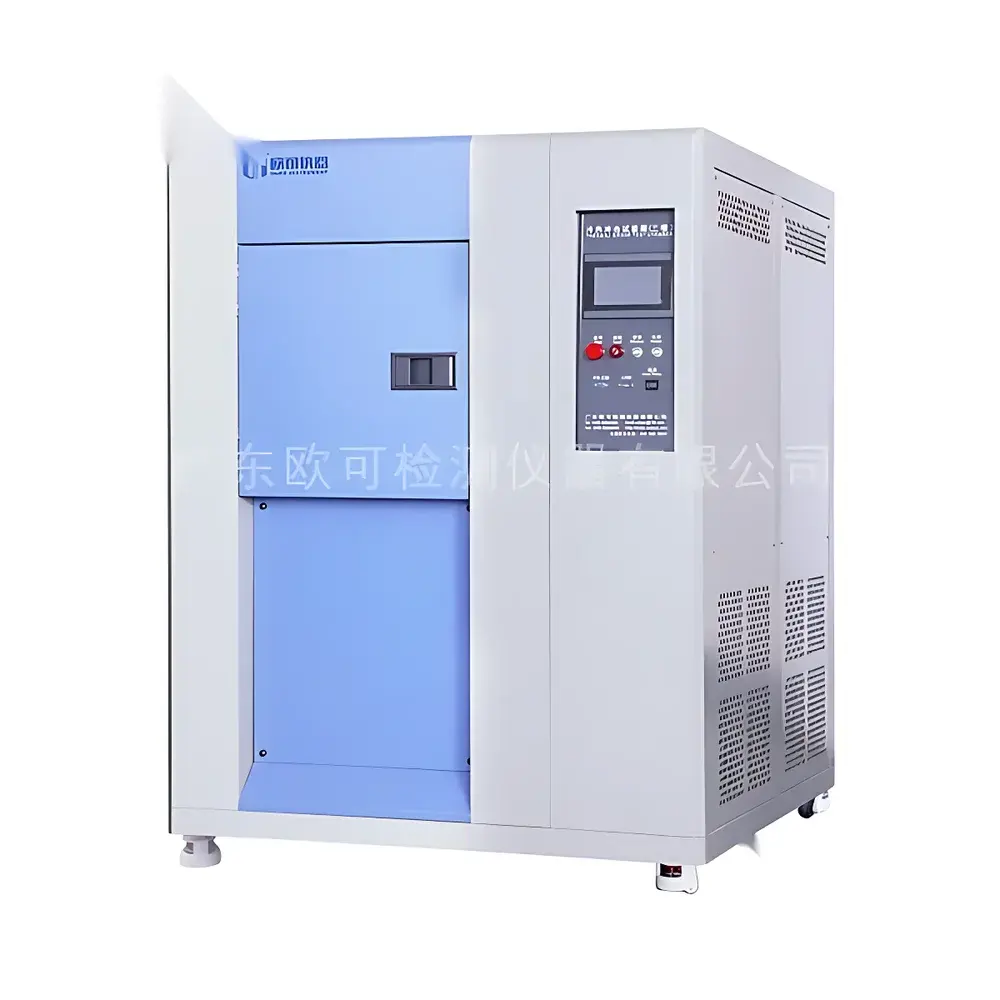
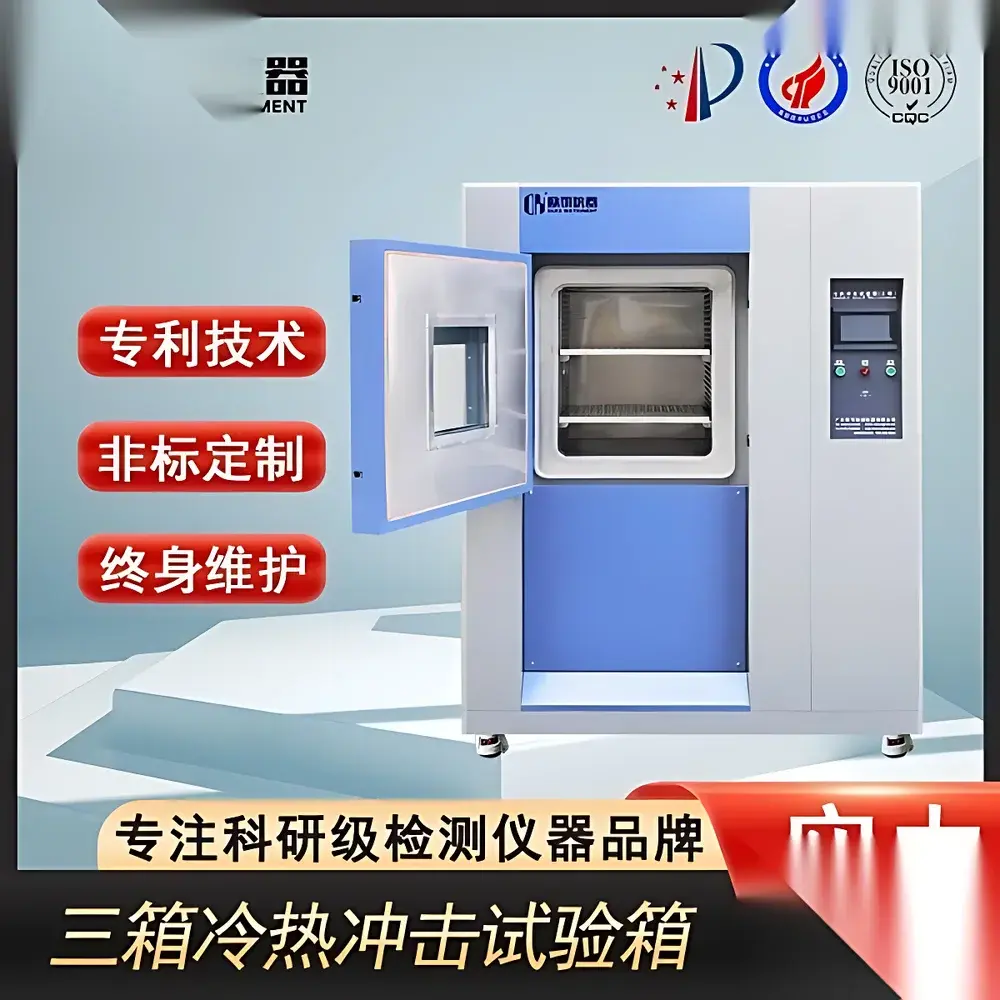
OK-HH Series Thermal Shock Test Chamber – Manufacturer-Supplied Environmental Test System
| Key Features | Three-zone or two-zone configuration |
|---|---|
| Temperature Range | +200°C (hot soak) to –70°C (cold soak) |
| Test Zone Operating Range | +60°C to +150°C (hot shock), 0°C to –65°C (cold shock) |
| Temperature Transition Time | <5 min |
| Temperature Uniformity | ±2.0°C |
| Control Accuracy | ±0.5°C |
| Refrigeration | Dual-stage cascade system with imported semi-hermetic compressors |
| Cooling Medium | R404A/R23 |
| Construction | Interior – mirror-finish SUS304 stainless steel |
| Insulation | High-density, fire-retardant PU foam |
| Power Supply | AC380V±5%, 50Hz±0.5Hz, 3-phase 5-wire |
Overview
The OK-HH Series Thermal Shock Test Chamber is an engineered environmental stress screening (ESS) system designed for accelerated reliability validation of electronic components, automotive modules, aerospace hardware, and advanced material assemblies. It operates on the principle of rapid thermal transition between extreme temperature extremes—utilizing either a three-chamber (hot/ambient/cold) or two-chamber (hot/cold) architecture—to induce controlled thermal gradients across test specimens. This methodology replicates real-world operational stresses such as solder joint fatigue, interfacial delamination, seal integrity failure, and coefficient-of-thermal-expansion (CTE) mismatch-induced microcracking. Unlike standard temperature cycling chambers, the OK-HH series delivers high-rate thermal transitions (≤5 minutes between extremes) via pneumatic air-flap switching (three-chamber) or motorized basket transfer (two-chamber), minimizing dwell time in transitional zones and maximizing thermal shock severity per cycle. The system is calibrated and validated for traceable performance against ISO/IEC 17025-accredited procedures and supports full audit trails required under GLP and GMP frameworks.
Key Features
- Configurable architecture: Selectable three-zone (separate hot soak, cold soak, and test chamber) or two-zone (hot/cold chambers with automated specimen transfer basket) design to match application-specific throughput, specimen size, and shock profile requirements.
- Precision dual-stage cascade refrigeration: Integrated German-sourced semi-hermetic compressors operating on environmentally compliant R404A (high-stage) and R23 (low-stage) refrigerants, enabling stable operation down to –70°C in the cold reservoir and up to +200°C in the hot reservoir.
- Thermal performance certification: Achieves ≤5-minute transition time between temperature extremes, ±0.5°C temperature control accuracy, and ±2.0°C uniformity across the working volume—verified per IEC 60068-3-5 and ASTM E1545 calibration protocols.
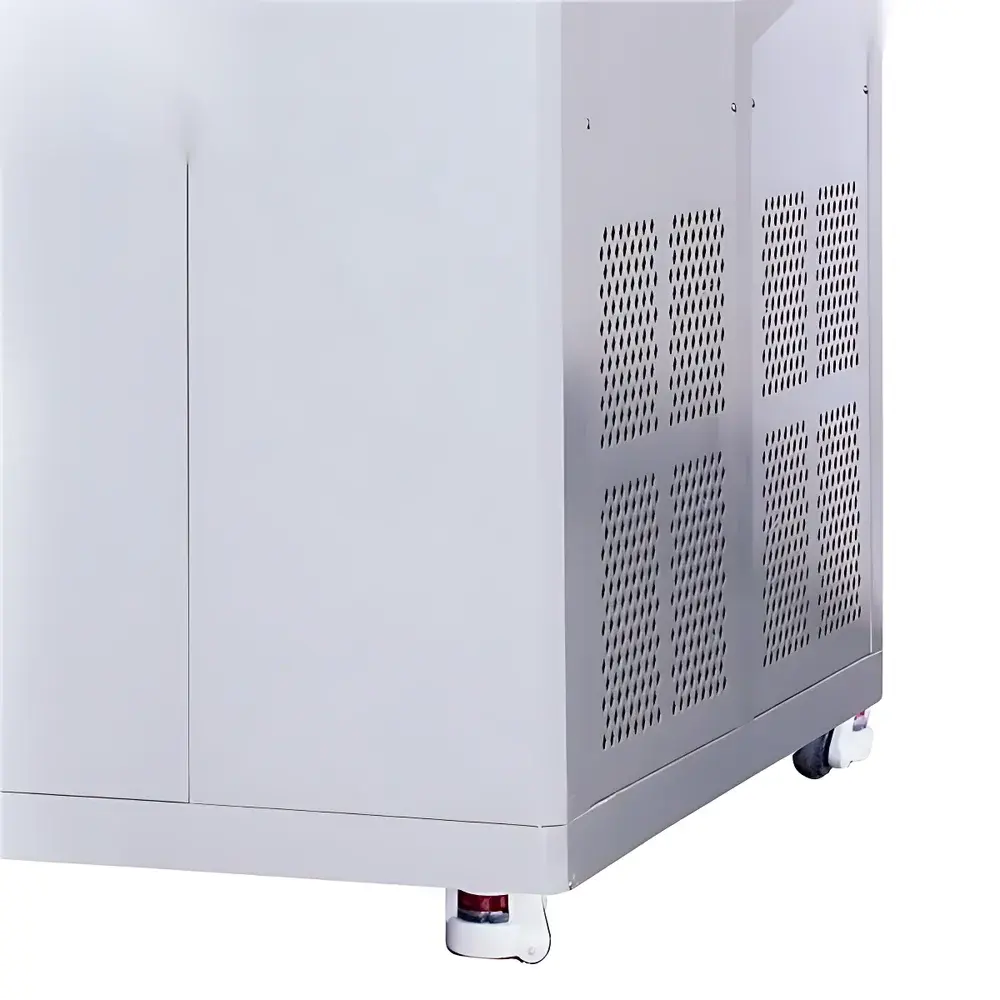
- Robust mechanical construction: Interior chamber fabricated from electropolished SUS304 stainless steel with non-porous mirror finish; exterior housing options include corrosion-resistant SUS304 or industrial-grade powder-coated carbon steel; high-density, flame-retardant polyurethane insulation minimizes thermal leakage and energy consumption.
- Modular electrical integration: Standard 3-phase 5-wire AC380V power interface with integrated overcurrent protection, grounding continuity monitoring, and optional uninterruptible power supply (UPS) compatibility for mission-critical test campaigns.
Sample Compatibility & Compliance
The OK-HH series accommodates specimens ranging from small PCBs and semiconductor packages to large automotive ECUs and composite structural panels—custom internal dimensions (49 L to 225 L) allow adaptation to diverse product footprints. All configurations include standardized 50 mm diameter cable/port access, dual-tier SUS304 sample shelves, and adjustable mounting rails. Regulatory alignment includes full conformance with GB/T 2423.1 (cold testing), GB/T 2423.2 (dry heat), GB/T 2423.22 (temperature change), GJB 150.3–5 (military environmental test standards), IEC 60068-2-14 (Test N: Change of temperature), MIL-STD-810G Method 503.5, EIA-364-32 (thermal shock for connectors), and QC/T 17 (automotive component weathering). Documentation packages support FDA 21 CFR Part 11-compliant electronic records when paired with validated data acquisition software.
Software & Data Management
The chamber integrates with OK-Logix™ Environmental Test Suite—a Windows-based platform supporting real-time monitoring, multi-channel temperature logging (≥16 channels), programmable ramp/soak profiles, automatic cycle counting, and alarm-triggered event capture. All data files are timestamped, digitally signed, and stored in CSV and PDF report formats compliant with ISO 13485 and IATF 16949 documentation requirements. Audit trail functionality records operator ID, parameter modifications, calibration events, and system faults—enabling full traceability during regulatory inspections. Optional OPC UA server integration allows seamless connectivity to MES and PLM systems for centralized test campaign orchestration.
Applications
- Electronics: Solder joint reliability assessment of BGA, QFN, and wafer-level CSP packages under JEDEC JESD22-A104 thermal shock conditions.
- Automotive: Validation of ADAS sensors, battery management systems (BMS), and infotainment modules per ISO 16750-4 and LV-124 specifications.
- Aerospace: Qualification of avionics enclosures, MEMS inertial units, and radome materials per DO-160 Section 4 and RTCA/DO-160G.
- Materials Science: Evaluation of polymer matrix composites, ceramic coatings, and metal-ceramic brazed joints for CTE-driven interfacial degradation.
- Medical Devices: Biocompatibility and hermeticity verification of implantable electronics per ISO 10993-12 and AAMI TIR17.
FAQ
What is the difference between two-chamber and three-chamber thermal shock configurations?
In a two-chamber system, the test specimen moves between hot and cold zones via a motorized basket—ideal for smaller parts requiring high-frequency cycling. In a three-chamber design, the specimen remains stationary while conditioned air is routed via pneumatic dampers—reducing mechanical stress on fixtures and enabling larger, heavier, or more delicate assemblies.
Does the system support automated test sequencing and reporting?
Yes—when operated with OK-Logix™ software, users can define multi-step profiles (e.g., pre-conditioning → thermal shock → functional test), schedule unattended runs, and generate ISO/IEC 17025-aligned reports with embedded calibration certificates and uncertainty budgets.
Is external cooling water infrastructure required?
The dual-stage cascade refrigeration system requires a dedicated closed-loop cooling water circuit delivering ≥10 m³/h at 32°C inlet temperature. A field-installed cooling tower (user-supplied) is mandatory for continuous operation above 85% duty cycle.
Can the chamber be validated for IQ/OQ/PQ protocols?
Yes—full qualification documentation kits—including installation qualification (IQ), operational qualification (OQ), and performance qualification (PQ) templates aligned with ASTM E2500 and Annex 15—are available upon request and supported by factory-trained field service engineers.
What maintenance intervals are recommended for long-term reliability?
Compressor oil analysis every 2,000 operating hours, refrigerant leak detection quarterly, door gasket inspection monthly, and full system calibration annually per ISO/IEC 17025 accredited procedures.



