
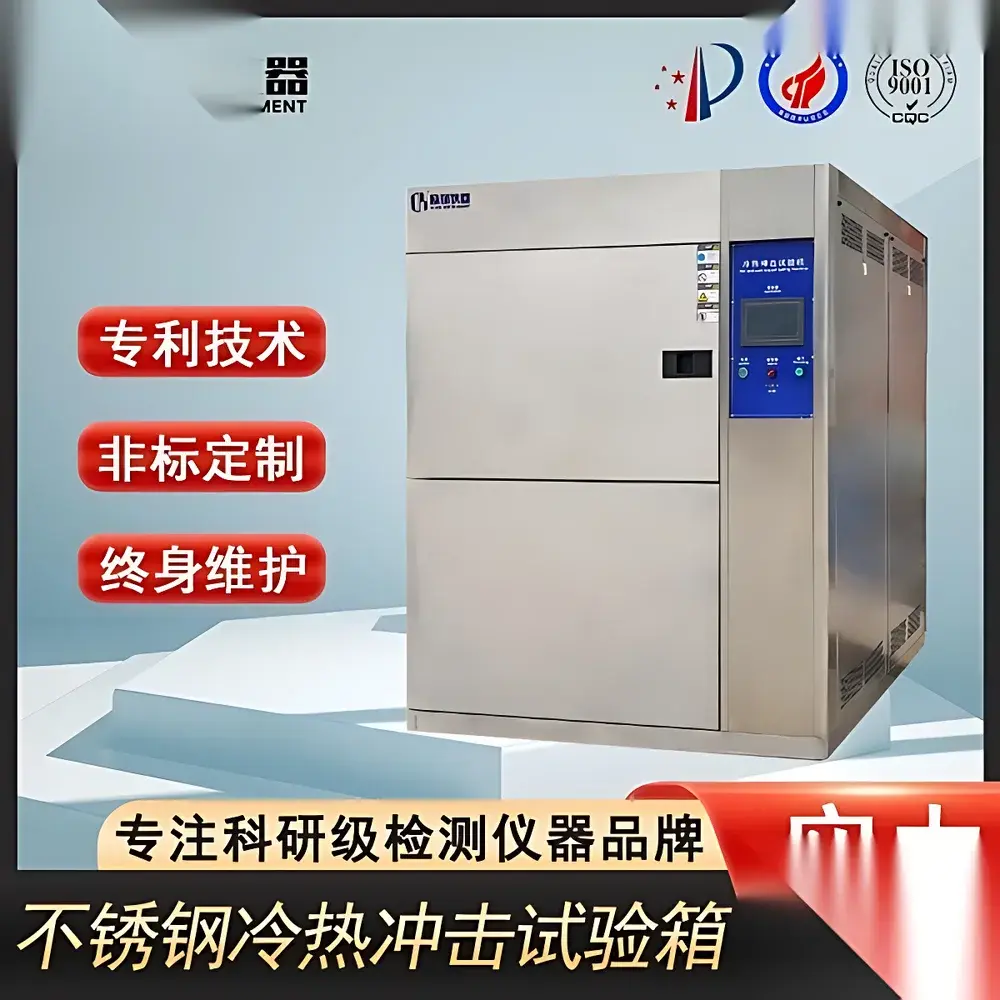
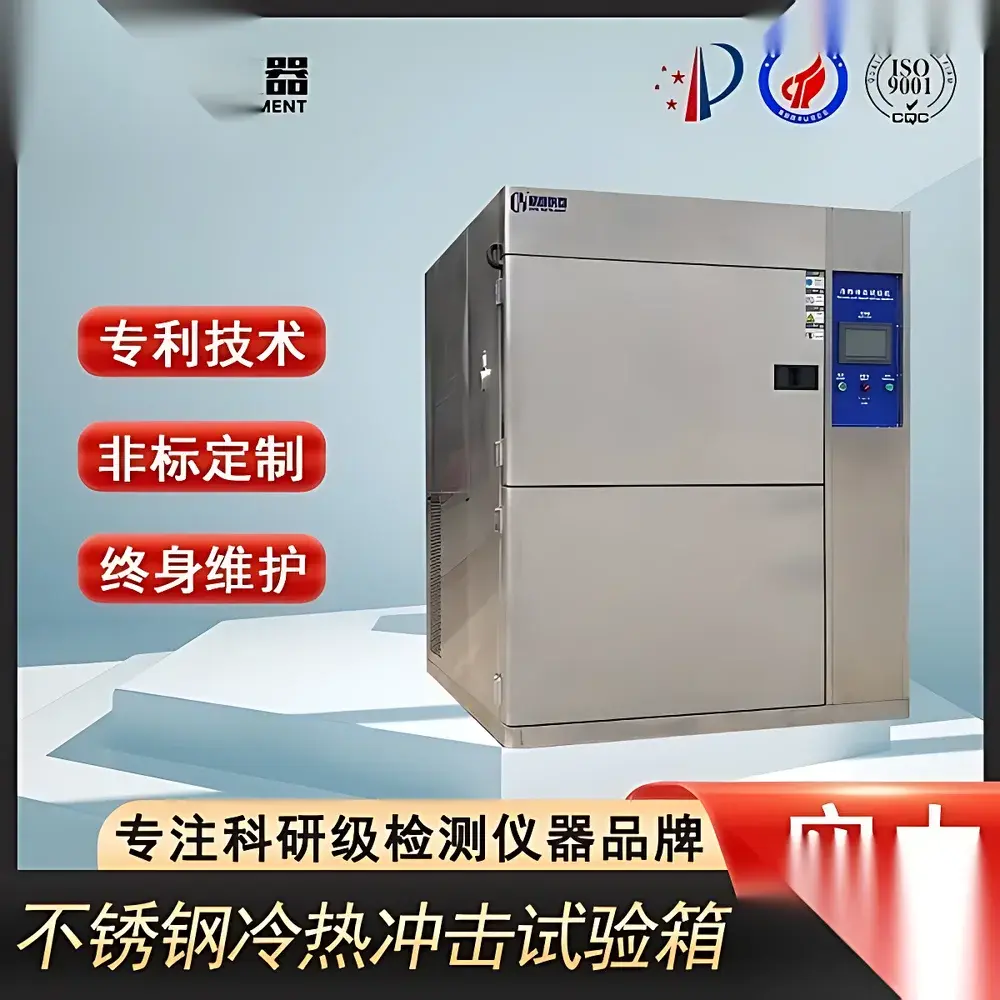
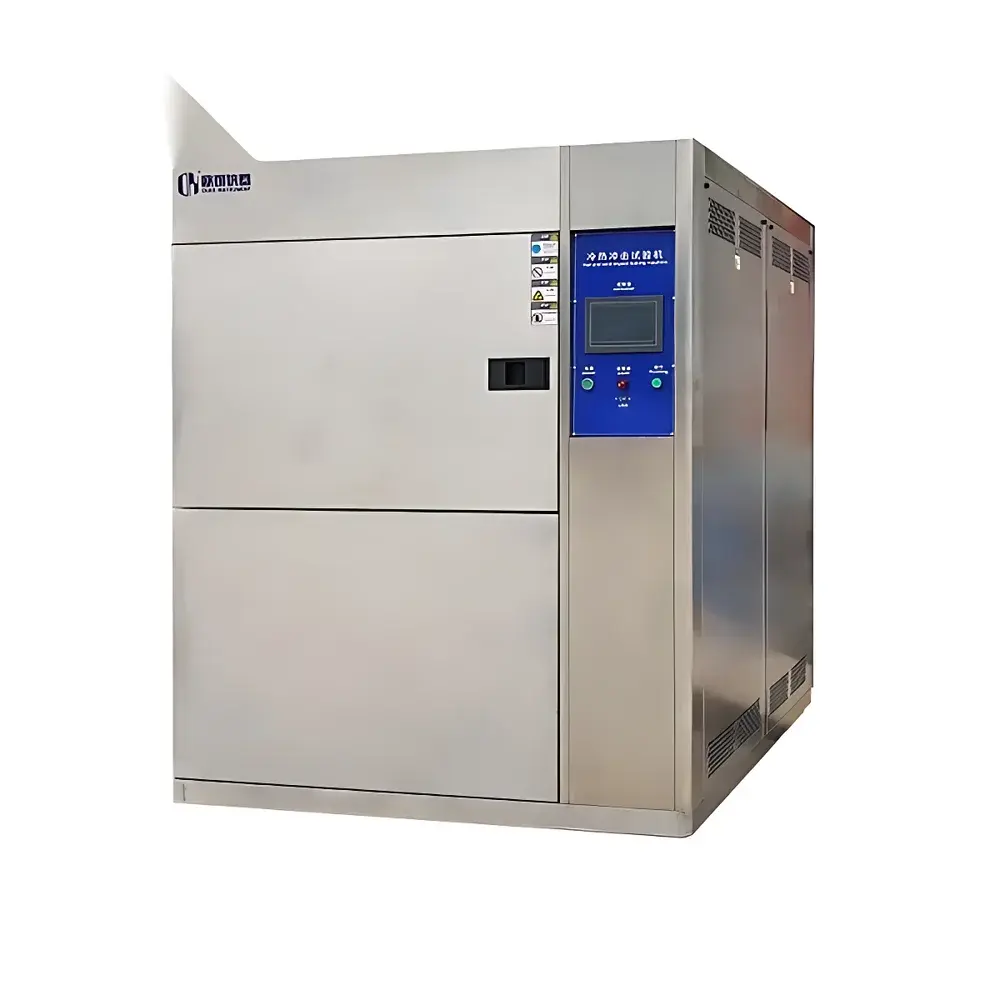
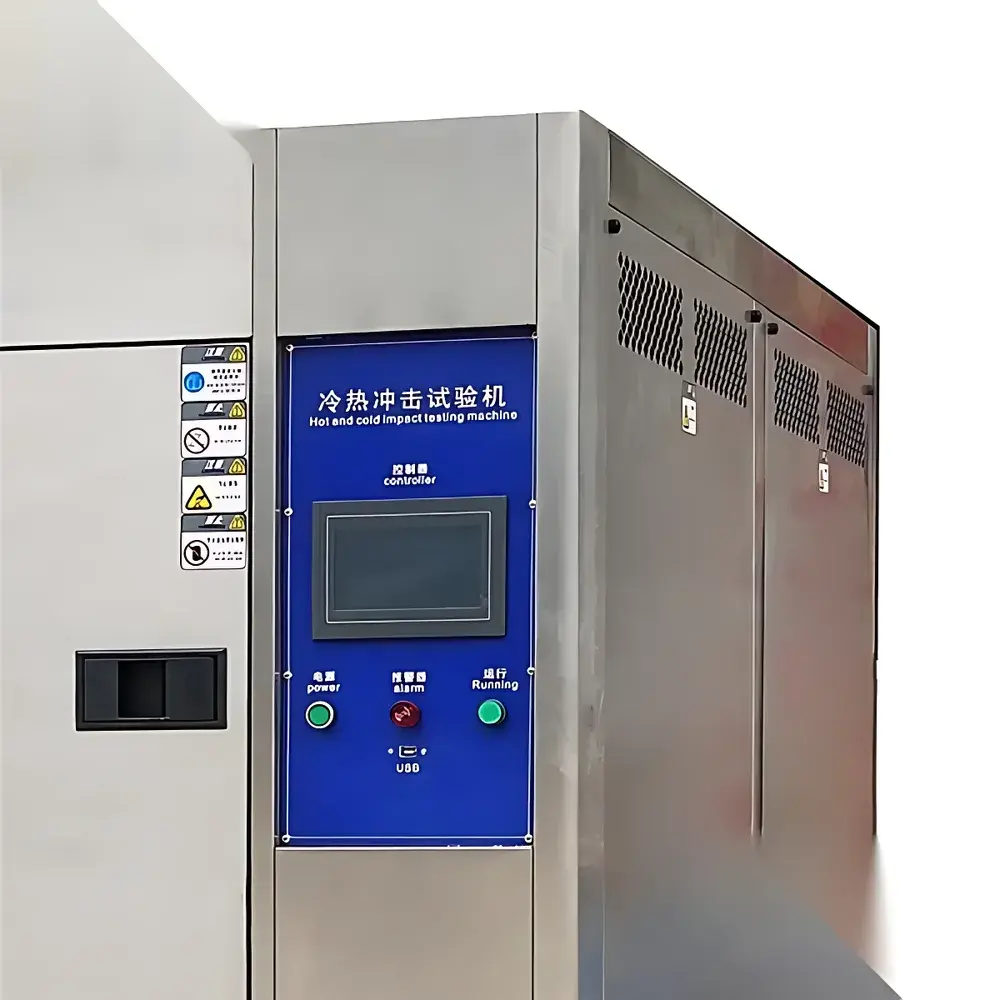
OK-HH Series Two-Zone Thermal Shock Test Chamber
| Brand | Other Brands |
|---|---|
| Origin | Imported |
| Manufacturer Type | Authorized Distributor |
| Price | USD 12,500 (FOB) |
| Internal Dimensions (W×H×D) | 40×35×30 cm to 70×60×60 cm |
| External Dimensions (W×H×D) | 145×180×140 cm to 190×170×270 cm |
| High-Temperature Zone Range | RT to +200 °C |
| Low-Temperature Zone Range | RT to −70 °C |
| Test Zone Temperature Range | +60 °C to +150 °C (hot shock) |
| Temperature Control Accuracy | ±0.5 °C |
| Temperature Uniformity | ±2.0 °C |
| Recovery Time | <5 min |
| Preheating Time (RT→150 °C) | ~30 min |
| Precooling Time (RT→−70 °C) | ~85 min |
| Refrigeration System | Dual-stage cascade refrigeration with semi-hermetic compressors (Germany-sourced), R404A/R23 refrigerants |
| Insulation | High-density fire-retardant PU foam |
| Interior Material | Mirror-finish SUS304 stainless steel |
| Exterior Material | SUS304 stainless steel or powder-coated steel |
| Power Supply | AC 380 V ±5%, 50 Hz ±0.5 Hz, 3-phase 5-wire |
Overview
The OK-HH Series Two-Zone Thermal Shock Test Chamber is an engineered environmental test system designed for rapid, repeatable thermal cycling between extreme high- and low-temperature environments. Unlike single-chamber or three-chamber configurations, this two-zone architecture employs physically separated hot and cold reservoirs—each independently conditioned—and transfers test specimens via a motor-driven basket mechanism. This design eliminates thermal mass interference from the test chamber walls, enabling faster transition times, tighter temperature stability, and higher reproducibility in thermal shock qualification. The system operates on the principle of controlled convective heat transfer across discrete thermal domains, supporting deterministic evaluation of material integrity, solder joint reliability, packaging adhesion, and interfacial delamination under accelerated thermal stress conditions. It is widely deployed in aerospace component validation, automotive electronics qualification, semiconductor packaging testing, and military-grade electronic assembly certification per MIL-STD-810 and IEC 60068-2-14.
Key Features
- Independent dual-zone thermal reservoirs: High-temperature zone (RT to +200 °C) and low-temperature zone (RT to −70 °C), each equipped with dedicated heating and refrigeration circuits.
- Motorized specimen transfer basket with pneumatic door actuation ensures precise positioning and minimizes cross-contamination of thermal zones.
- Dual-stage cascade refrigeration system utilizing semi-hermetic compressors (Germany-manufactured) and environmentally compliant refrigerants (R404A/R23), delivering stable sub-zero performance down to −65 °C in test mode.
- High-efficiency insulation using imported fire-retardant polyurethane (PU) foam with ≥150 mm thickness in critical zones, achieving thermal leakage <0.8 K/h under steady-state conditions.
- Precision temperature control via PID algorithm with real-time feedback from multiple Pt100 sensors; control accuracy maintained at ±0.5 °C, uniformity within ±2.0 °C across the test volume.
- Configurable test profiles including programmable dwell time, ramp rate, cycle count, and automatic recovery sequencing—all accessible via intuitive touchscreen HMI with multi-level user authentication.
Sample Compatibility & Compliance
The OK-HH chamber accommodates samples up to 70 × 60 × 60 cm (W×H×D) in internal volume, with optional custom sizing available upon request. Standard features include one 50 mm diameter cable/port access hole and two adjustable SUS304 stainless steel shelves. The chamber complies with international standards governing thermal shock testing, including IEC 60068-2-14 (Test N: Change of Temperature), MIL-STD-810H Method 503.5, GJB 150.5A–2009, GB/T 2423.22–2012, and QC/T 17–1992 for automotive component durability. All thermal profiles are traceable to NIST-calibrated reference sensors, and system validation reports support GLP-compliant audit requirements. Optional IQ/OQ documentation packages are available for regulated industries requiring FDA 21 CFR Part 11–compliant validation.
Software & Data Management
The embedded controller runs proprietary firmware supporting up to 99 programmable test sequences, each with up to 99 steps (including ramp, dwell, and transition phases). Real-time data logging records temperature, time, door status, compressor load, and alarm events at user-defined intervals (1 s to 60 min resolution). Export formats include CSV and PDF reports with digital signatures. Optional PC-based software enables remote monitoring, historical trend analysis, deviation alerts, and integration with LIMS or MES platforms via Modbus TCP or Ethernet/IP protocols. Audit trails meet ISO/IEC 17025 and FDA 21 CFR Part 11 requirements, including electronic signature capability, operator login tracking, and immutable event logs.
Applications
This thermal shock chamber is routinely applied in failure mode analysis of printed circuit board assemblies (PCBAs), qualification of MEMS sensors, screening of optoelectronic modules, validation of battery pack thermal interfaces, and reliability assessment of conformal coatings and encapsulants. In aerospace, it supports qualification of avionics housings per DO-160 Section 4. In automotive, it fulfills AEC-Q200 stress testing for passive components and ISO 16750-4 for environmental robustness. Research laboratories use it for accelerated aging studies of polymer composites, phase-change materials, and thin-film adhesion systems where interfacial stress due to CTE mismatch is a dominant failure mechanism.
FAQ
What is the difference between two-zone and three-zone thermal shock chambers?
Two-zone systems separate hot and cold reservoirs and move the specimen between them, minimizing thermal inertia from chamber walls. Three-zone systems add a dedicated test chamber, allowing specimen static placement—but require larger footprint and longer stabilization times.
Is external cooling water required?
Yes. The dual-stage cascade refrigeration system requires a dedicated recirculating cooling tower (10 m³/h capacity) installed outdoors. Water inlet temperature must remain ≤32 °C for optimal condenser performance.
Can the chamber be integrated into an automated test line?
Yes. Standard RS485 Modbus RTU and optional Ethernet/IP interfaces support PLC-level integration, trigger synchronization, and status reporting for inline production test cells.
What maintenance is required for long-term reliability?
Quarterly inspection of refrigerant charge, condenser coil cleaning, door gasket integrity verification, and annual calibration of all Pt100 sensors using certified reference standards are recommended.
Does the system support custom test profiles for non-standard specifications?
Yes. Users may define arbitrary temperature vs. time functions—including non-linear ramps, hold-and-soak segments, and conditional branching—via the onboard editor or PC software.



