
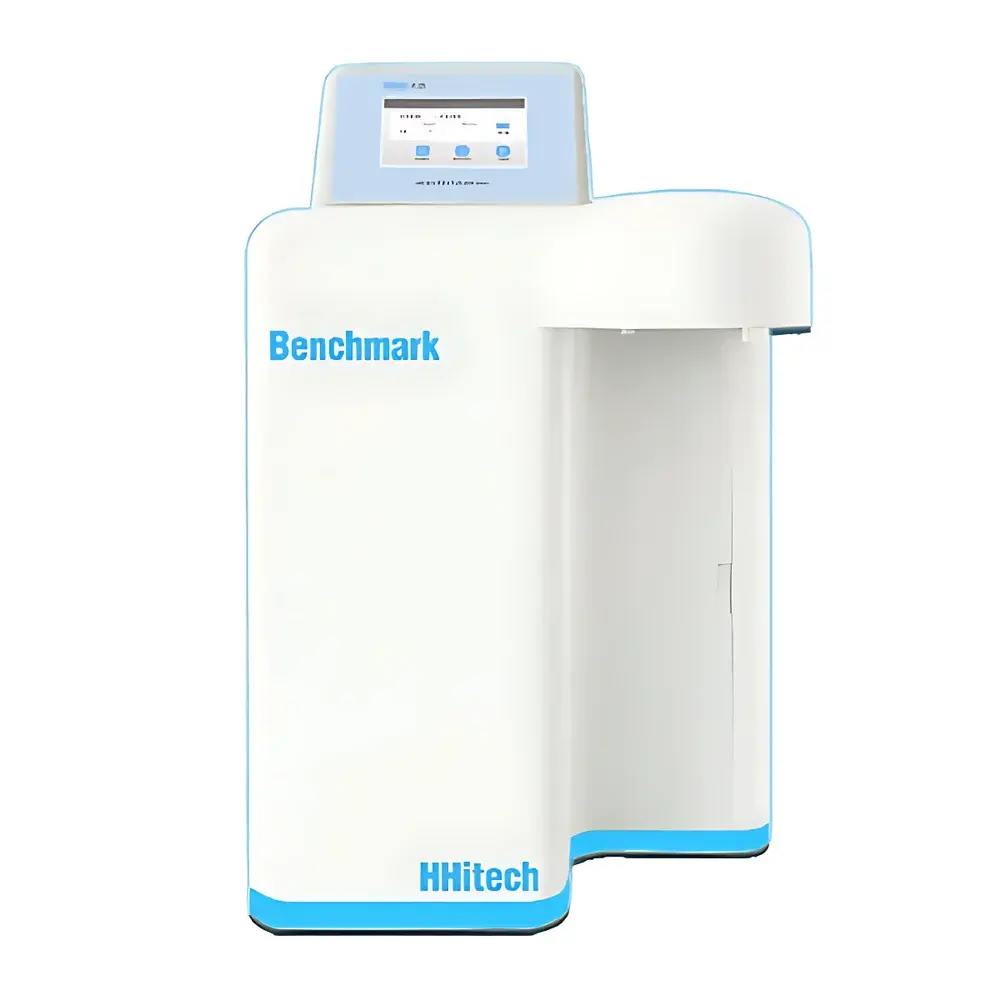
HHitech Benchmark Ultra Pure Water System
| Brand | HHitech |
|---|---|
| Origin | Shanghai, China |
| Model | Benchmark |
| Pure Water Output | 60 L/hour |
| Max Flow Rate | 2.0 L/min (1.0 L/min continuous) |
| DI Water Resistivity | 16–18 MΩ·cm |
| UP Water Resistivity | 18.2 MΩ·cm @ 25°C |
| Bacterial Count | <0.01 CFU/mL |
| Particles (>0.2 µm) | <1/mL |
| TOC | <10 ppb (UP), <3 ppb (with UV 185/254 nm) |
| Endotoxin | <0.001 EU/mL (with UF membrane) |
| RNase | <1 pg/mL |
| DNase | <5 pg/mL |
| Dimensions (L×W×H) | 500 × 385 × 650 mm |
| Weight | ~25 kg |
| Power Supply | 100–240 V, 50/60 Hz, 192 W |
| Feed Water | Municipal tap water (5–35°C, 1.0–4.0 bar) |
Overview
The HHitech Benchmark Ultra Pure Water System is an integrated, high-reliability laboratory water purification platform engineered for consistent production of Type I ultrapure water per ISO 3696:1987 and ASTM D1193-06 standards. It employs a multi-stage purification architecture combining pretreatment, reverse osmosis (RO), dual-wavelength UV photooxidation (185 nm + 254 nm), electro-deionization (EDI) or mixed-bed ion exchange (depending on configuration), ultrafiltration (5,000 Da MWCO), and final point-of-use filtration. The system is designed for continuous operation in analytical laboratories, life science research facilities, and quality control environments where stringent water purity requirements govern applications such as HPLC mobile phase preparation, cell culture media formulation, molecular biology assays (e.g., PCR, sequencing), and trace elemental analysis (ICP-MS, AAS). Its closed-loop internal circulation design minimizes microbial proliferation and maintains stable resistivity without reliance on external storage tanks—addressing a key limitation of conventional systems that introduce contamination risk during static storage.
Key Features
- 5.0-inch full-color capacitive touchscreen interface with animated menu navigation and real-time graphical feedback for intuitive system monitoring and operation.
- Triple-point water quality monitoring: simultaneous real-time display of feed water conductivity, RO permeate resistivity, and UP water resistivity (0–18.25 MΩ·cm) without manual sampling.
- Integrated ergonomic handheld dispenser with 2.0-inch color LCD showing resistivity, temperature, flow rate, and cumulative volume; supports both instant and programmable quantitative dispensing (10–999,999 mL) and qualitative dispensing (to target resistivity).
- Internal pressurized buffer tank (1 L) enables stable flow delivery during intermittent draw cycles while preserving UP water integrity—eliminating pressure fluctuations common in tankless designs.
- No external reservoir required: 60 L/hour sustained output and 2.0 L/min peak flow support direct instrument feeding (e.g., LC systems, automated analyzers), reducing footprint and eliminating secondary contamination pathways.
- Comprehensive contamination control: 0.2 µm final filter, 5 kDa ultrafiltration module (endotoxin/RNase/DNase removal), dual UV lamps (185 nm for TOC reduction, 254 nm for microbial inactivation), and optional air-filtered PE water tanks (20–500 L) with integrated UV.
Sample Compatibility & Compliance
The Benchmark system delivers water meeting or exceeding the purity specifications defined in ISO 3696 (Grade 1), CLSI EP22-A2 (for clinical lab water), and USP “Water for Pharmaceutical Purposes.” Its UP water output satisfies critical requirements for sensitive applications including: low-background ICP-MS analysis (metal contaminants <0.01 ppb), mammalian cell culture (endotoxin <0.001 EU/mL), RNA-seq library prep (RNase <1 pg/mL), and high-resolution mass spectrometry (TOC <3 ppb with dual UV). All wetted materials comply with USP Class VI biocompatibility standards. The system supports audit-ready documentation through optional GLP/GMP-compliant software modules featuring electronic signatures, user access levels, and 21 CFR Part 11–compliant audit trails.
Software & Data Management
The embedded firmware logs all operational parameters—including date/time stamps, conductivity/resistivity trends, UV lamp operating hours, filter saturation indicators, and alarm history—for up to 12 months. Data export is supported via USB port in CSV format for integration into LIMS or QA/QC reporting workflows. Optional PC-based software provides remote monitoring, customizable alert thresholds (email/SMS), predictive maintenance scheduling based on usage metrics, and compliance report generation aligned with ISO/IEC 17025 and CAP accreditation requirements.
Applications
- HPLC, UHPLC, and LC-MS mobile phase and blank preparation
- Preparation of standards and calibration solutions for trace metal analysis (ICP-OES, ICP-MS)
- Cell culture media, PBS, and reagent dilutions requiring endotoxin-free water
- Molecular biology workflows: PCR, qRT-PCR, NGS library construction, CRISPR editing
- Electrophysiology and patch-clamp experiments demanding ultra-low ion content
- Atomic absorption spectroscopy (AAS) and graphite furnace analysis
- Pharmaceutical stability testing and dissolution media preparation per USP guidelines
FAQ
What feed water quality is required for optimal performance?
Municipal tap water with turbidity <1 NTU, chlorine <3 ppm, and total organic carbon <5 ppm is recommended. For D-series models, pre-purified feed (RO, distilled, or deionized water) at 0–1 bar pressure is acceptable.
How often must consumables be replaced?
RO membrane service life is typically 12–24 months depending on feed water hardness and chlorine exposure; UP polishing cartridges require replacement every 6–12 months or after 1,500–3,000 L of UP water produced—monitored automatically via resistivity decay and runtime counters.
Is the system compatible with central water distribution networks?
Yes. Optional R-DIS standalone dispensers and loop-compatible configurations support integration into building-wide purified water loops, with flow-controlled take-off points and integrated recirculation pumps.
Can the system meet FDA 21 CFR Part 11 requirements?
When equipped with the optional Compliance Package, the Benchmark system provides electronic audit trails, role-based user authentication, data integrity safeguards, and electronic signature capability—fully compliant with 21 CFR Part 11 for regulated pharmaceutical and clinical labs.
Does the system include leak detection and automatic shutdown?
All Benchmark models feature integrated leak sensors at critical junctions (pump, valves, tank interfaces) and initiate immediate shutdown with visual/audible alerts upon moisture detection—preventing equipment damage and lab flooding.



