
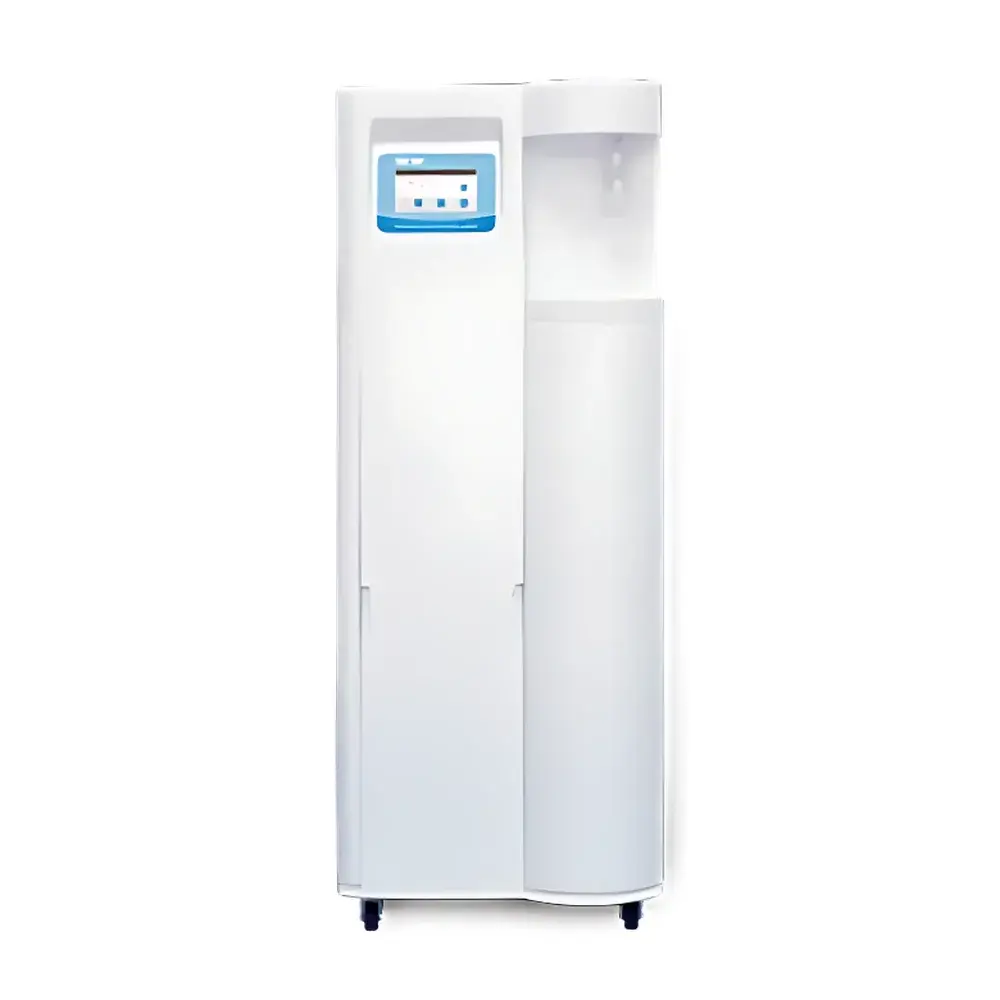
HHitech Center Series Ultra Pure Water System
| Brand | HHitech |
|---|---|
| Origin | Shanghai, China |
| Model | Center Series |
| Pure Water Output | 45/60/90 L/hour |
| Ultra-Pure Water Output | Up to 2.0 L/min (with full reservoir) |
| Resistivity (25°C) | ≥18.2 MΩ·cm |
| TOC | <3–10 ppb |
| Bacteria | <0.01 CFU/mL |
| Particles (>0.2 µm) | <1/mL |
| Endotoxins | <0.001 EU/mL (FC/FV models) |
| RNases | <1 pg/mL (FV models) |
| DNases | <5 pg/mL (FV models) |
| RO Feed Water Conductivity Reduction | ~95% (1st stage) |
| Dimensions (L×W×H) | 610×585×1580 mm |
| Weight | ~70 kg |
| Power | 220 V, 50 Hz, 480 W |
| Pre-treatment | DOW RO membrane |
| Final Polishing | Nuclear-grade ion exchange resin, dual-wavelength UV (254 & 185 nm), 5 kDa UF, 0.2 µm PES final filter |
| Compliance | ASTM D1193 Type I, NCCLS, CAP, GLP-aligned data logging (1 year), NSF-certified fluid path components |
Overview
The HHitech Center Series Ultra Pure Water System is an integrated, multi-stage laboratory water purification platform engineered for consistent production of Type I ultrapure water per ASTM D1193 and ISO 3696 standards. It combines pretreatment via high-rejection Dow FilmTec™ reverse osmosis membranes, dual-stage deionization using nuclear-grade mixed-bed resins, and terminal polishing with 254/185 nm UV oxidation, 5 kDa ultrafiltration, and 0.2 µm polyethersulfone (PES) membrane filtration. The system operates on municipal potable feed water (5–45°C, 1.0–4.0 kgf/cm² pressure) and delivers ultrapure water at up to 2.0 L/min when the internal 20 L PE reservoir is pressurized — enabling stable, low-particulate, low-TOC, endotoxin-free output critical for molecular biology, HPLC, LC-MS, cell culture, and trace elemental analysis.
Key Features
- Modular architecture supporting four configuration tiers: Standard (Center), Endotoxin-Reduced (Center-F), Low-TOC (Center-V), and Dual-Optimized (Center-FV) — each scalable across 45, 60, and 90 L/hour pure water production capacities.
- Intelligent microprocessor control with 106 × 57 mm backlit LCD interface, animated status visualization, and multilevel menu navigation — eliminating manual intervention during routine operation.
- Real-time, three-point online conductivity/resistivity monitoring: feed water, RO permeate, and final ultrapure water — with configurable alarm thresholds for resistivity deviation, low-level, overflow, and consumable exhaustion.
- Automated maintenance protocols including programmable chemical sanitization cycles, continuous recirculation loop (0.5–1.0 L/min) with UV exposure, and consumable lifetime tracking based on actual usage metrics (not time-based estimates).
- High-capacity 22 L mixed-bed cartridge with optimized flow dynamics — achieving >99.9% ionic removal efficiency while extending service intervals and reducing total cost of ownership.
- Full fluid path constructed from NSF/ANSI 61-certified materials: quick-connect fittings, PTFE-lined tubing, and USP Class VI-compliant wetted surfaces — ensuring extractables compliance and minimizing leachables.
Sample Compatibility & Compliance
The Center Series meets stringent requirements for analytical and life science applications where water purity directly impacts assay fidelity. Its ultrapure output complies with ASTM D1193 Type I specifications for resistivity (≥18.2 MΩ·cm at 25°C), TOC (<3 ppb in FV models), bacterial load (<0.01 CFU/mL), and particle count (0.2 µm). Models equipped with ultrafiltration (F/FV) achieve endotoxin levels <0.001 EU/mL and nuclease activity below detection limits (RNase <1 pg/mL; DNase <5 pg/mL), satisfying USP , EP 2.2.44, and CLSI guidelines for sterile preparation and sensitive enzymatic workflows. All electronic logging functions support GLP/GMP traceability, including timestamped event records, calibration logs, and 12-month audit-ready data export via RS232 or USB.
Software & Data Management
The embedded controller stores over 12 months of operational history, including daily resistivity/TOC trends, UV lamp operating hours, cartridge usage metrics, and alarm event timestamps. Data export is compatible with standard spreadsheet formats and LIMS integration via ASCII text or CSV protocols. No proprietary software installation is required: raw logs are accessible through direct USB mass-storage mode or serial terminal emulation. Audit trail functionality adheres to FDA 21 CFR Part 11 principles — all modifications are logged with user ID, timestamp, and reason code. Optional Ethernet-enabled firmware upgrades allow remote diagnostics and security patch deployment without physical access.
Applications
- Molecular biology: PCR, qRT-PCR, NGS library prep, CRISPR editing, and transfection-grade media formulation.
- Chromatography & mass spectrometry: Mobile phase preparation for HPLC, UPLC, IC, GC-MS, and LC-MS/MS — minimizing baseline noise and column fouling.
- Clinical diagnostics: Reagent preparation for immunoassays (ELISA, CLIA), hematology analyzers, and automated chemistry platforms.
- Pharmaceutical QC: USP TOC testing, WFI surrogate generation, and stability-indicating method development.
- Materials science: Nanoparticle synthesis, thin-film deposition, and semiconductor wafer rinsing where ionic residue must be sub-ppt level.
FAQ
What feed water quality is required for optimal performance?
Municipal drinking water meeting WHO or local regulatory standards is required. Feed conductivity should not exceed 500 µS/cm; higher levels may reduce RO membrane lifespan and increase prefilter replacement frequency.
Can the system be integrated into a central purified water distribution loop?
Yes — optional 0.22 µm point-of-use filters and stainless-steel manifold kits are available for multi-outlet configurations. Pressure-rated reservoirs support gravity-fed or booster-pump delivery to satellite workstations.
How often must consumables be replaced under typical lab usage?
RO membranes: 2–3 years; UV lamps: 12,000 hours (≈14 months continuous use); UF cartridges: 12–18 months; mixed-bed resins: 6–12 months depending on feed water hardness and silica content.
Is validation documentation provided for IQ/OQ/PQ protocols?
Factory-installed calibration certificates, as-built schematics, and FAT/SAT reports are included. Optional IQ/OQ templates aligned with ISO/IEC 17025 and Annex 11 are available upon request.
Does the system support remote monitoring via network interface?
Standard models include RS232 and USB ports. Ethernet and Modbus TCP modules are available as field-installable options for building management system (BMS) integration and centralized lab infrastructure monitoring.



