
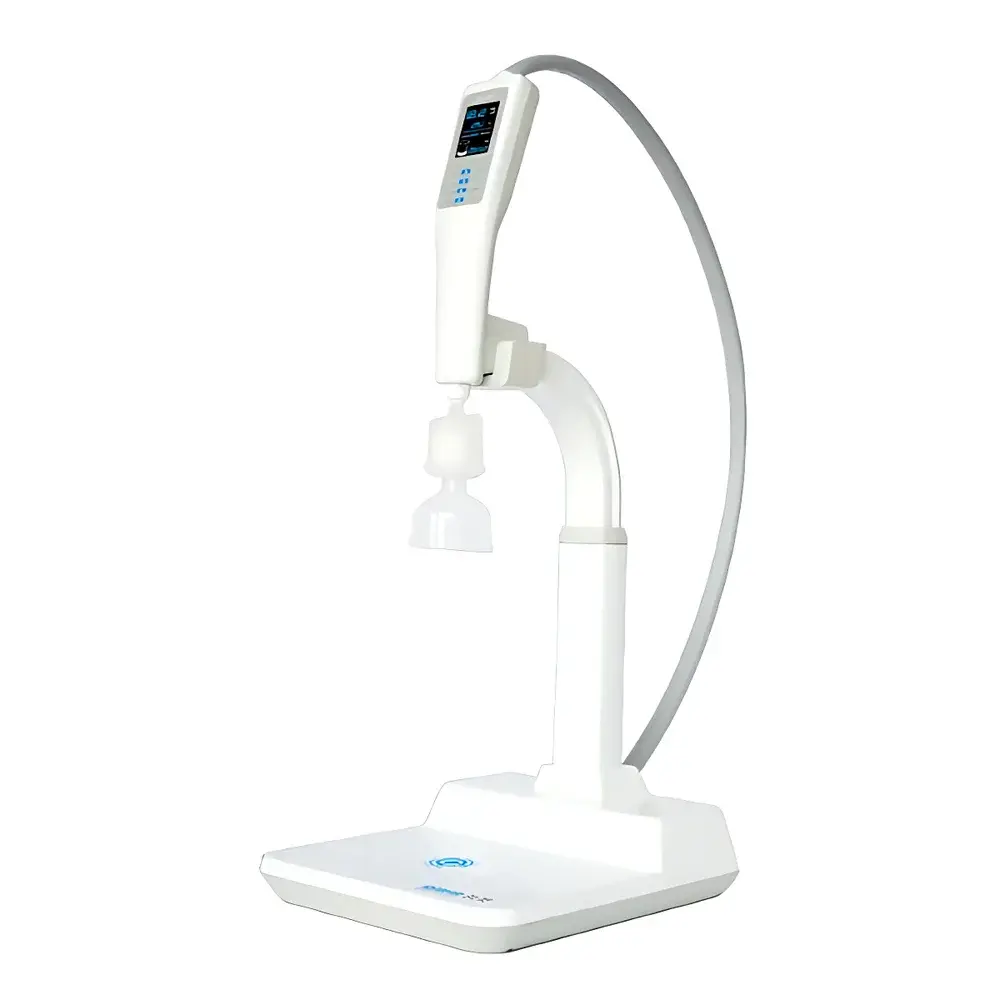
HHitech R-DIS Remote Mobile Dispenser for Ultra-Pure Water Systems
| Brand | HHitech |
|---|---|
| Origin | Shanghai, China |
| Model | R-DIS |
| Type | Standalone or Touch-System-Integrated Remote Dispenser |
| Compliance | Designed for ISO 3696 Grade 1 / ASTM D1193 Type I / CLSI EP21-A2 water quality monitoring |
| Display | 3.0-inch color TFT graphic LCD |
| Dispensing Modes | Instant Flow & Precise Volume Delivery (10–9990 mL) |
| Flow Sensor | Integrated electromagnetic flow meter |
| Resistivity Sensor | High-accuracy inline conductivity/resistivity probe (0.01 µS/cm resolution, temperature-compensated to 25°C) |
| Platform Dimensions | 222 × 150 mm tempered glass base |
| Adjustable Height Range | 280–480 mm |
| Material Contact | FDA-compliant PEEK, PTFE, and 316L stainless steel wetted parts |
| Data Logging | Internal buffer for ≥10,000 dispensing events with timestamp, volume, resistivity, and temperature metadata |
Overview
The HHitech R-DIS Remote Mobile Dispenser is an engineered interface module designed for real-time, operator-controlled delivery of ultra-pure water (UPW) from centralized or point-of-use purification systems. Unlike conventional wall-mounted or benchtop faucets, the R-DIS integrates dual-sensor metrology—inline resistivity measurement and electromagnetic flow detection—within a mobile, height-adjustable platform. Its architecture supports two operational paradigms: standalone deployment (R-DIS standalone variant), where it functions as an autonomous water quality and flow monitor at branch points in central UPW distribution loops; and system-integrated operation (R-DIS-I and R-DIS-II variants), where it serves as a peripheral human-machine interface for HHitech’s Touch-series ultrapure water systems. The device operates on the principle of continuous conductivity-based resistivity calculation (per ASTM D5391 and ISO 7888), dynamically compensating for temperature drift using a built-in Pt1000 sensor. This ensures traceable, NIST-traceable water quality verification at the point of dispense—critical for applications governed by USP , EP 2.2.42, and CLSI guidelines for reagent-grade water.
Key Features
- Modular configuration: Three variants—R-DIS (standalone), R-DIS-I (full base + handpiece + mounting bracket), and R-DIS-II (handpiece-only)—enable flexible integration across lab infrastructure tiers.
- Ergonomic handpiece with integrated tactile buttons: Enables one-handed operation with minimal wrist torque; IP54-rated housing ensures resistance to splashes and routine disinfection.
- Height-adjustable column (280–480 mm range): Accommodates volumetric flasks (e.g., Class A 1000 mL), graduated cylinders, and cell culture bottles without manual repositioning of vessels.
- Tempered glass work surface (222 × 150 mm): Chemically inert, non-porous, and autoclavable-compatible for decontamination between high-containment workflows.
- Dual dispensing logic: Instant-flow mode delivers water on demand with mechanical button release; quantitative mode accepts user-defined volumes (10–9990 mL in 1 mL increments) and terminates flow automatically upon reaching setpoint—validated per ISO 8655-6 gravimetric protocols.
- Onboard circulation loop: Maintains laminar recirculation within the dispensing manifold at ≥0.8 m/s velocity, preventing biofilm nucleation and ensuring TOC stability (<1 ppb) during idle periods.
Sample Compatibility & Compliance
The R-DIS is compatible with all ultra-pure water sources meeting ISO 3696 Grade 1 or ASTM D1193 Type I specifications—including those generated by EDI, UV photooxidation, and 0.2 µm final filtration stages. Its wetted path materials (316L SS, PEEK, PTFE) comply with USP Class VI biocompatibility requirements and exhibit no extractables under prolonged exposure to UPW (tested per USP ). The system supports audit-ready compliance for GLP and GMP environments: resistivity and temperature data are time-stamped, non-erasable, and exportable via USB-C to CSV or PDF reports. Firmware adheres to FDA 21 CFR Part 11 principles for electronic records—enabling role-based access control, digital signatures, and immutable audit trails for dispensing events.
Software & Data Management
While the R-DIS operates autonomously without PC dependency, its embedded microcontroller logs ≥10,000 dispensing records—including volume dispensed, real-time resistivity (in MΩ·cm), water temperature (°C), flow rate (mL/min), and timestamp (YYYY-MM-DD HH:MM:SS). Data export is performed via plug-and-play USB-C connection; no proprietary drivers required. Optional firmware updates (distributed as signed .bin files) maintain alignment with evolving CLSI EP21-A2 validation frameworks. For labs deploying multiple R-DIS units, HHitech’s centralized Touch System Manager software provides remote calibration status monitoring, sensor health diagnostics (e.g., probe fouling alerts), and aggregated usage analytics across facility-wide UPW nodes.
Applications
- HPLC and LC-MS mobile phase preparation requiring consistent resistivity >18.2 MΩ·cm and TOC <3 ppb.
- Cell culture media formulation where endotoxin-free water delivery must avoid cross-contamination from fixed faucet installations.
- QC laboratories performing daily conductivity verification per USP —leveraging the R-DIS as a field-deployable reference node.
- Centralized UPW systems serving multi-floor research facilities: R-DIS standalone units act as distributed quality gateways, identifying localized degradation (e.g., due to pipe corrosion or valve leakage) before it propagates downstream.
- Teaching laboratories needing intuitive, safe water dispensing for undergraduate analytical chemistry workflows—eliminating risk of overflow or misreading analog gauges.
FAQ
Can the R-DIS be retrofitted to non-HHitech pure water systems?
Yes—the standalone R-DIS variant is protocol-agnostic and connects directly to any UPW source with standard 1/4″ Swagelok or BSPP inlet fittings. No system-level integration is required.
Does the resistivity sensor require periodic calibration?
The inline electrode is factory-calibrated against NIST-traceable KCl standards. Field verification is recommended every 30 days using certified 1413 µS/cm and 12.9 µS/cm solutions per ASTM D1125.
Is the circulation loop energy-efficient?
The recirculation pump operates only during active dispensing and for 90 seconds post-dispense, consuming <1.2 W average power—designed to minimize heat load and microbial growth risk.
What maintenance intervals apply to the flow sensor?
The electromagnetic flow meter has no moving parts and requires no scheduled maintenance; however, visual inspection of the quartz-lined measurement chamber is advised quarterly for particulate accumulation.
How is cybersecurity addressed in networked deployments?
The R-DIS itself contains no Wi-Fi, Bluetooth, or Ethernet interfaces. When connected via USB to a validated laboratory computer, data transfer occurs in read-only mode—no executable code execution is permitted.



