
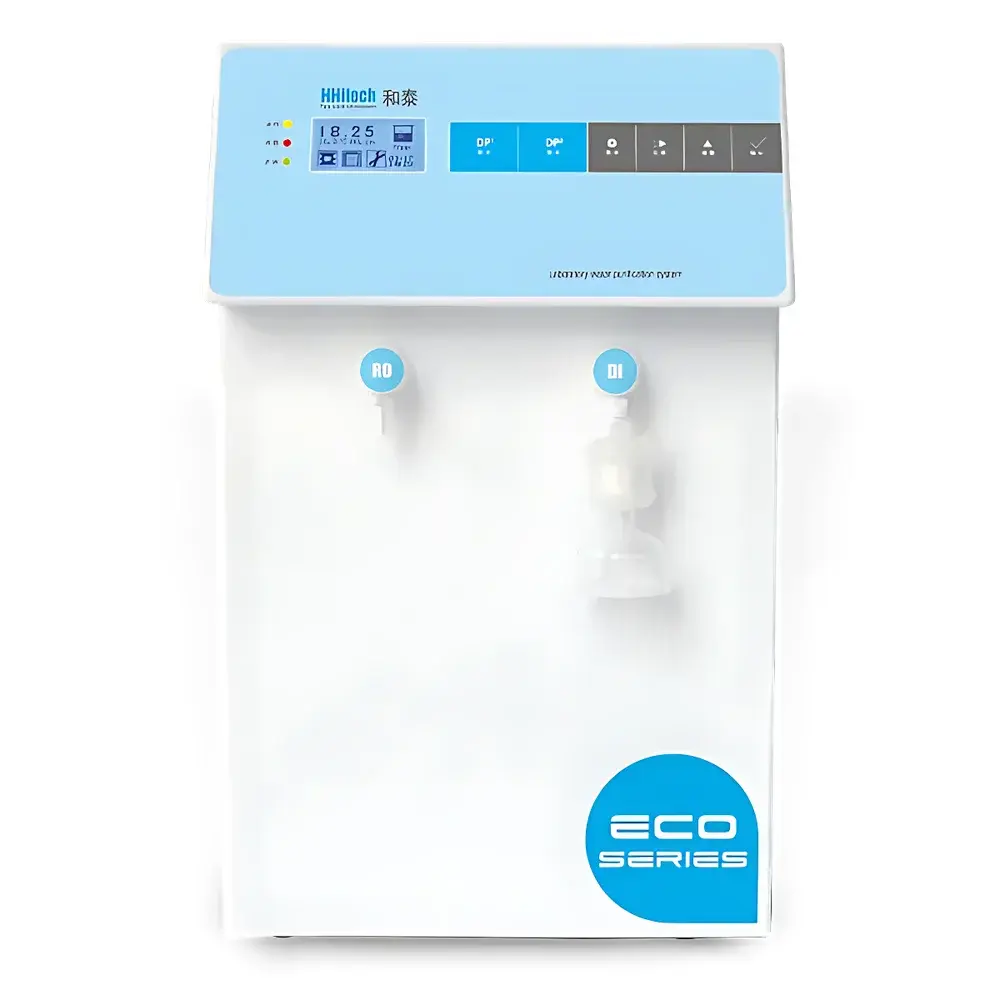
HHitech Eco-S Ultra Pure Water System
| Brand | HHitech |
|---|---|
| Origin | Shanghai, China |
| Manufacturer Type | Authorized Distributor |
| Product Category | Domestic |
| Model | Eco-S |
| Pricing | Available Upon Request |
| Pure Water Output | 15 / 30 L/hour |
| Ultra-Pure Water Output | Up to 2.0 L/min (with pressurized tank) |
| Resistivity | 18.2 MΩ·cm @ 25°C |
| Heavy Metals | < 0.01 ppb |
| TOC | <10 ppb (Standard), <3 ppb (UV-equipped models) |
| Bacteria | <0.01 CFU/mL |
| Endotoxins | <0.001 EU/mL (UV + UF models) |
| Particles (>0.1 µm) | <1/mL |
| RNases | <1 pg/mL (UV + UF models) |
| DNases | <5 pg/mL (UV + UF models) |
| RO Salt Rejection | 97–99% (new membrane) |
| RO Organic Rejection | >99% (MW > 200 Da) |
| RO Microbial/Particulate Rejection | >99% |
| Feed Water | Municipal tap water, 5–45°C, 1.0–4.0 kgf/cm² |
| Dimensions (L×W×H) | 340 × 500 × 560 mm |
| Weight | ~25 kg |
| Electrical | 220 V, 50 Hz |
| Power Consumption | 72 W |
| Terminal Filtration | 0.45 + 0.1 µm PES Membrane |
Overview
The HHitech Eco-S Ultra Pure Water System is an integrated, modular laboratory water purification platform engineered for consistent production of Type I ultrapure water per ISO 3696:1987 and ASTM D1193-06 standards. It employs a multi-stage purification architecture—comprising pretreatment, reverse osmosis (RO), dual-wavelength ultraviolet (UV) photooxidation, ultrafiltration (UF), and final submicron filtration—to systematically remove ions, organic compounds, particulates, microorganisms, endotoxins, nucleases, and volatile organics. The system is designed for continuous operation in analytical laboratories, life science research environments, and quality control settings where reproducible water purity is critical for HPLC, LC-MS, cell culture, molecular biology (e.g., PCR, sequencing, transfection), and trace elemental analysis.
Key Features
- Automated RO membrane antiscalant flush cycle—executed every 2 hours—with optional manual override to minimize fouling and extend membrane service life beyond 24 months under typical municipal feed conditions.
- Real-time system status monitoring via tri-color LED indicators (operational / alarm / tank full), enabling rapid visual assessment without software interface dependency.
- Programmable clock with date/time stamping (year/month/day/hour/minute) for audit-ready operational logging; supports dual-level password protection (factory and user levels) for configuration integrity and regulatory compliance.
- NSF-certified fluid path components—including tubing, quick-connect fittings, and pressure-rated housings—minimize leachable TOC and ensure long-term chemical compatibility with ultrapure water.
- Modular architecture isolates pretreatment, RO, and polishing stages into physically independent units, simplifying maintenance, reducing downtime, and enabling targeted component replacement without system-wide disassembly.
- Dual-wavelength UV lamp assembly (185 nm + 254 nm) provides synergistic germicidal action and advanced oxidation of low-MW organics, achieving sustained TOC reduction to <3 ppb in UV-equipped configurations (Eco-S UVF/UV).
- Integrated 5000 Da molecular weight cutoff (MWCO) ultrafiltration module removes endotoxins (<0.001 EU/mL) and aggregates, supporting sensitive applications including IVF media preparation and primary neuronal culture.
- Terminal 0.45 + 0.1 µm polyethersulfone (PES) membrane filter ensures sterility at point-of-use, validated to retain ≥99.999% of bacteria and mycoplasma.
Sample Compatibility & Compliance
The Eco-S system delivers water meeting or exceeding the purity specifications required for ISO/IEC 17025-accredited testing laboratories and GLP-compliant research facilities. Its output complies with USP “Water for Pharmaceutical Purposes”, EP 2.2.44 “Water for Injection (WFI) – Purification Methods”, and CLSI GP30-A3 guidelines for clinical laboratory reagent water. All electrical components conform to IEC 61010-1 safety standards. NSF/ANSI Standard 58 certification applies to the RO membrane module; NSF/ANSI Standard 61 compliance is maintained across wetted materials. The system supports 21 CFR Part 11–ready data export when paired with optional logging software and external timestamped storage.
Software & Data Management
While the Eco-S operates as a standalone hardware platform with embedded logic control, it supports integration with third-party Laboratory Information Management Systems (LIMS) via RS232 or optional Ethernet module. System event logs—including RO flush timestamps, UV lamp operating hours, alarm triggers, and tank fill cycles—are stored onboard with non-volatile memory retention. Audit trails include operator ID (via password entry), parameter changes, and maintenance alerts. Optional PC-based monitoring software enables trend analysis of resistivity decay, TOC drift, and UV intensity degradation—facilitating predictive maintenance and calibration verification per ISO/IEC 17025 Clause 6.4.2.
Applications
- HPLC and UHPLC mobile phase preparation and column equilibration
- LC-MS solvent blanks and instrument rinse solutions
- Cell culture media formulation and passaging buffers (especially Eco-S UVF/UV models with UF)
- PCR master mix preparation, cDNA synthesis, and CRISPR reagent dilution
- Atomic absorption spectroscopy (AAS), ICP-OES, and ICP-MS standard dilutions
- Electrophysiology saline solutions and patch-clamp bath formulations
- Pharmaceutical stability testing and dissolution media preparation
- Calibration of conductivity and TOC analyzers
FAQ
What feed water quality is required for optimal Eco-S performance?
Municipal potable water meeting WHO Guidelines for Drinking-water Quality is recommended. Feed TDS should remain below 500 ppm; higher levels necessitate enhanced pretreatment or optional feed water conditioning.
Can the Eco-S be connected to a central distribution loop?
Yes—via optional stainless steel or PVDF distribution manifolds with recirculation pumps and inline UV sterilization. Loop integration requires flow rate matching and periodic validation per ISO 14644-1 Class 5 environmental controls.
How often must consumables be replaced?
Pretreatment cartridges (5 µm PP, KDF, coconut-shell carbon) are rated for 12 months or 3,000 L; RO membranes for 24–36 months depending on feed quality; UF modules for 18–24 months; terminal filters every 6 months or 1,000 L—whichever occurs first.
Is the system compatible with GMP documentation requirements?
Yes—the dual-password architecture, timestamped event logging, and NSF-certified wetted parts support IQ/OQ/PQ protocols and FDA 21 CFR Part 11 compliance when deployed with validated software and electronic signature workflows.
Does the Eco-S support remote diagnostics?
Basic remote monitoring is available via optional Ethernet gateway with SNMP or Modbus TCP interface; full remote troubleshooting requires on-site service authorization and secure VPN tunneling per institutional IT policy.



