
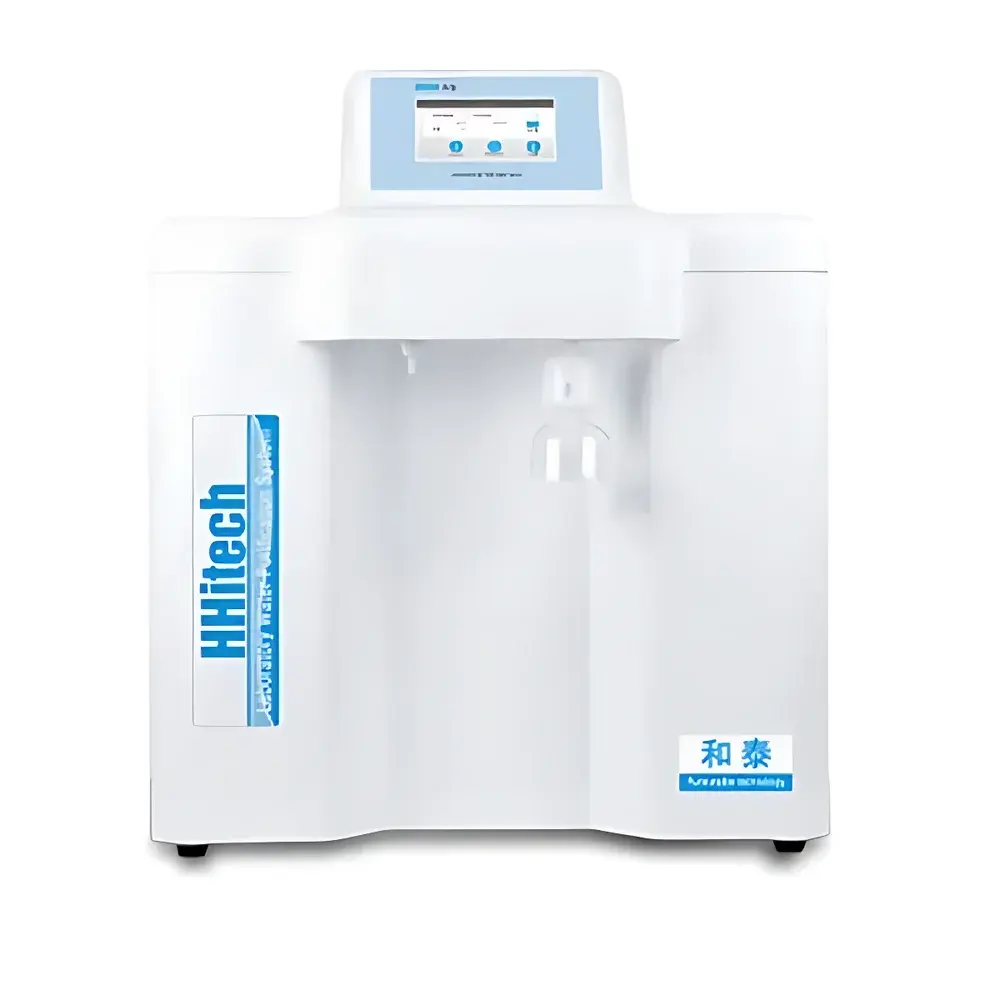
HHitech EDI-Q10 and EDI-S10 Series Ultra Pure Water Systems
| Brand | HHitech |
|---|---|
| Origin | Shanghai, China |
| Model | EDI-Q10 / EDI-Q10UT / EDI-S10 / EDI-S10UF / EDI-S10UV / EDI-S10UVF |
| Pure Water Output | 10 L/h |
| Ultra-Pure Water Output | Up to 2.0 L/min (with full tank) |
| Resistivity (EDI water) | >10 MΩ·cm @ 25°C |
| Resistivity (UP water) | 18.2 MΩ·cm @ 25°C |
| TOC (EDI) | <30 ppb |
| TOC (UP) | <3–10 ppb |
| Bacteria | <0.01 CFU/mL |
| Particles (>0.1 µm) | <1/mL |
| Silica Rejection | >99.9% |
| RO Salt Rejection | 97–99% (new membrane) |
| Organic Rejection (MW >200 Da) | >99% |
| Endotoxin | <0.001 EU/mL (UF/UVF models) |
| RNase | <1 pg/mL (UF/UVF models) |
| DNase | <5 pg/mL (UF/UVF models) |
| Feed Water | Municipal tap water, 5–45°C, 1.0–4.0 kgf/cm² |
| Dimensions (L×W×H) | 500×360×540 mm |
| Weight | 18–30 kg |
| Power | 120 W, 100–240 V, 50/60 Hz |
| Certifications | NSF-certified tubing and fittings |
Overview
The HHitech EDI-Q10 and EDI-S10 Series Ultra Pure Water Systems are engineered for laboratories requiring consistent, high-fidelity Type I ultrapure water per ISO 3696:1987 and ASTM D1193-06 standards. These systems integrate continuous electrodeionization (EDI) with multi-stage pretreatment—including dual-wavelength UV (185 nm & 254 nm), optional ultrafiltration (UF), and terminal 0.1 µm PES membrane filtration—to deliver water suitable for critical applications such as HPLC mobile phase preparation, trace elemental analysis (ICP-MS), cell culture, molecular biology (PCR, sequencing), and pharmaceutical QC testing. Unlike batch-mode deionization, the EDI module operates continuously without chemical regeneration, ensuring stable resistivity ≥18.2 MΩ·cm and TOC ≤3 ppb in UP-grade output. The system’s closed-loop recirculation architecture minimizes microbial proliferation while maintaining low energy consumption—typical standby power draw is <5 W during non-production intervals.
Key Features
- Modular architecture with independent pre-treatment, RO, and polishing units—enabling rapid cartridge replacement and service isolation without system shutdown
- Dual-wavelength UV oxidation (185 nm + 254 nm) using imported low-pressure mercury lamps to simultaneously degrade organic contaminants and inactivate microorganisms
- NSF-certified fluid path components—including tubing, quick-connect fittings, and diaphragm valves—to suppress extractable TOC and ensure compliance with USP and EP 2.2.44
- Automated RO membrane antiscalant flush cycle programmable by interval (1–24 h) and duration (15–120 s); manual override available for maintenance or low-pressure conditions
- Full-system disinfection protocol with user-selectable modes: tank recirculation, point-of-use outlet purge, tank refill priming, and manual drain—each logged with timestamp and operator ID
- Dual-level password protection (factory default + user-defined) governing access to calibration, alarm thresholds, timer settings, and consumable reset functions
- Real-time data logging of conductivity, TOC, pressure differentials, flow rates, and consumable usage; exportable via USB to CSV for GLP/GMP audit trails
Sample Compatibility & Compliance
The EDI-S10UVF configuration meets stringent requirements for endotoxin-sensitive workflows including IVF media preparation and primary neuronal culture, delivering <0.001 EU/mL endotoxin and <1 pg/mL RNase activity—validated per USP and . All models comply with electrical safety standards IEC 61010-1 and electromagnetic compatibility per EN 61326-1. The integrated 20 L polyethylene reservoir features a hydrophobic vent filter (0.2 µm PTFE) and level-sensing float switch to prevent dry-run operation. Feed water compatibility is verified for municipal supplies meeting WHO Guidelines for Drinking-water Quality (4th ed.), with inlet pressure stabilization via built-in pressure regulator and thermal cutoff at 45°C.
Software & Data Management
A dedicated embedded controller supports time-stamped event logging for up to 12 months of operational history, including daily water volume dispensed, real-time resistivity/TOC trends, alarm triggers (e.g., low RO pressure, high TOC deviation), and consumable lifespan countdowns. System clocks are battery-backed and support NTP synchronization via optional Ethernet interface. Audit-ready reports can be generated for FDA 21 CFR Part 11 compliance when paired with validated third-party LIMS integration—user action logs include operator ID, timestamp, parameter changed, and pre-/post-value. Firmware updates are performed via secure USB key with SHA-256 signature verification.
Applications
- HPLC and UHPLC mobile phase preparation where sub-ppb ionic contamination affects baseline stability and column longevity
- ICP-MS and GF-AAS analysis requiring ultra-low metal content (<0.01 ppb Pb, Cd, As) and minimal carbon interference
- Molecular diagnostics including qRT-PCR, CRISPR-Cas9 editing, and single-cell RNA-seq—where residual RNase/DNase or endotoxin induces false negatives or cytotoxicity
- Pharmaceutical stability testing per ICH Q5C, where water purity directly impacts degradation kinetics and particulate formation
- Calibration of reference standards in metrology labs accredited to ISO/IEC 17025:2017
FAQ
What is the expected service life of the RO membrane under typical municipal feed water conditions?
With automated antiscalant flushing and KDF/carbon pretreatment, the Dow FilmTec™ SW30HRLE-400 RO element typically achieves 2–3 years of stable salt rejection (>97%) before replacement—verified by quarterly performance validation per ASTM D4195.
Can the system be integrated into a building-wide water monitoring network?
Yes—optional analog 4–20 mA outputs for resistivity and TOC, plus Modbus RTU over RS-485, enable connection to SCADA or BMS platforms for centralized oversight of multiple units.
Is validation documentation provided for IQ/OQ/PQ protocols?
HHitech supplies a comprehensive Validation Support Package including DQ templates, FAT/SAT checklists, calibration certificates for onboard sensors, and blank PQ execution forms aligned with EU GMP Annex 15 and ANSI/AAMI ST79.
How does the system handle seasonal variations in feed water quality?
Adaptive control logic adjusts UV intensity and EDI current density in response to real-time conductivity and TOC readings from the RO permeate stream—ensuring consistent UP water quality across winter (low TDS) and summer (high organics) conditions.



