
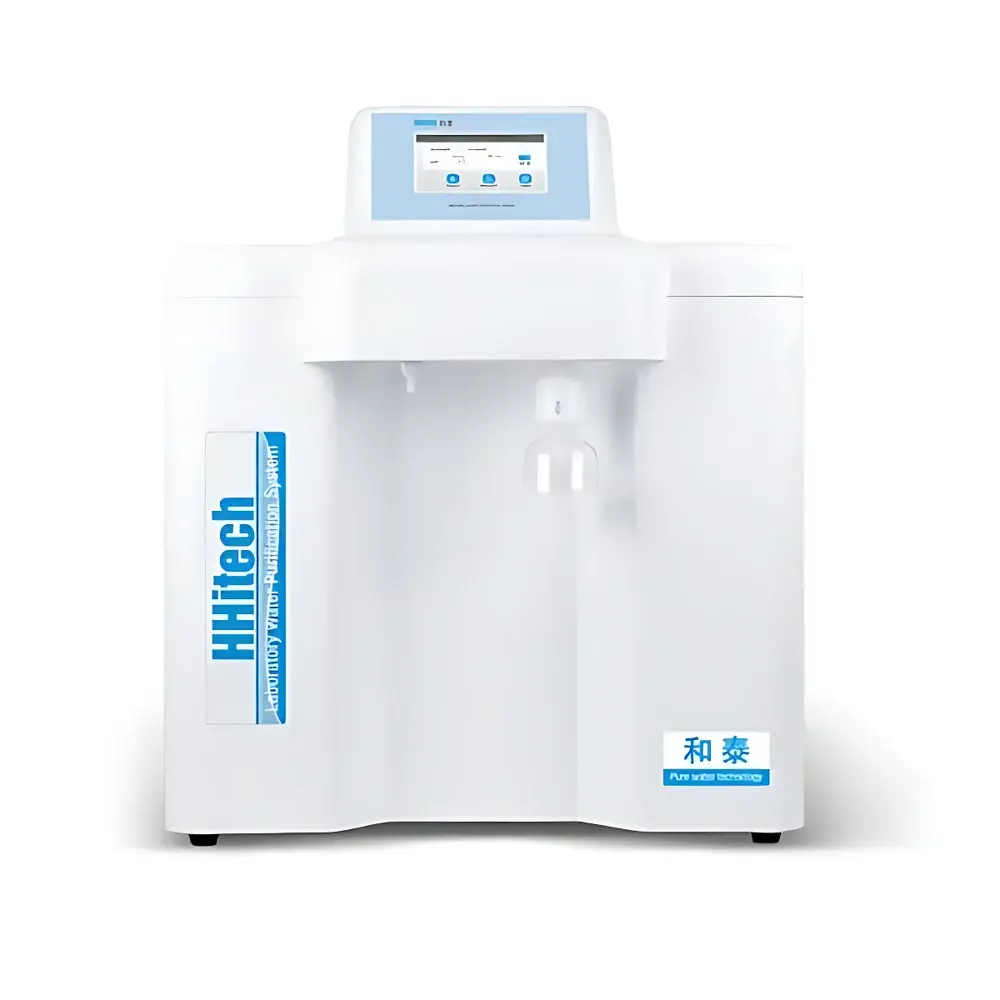
HHitech Master-D Ultra Pure Water System
| Brand | HHitech |
|---|---|
| Origin | Shanghai, China |
| Manufacturer Type | Authorized Distributor |
| Region | Domestic (China) |
| Model | Master-D |
| Pricing | Upon Request |
Overview
The HHitech Master-D Ultra Pure Water System is an engineered laboratory-grade water purification platform designed to produce Type I ultrapure water (ASTM D1193-20) and Type III purified water from pretreated feed sources such as reverse osmosis (RO) permeate, deionized (DI) water, or distilled water. It employs a multi-stage purification architecture grounded in established physical and electrochemical separation principles: sedimentation and adsorption via KDF–activated carbon prefiltration, size-exclusion and ion rejection via thin-film composite RO membranes (Dow FilmTec™), photochemical oxidation and microbial inactivation via dual-wavelength (185/254 nm) UV irradiation, molecular weight cutoff-based endotoxin removal via 5,000 Da ultrafiltration (UF), and final sterile filtration through hydrophilic PES membrane (0.45 + 0.2 µm). The system operates under continuous recirculation mode with programmable low-flow loop control—minimizing biofilm formation while maintaining thermal and chemical stability of the stored ultrapure water.
Key Features
- Modular, service-oriented architecture: Independent pre-treatment, RO, and polishing modules enable rapid maintenance, targeted component replacement, and minimal system downtime.
- Intelligent RO management: Programmable automatic anti-scaling flush cycles (configurable interval and duration), plus manual forced flush function to extend membrane service life and sustain >99% salt rejection performance.
- NSF-certified fluid path: All tubing, fittings, and housings comply with NSF/ANSI Standard 58 and 61, ensuring negligible leachable TOC contribution (<1 ppb background) and compatibility with GLP/GMP traceability requirements.
- Dual-wavelength UV oxidation: Imported 185 nm + 254 nm UV lamp assembly achieves simultaneous photolysis of organic contaminants (TOC reduction) and nucleic acid–level microbial inactivation (log⁴ reduction of viable bacteria).
- Endotoxin- and nuclease-controlled output: Integrated MWCO 5,000 Da UF module reduces endotoxin to <0.001 EU/mL; terminal PES filter eliminates RNase (<1 pg/mL) and DNase (<5 pg/mL) activity—validated for cell culture, IVF, qPCR, and monoclonal antibody formulation.
- Full-system sanitization protocol: Operator-initiated disinfection routines include loop circulation sterilization, dispensing point sanitization, tank refill control, and manual drain—supporting ISO 14644 cleanroom-compatible operation.
- Multi-tier security & audit readiness: Dual-level password protection (factory default + user-defined), real-time clock with scheduled standby/shutdown, and full event logging (water quality trends, consumables usage, alarm history, operator actions) compliant with FDA 21 CFR Part 11 data integrity expectations.
Sample Compatibility & Compliance
The Master-D system accepts feed water meeting ASTM D1193 Type III specifications (resistivity ≥ 5 MΩ·cm at 25 °C), including RO permeate, DI water, or distilled water. Inlet conditions must be maintained within 5–45 °C and 1 atm nominal pressure. Output water conforms to ISO 3696:1987 Grade 1, CLSI EP28-A3c, and USP purified water standards. For ultrapure applications, it meets or exceeds requirements for molecular biology (RNase/DNase-free), pharmaceutical manufacturing (endotoxin-sensitive processes), and analytical instrumentation (ICP-MS, HPLC mobile phase preparation). All wetted materials are USP Class VI certified; UV lamps and UF membranes carry CE and RoHS declarations.
Software & Data Management
The embedded control interface provides timestamped, non-erasable records of all operational events—including resistivity/TOC/temperature measurements per dispense cycle, cumulative volume delivered, cartridge saturation status, and alarm triggers (e.g., low pressure, high TOC, UV lamp failure). Data export is supported via USB port in CSV format for integration into LIMS or electronic lab notebooks. Audit trail functionality includes operator ID tagging (where configured), change history of setpoints, and immutable timestamps aligned to NIST-traceable RTC. Firmware supports remote diagnostics via optional Ethernet module (not included).
Applications
- Cell and tissue culture media preparation requiring endotoxin-free, nuclease-free water
- High-sensitivity analytical techniques: LC-MS, GC-MS, ICP-OES, and ICP-MS calibration and blank preparation
- Molecular biology workflows: PCR, RT-qPCR, NGS library construction, and CRISPR reagent dilution
- Pharmaceutical QC testing per USP , EP 2.2.44, and JP 17
- HPLC and UHPLC mobile phase formulation where organic residue and metal ion contamination must be minimized
- Electrophysiology and patch-clamp experiments demanding ultra-low conductivity and ion-free background
FAQ
What feed water quality is required for optimal Master-D performance?
Feed water must be pre-purified—typically RO permeate or DI water—with resistivity ≥5 MΩ·cm (25 °C), TOC <500 ppb, and free chlorine <0.1 ppm. Hardness should be <100 ppm CaCO₃ equivalent.
Can the Master-D be integrated with a pressurized storage tank?
Yes—the system supports both pressure-type stainless steel tanks and gravity-fed level-sensing reservoirs via configurable pump control logic and pressure switch inputs.
How often must consumables be replaced under typical lab use?
Pre-filters: 6–12 months depending on feed water quality; RO membrane: 2–3 years; UF cartridge: 12–18 months; final PES filter: 3–6 months; UV lamp: 9,000 hours (≈12 months continuous operation).
Is remote monitoring or network connectivity available?
Standard configuration includes local display and USB data export. Optional Ethernet or RS485 communication modules enable integration with building management systems or centralized lab monitoring platforms.
Does the system support 21 CFR Part 11 compliance?
Yes—when deployed with enabled audit trail, electronic signatures (via external authentication), and secure user access controls, it satisfies core technical requirements for electronic records and signatures in regulated environments.
Related Products



