
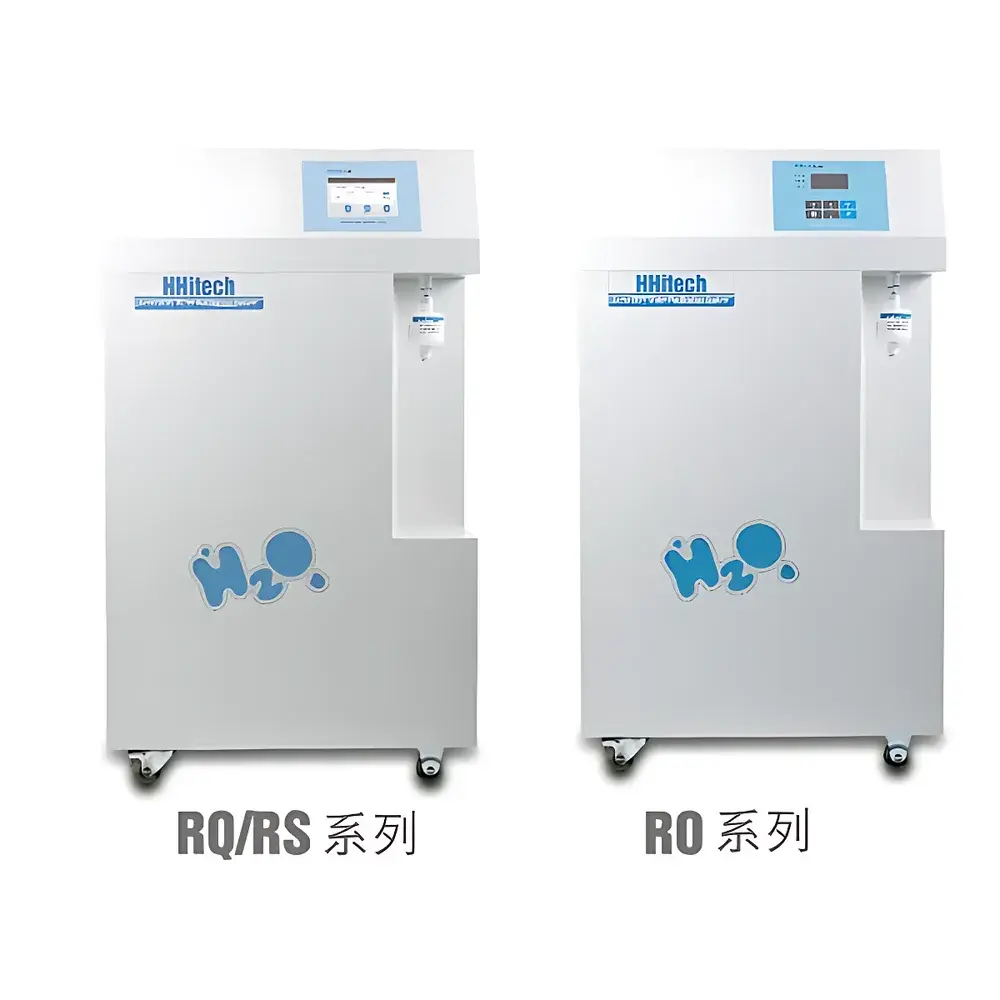
HHitech Pilot-R Dual-Stage Reverse Osmosis Ultra-Pure Water System
| Brand | HHitech |
|---|---|
| Origin | Shanghai, China |
| Model | Pilot-R |
| Pure Water Output | 30/45/60/90 L/hr (2nd-stage RO) |
| RO Resistivity | 1–5 µS/cm |
| DI Resistivity | 10–18.2 MΩ·cm |
| UP Resistivity | 18.2 MΩ·cm @ 25°C |
| TOC | <10 ppb (UV), <3 ppb (UVF) |
| Endotoxin | <0.001 EU/mL (UF/UVF) |
| RNase | <1 pg/mL (UF/UVF) |
| DNase | <5 pg/mL (UF/UVF) |
| Bacteria | <0.01 CFU/mL |
| Particles (>0.2 µm) | <1/mL |
| Feed Water | Municipal tap water, 5–45°C, 1.0–4.0 kgf/cm² |
| Dimensions (L×W×H) | 640×540×1110 mm |
| Weight | ~75 kg |
| Power | 220 V, 50 Hz, 240 W |
| Compliance | GLP-ready, NSF-certified fluid path components, ASTM D1193 Type I & II, ISO 3696 Grade 1 |
Overview
The HHitech Pilot-R is a dual-stage reverse osmosis (RO) ultra-pure water system engineered for laboratories requiring continuous, high-reliability production of Type I ultrapure water per ASTM D1193 and ISO 3696 standards. It integrates two independent RO stages—each with dedicated high-efficiency pumps and Dow FilmTec™ RO membranes—separated by an intermediate storage tank to stabilize feed pressure, minimize fouling, and maximize salt rejection (>99% for ions, >99% for organics >200 Da). This architecture ensures consistent feedwater quality to the downstream deionization and polishing modules, enabling stable resistivity ≥18.2 MΩ·cm at 25°C, TOC <3 ppb (with UVF configuration), and endotoxin levels below 0.001 EU/mL—critical for cell culture, IVF, molecular biology, and HPLC mobile phase preparation.
Key Features
- Dual-pump, dual-membrane RO architecture with intermediate buffer tank reduces energy consumption by up to 25% versus single-stage equivalents while lowering wastewater ratio and enhancing long-term membrane stability.
- Automated daily RO membrane flush cycle prevents scale accumulation and extends membrane service life—programmable via embedded controller without manual intervention.
- Stainless steel powder-coated chassis meets GLP environmental requirements: corrosion-resistant, non-shedding, and compatible with cleanroom-grade installation protocols.
- NSF/ANSI 61-certified fluid path components—including PES 0.2 µm final filters, Dow nuclear-grade mixed-bed resin cartridges, and dual-wavelength (185/254 nm) UV lamps—minimize organic leaching and microbial regrowth.
- Modular purification units (pre-treatment, primary RO, secondary RO, DI, UF/UV/UVF polishing) allow isolated maintenance, cartridge replacement, and system reconfiguration without full shutdown.
- Factory- and user-configurable password protection (dual-level access) secures operational parameters, calibration logs, and alarm thresholds in compliance with audit trail requirements.
Sample Compatibility & Compliance
The Pilot-R accommodates municipal tap water as feedstock (5–45°C, 1.0–4.0 kgf/cm² pressure) and delivers output suitable for analytical, pharmaceutical, and life science applications demanding strict purity control. Its purified water meets or exceeds ASTM D1193 Type I specifications for resistivity, TOC, silica, sodium, chloride, and particle count. The UF/UVF variant satisfies USP requirements for Water for Injection (WFI)-grade purity in endotoxin and nuclease content, and is validated for use in GMP environments where trace contaminants impact assay reproducibility or cell viability. All wetted materials comply with FDA 21 CFR 177 and EU 10/2011 food-contact regulations; system architecture supports 21 CFR Part 11-compliant electronic records when paired with optional RS232/USB data logging.
Software & Data Management
The integrated touchscreen controller provides real-time monitoring of feed/RO/DI/UP conductivity, TOC, UV intensity, pressure differentials, and cartridge exhaustion indicators. Built-in memory archives >12 months of timestamped water quality data (resistivity, temperature, flow rate, alarm events) with automatic export capability via USB or RS232 interface. Audit trail functionality records all parameter changes—including operator ID, timestamp, and pre-/post-change values—enabling full traceability for GLP/GMP audits. Optional software integration supports centralized fleet management across multi-instrument lab networks using standard Modbus TCP or OPC UA protocols.
Applications
- HPLC, LC-MS, and ICP-MS mobile phase and blank preparation where low TOC and metal ion contamination are critical.
- Cell culture media formulation and stem cell expansion requiring endotoxin-free, nuclease-free water.
- Molecular biology workflows including PCR, qRT-PCR, NGS library prep, and CRISPR transfection.
- Trace metal analysis (e.g., EPA Method 200.8) where sub-ppt background interference must be eliminated.
- Calibration of conductivity meters, pH electrodes, and TOC analyzers using certified reference water standards.
- Pharmaceutical QC testing under USP , EP 2.2.44, and JP 17 guidelines for purified and water-for-injection systems.
FAQ
What is the difference between Pilot-R and single-stage RO systems?
The Pilot-R employs two sequential RO stages with independent pumps and an intermediate storage tank, achieving higher desalination efficiency (typically ≤5 µS/cm post-2nd stage) and greater stability under variable feedwater conditions compared to single-stage designs.
Can the system be integrated into existing lab water distribution networks?
Yes—the Pilot-R supports both pressure-tank and level-sensing reservoir configurations and offers optional 0–5 V or 4–20 mA analog outputs for seamless integration with building management systems (BMS) or central water loop controllers.
How often do consumables require replacement?
Pre-filters: every 6 months (or per 10,000 L); RO membranes: 2–3 years depending on feedwater TDS and SDI; UP polishing cartridges: 6–12 months based on usage volume and TOC load.
Is validation documentation available for GMP compliance?
HHitech provides IQ/OQ templates, DQ support files, and material certifications (Dow RO membranes, Resin CoA, UV lamp spectral reports) upon request—fully aligned with Annex 15 and ASTM E2500 guidance.
Does the system support remote diagnostics?
With optional Ethernet module, technicians can perform secure remote firmware updates, log review, and fault-tree analysis via encrypted TLS connection—reducing downtime and on-site service calls.



