
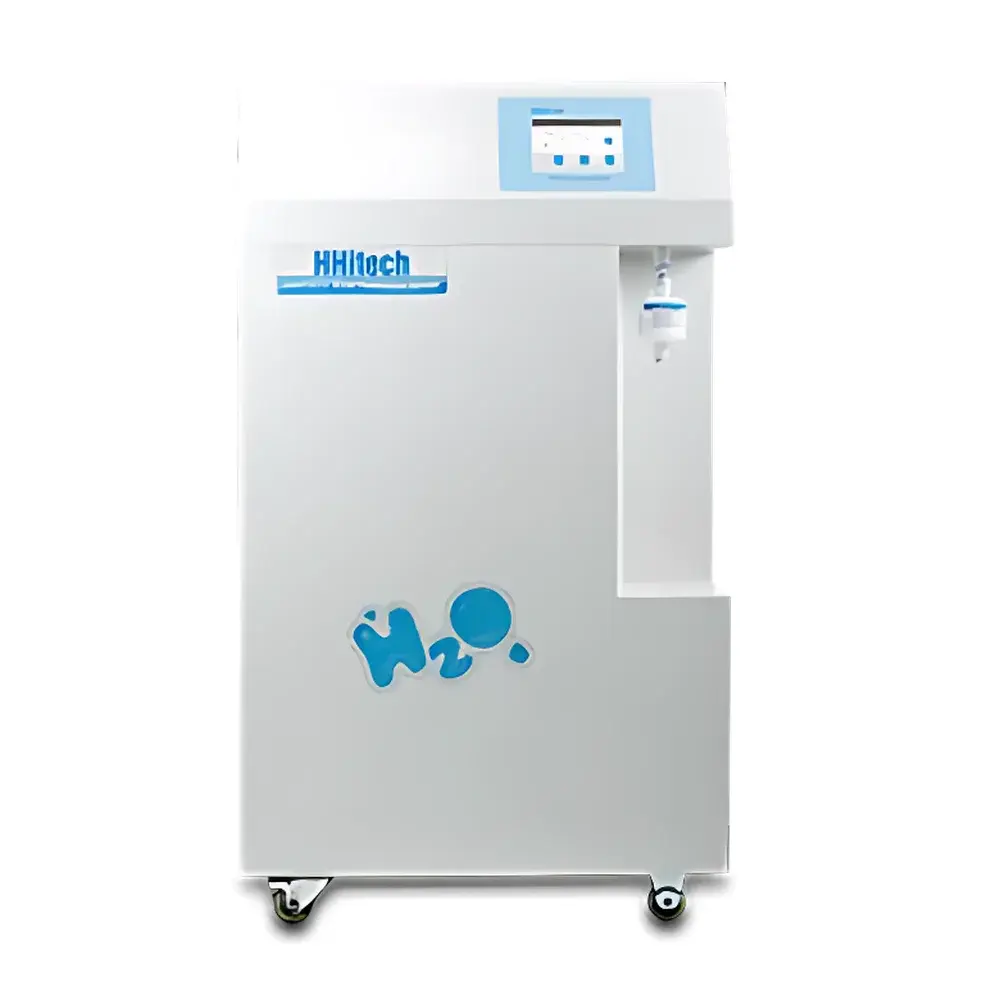
HHitech Pilot EDI Ultra-Pure Water System
| Brand | HHitech |
|---|---|
| Origin | Shanghai, China |
| Model | Pilot EDI-Q45 / Pilot EDI-Q60 / Pilot EDI-Q90 |
| Pure Water Output | 45 / 60 / 90 L/h |
| Resistivity (25 °C) | >10 MΩ·cm (EDI water) |
| TOC | <30 ppb (EDI water) |
| Silica Rejection Rate | >99.9% |
| Bacteria | <0.01 CFU/mL |
| Particles (>0.2 µm) | <1 /mL |
| RO Feed Water Conductivity Reduction | ~95% (1st pass) |
| Feed Water Requirements | Municipal tap water, 5–45 °C, pressure 1.0–4.0 kgf/cm² |
| Dimensions (L×W×H) | 640×540×1120 mm |
| Weight | ~70 kg |
| Electrical Supply | 220 V, 50 Hz |
| Power Consumption | 240 W / 300 W / 480 W |
| Certifications | NSF-certified tubing & fittings, GLP-compliant data logging, DOW RO membranes, dual-wavelength UV (185/254 nm), 5000 Da UF module, PES 0.2 µm final filter |
Overview
The HHitech Pilot EDI Ultra-Pure Water System is an integrated, laboratory-grade water purification platform engineered for continuous production of Type I ultrapure water (ASTM D1193-20) and Type II pure water (ISO 3696:1995) from municipal tap feed. It employs a multi-stage purification architecture combining pre-treatment (PP/KDF/AC), dual-stage reverse osmosis (RO), electrodeionization (EDI), and post-EDI ultra-purification (UV/UF/DI/TOC reduction). The system’s core design principle centers on stable, low-maintenance delivery of water meeting stringent analytical, life science, and regulatory requirements—including cell culture, HPLC mobile phase preparation, ICP-MS calibration, and molecular biology applications where endotoxin, silica, and organic contaminants must be minimized. Its dual-pump, dual-membrane RO stage with intermediate storage tank ensures consistent rejection efficiency and reduced wastewater generation, while the optimized EDI module delivers reproducible resistivity ≥10 MΩ·cm at 25 °C without chemical regeneration—reducing operational risk and consumable dependency.
Key Features
- Three-tier real-time water quality monitoring: simultaneous display of RO, EDI, and UP resistivity (0–18.25 MΩ·cm) and flow rate (two independent channels)
- High-precision dispensing: programmable volume (10–999,999 mL) and quality-based (resistivity threshold) delivery with auto-stop
- Integrated dual water storage: 20 L PE reservoir + 15 L pressurized tank, both internal—eliminating external footprint and contamination pathways
- Comprehensive GLP data governance: USB + SD card interface for one-year audit-trail logging; timestamped records include water quality events, consumable usage, alarm history, and manual interventions
- Intelligent consumables management: configurable lifetime thresholds for PP, KDF, AC, RO, DI, UP, UV, UF, and TF modules; visual status indicators and automated replacement alerts
- Dual-wavelength UV oxidation (185 nm + 254 nm) using imported low-pressure lamps to reduce TOC and inactivate microorganisms
- 5000 Da molecular weight cutoff (MWCO) ultrafiltration membrane for effective endotoxin removal (<0.001 EU/mL), validated for IVF and primary cell culture
- NSF-certified fluid path components—including PES 0.2 µm terminal filter—to minimize leachables and maintain low TOC output
- Automated RO membrane antiscalant flush cycle (configurable interval/duration) and manual override for extended membrane service life
- Role-based access control: factory-level and user-level password protection for system configuration, time settings, and maintenance logs
Sample Compatibility & Compliance
The Pilot EDI system is compatible with standard municipal potable water supplies meeting WHO Guidelines for Drinking-water Quality. Its robust pre-treatment train accommodates variable inlet conditions (5–45 °C, 1.0–4.0 kgf/cm²), while the DOW-sourced RO membranes ensure ≥99% salt rejection under fluctuating feed TDS. Final UP water complies with ISO 3696 Grade 1 specifications (resistivity ≥18.2 MΩ·cm, TOC ≤5 ppb, bacteria ≤0.01 CFU/mL, particles 0.2 µm) and supports USP purified water criteria. All wetted materials are non-leaching and chemically inert; the stainless steel powder-coated chassis meets GLP structural integrity requirements. System firmware supports 21 CFR Part 11–compliant electronic record retention when paired with validated USB export workflows.
Software & Data Management
A 0-inch color touchscreen interface provides animated, context-sensitive navigation and real-time visualization of all critical parameters. The embedded controller logs timestamped data—including conductivity/resistivity trends, flow rates, alarm triggers, consumable utilization, and manual operations—for ≥12 months. Export is performed via encrypted USB or SD card in CSV format, enabling integration into LIMS or QA documentation systems. Audit trails include operator ID (if assigned), action type, parameter values before/after change, and system state—fully traceable per GLP Annex 11 and ISO/IEC 17025 clause 7.9. User-configurable alert thresholds support proactive maintenance scheduling and deviation reporting.
Applications
This system serves high-sensitivity laboratory workflows requiring consistent, documented water quality. Key use cases include: preparation of HPLC and LC-MS mobile phases; calibration standards for ICP-OES and ICP-MS; rinsing of quartz cuvettes and optical components; formulation of electrophysiology buffers; media preparation for stem cell expansion and organoid culture; and reagent-grade water for NGS library construction. The UF/UV/TOC-reduction configuration enables compliance with ISO 13485 cleanroom water specifications and supports ISO 15189-accredited clinical testing laboratories.
FAQ
What is the expected service life of the DOW RO membrane under typical municipal feed conditions?
With proper pre-treatment and scheduled antiscalant flushing, the DOW membrane typically achieves 2–3 years of stable performance—subject to local water hardness and chlorine exposure.
Does the system support remote monitoring or Ethernet connectivity?
No built-in Ethernet or cloud interface is provided; however, periodic USB/SD data extraction enables offline integration with institutional networked QA systems.
Can the UP water resistivity be validated independently using a calibrated meter?
Yes—the system includes a dedicated, temperature-compensated resistivity port compliant with ASTM D1125; users may cross-check against NIST-traceable handheld meters.
Is the 185 nm UV lamp replaceable as a field-serviceable component?
Yes—UV lamp replacement is a user-performed procedure with no tools required; lamp life is tracked automatically and reported in the maintenance log.
How does the RO reject water不合格 emission function improve downstream column longevity?
The patented diversion valve routes substandard RO permeate away from the EDI stage until conductivity falls below the preset threshold—preventing premature ion exchange exhaustion and extending DI/UP column service intervals by up to 40%.



