
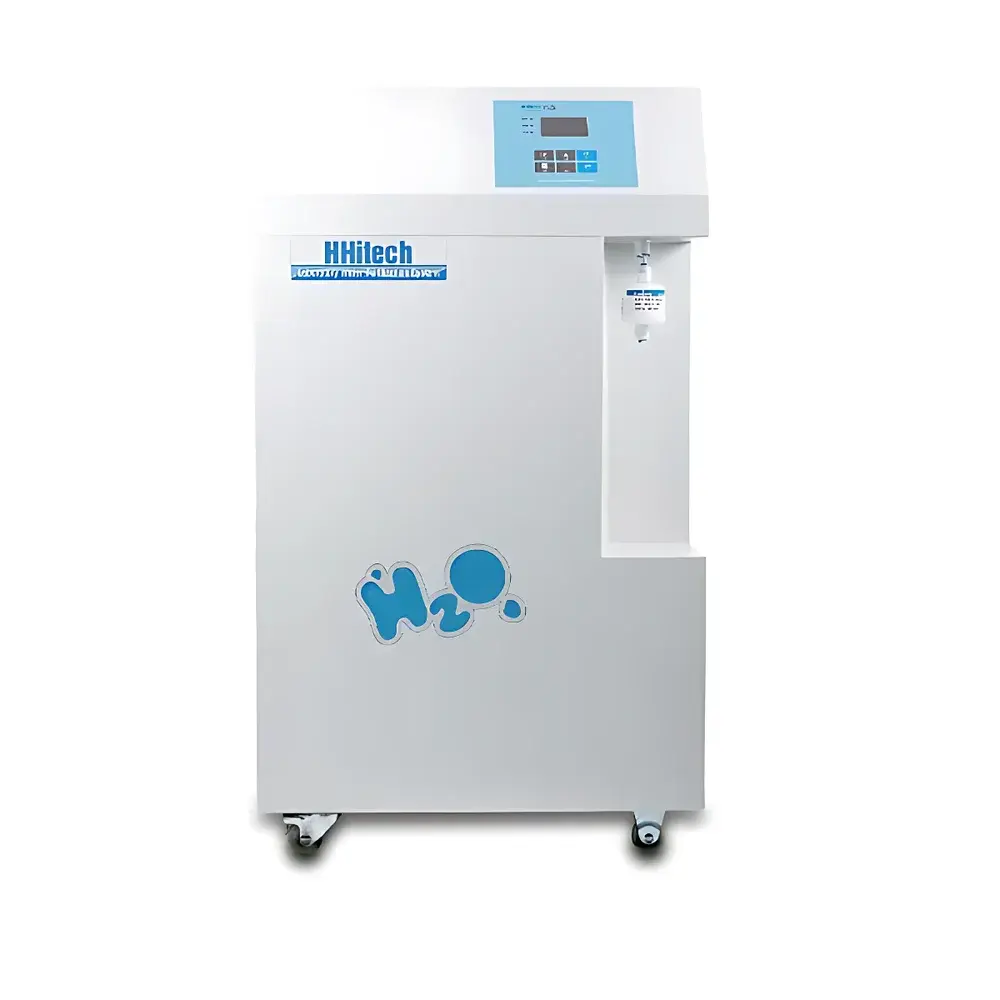
HHitech Pilot-RO Series Benchtop Reverse Osmosis Water Purification System (Economy Model)
| Brand | HHitech |
|---|---|
| Origin | Shanghai, China |
| Manufacturer Type | Authorized Distributor |
| Country of Origin | China |
| Model | Pilot-RO |
| Pricing | Available Upon Request |
| Pure Water Output | 45–180 L/hr (Model-Dependent) |
| RO Salt Rejection Rate | 97–99% (New Membrane) |
| Organic Rejection (>200 Da) | >99% |
| Particulate & Bacterial Retention | >99% |
| Bacterial Count | <0.01 CFU/mL (with optional 0.2 µm PES final filter) |
| Particles (>0.2 µm) | <1/mL (with optional 0.2 µm PES final filter) |
| Feed Water | Municipal tap water, 5–45 °C, 1.0–4.0 kgf/cm² pressure |
| Dimensions (L×W×H) | 640 × 540 × 1110 mm |
| Weight | ~70 kg |
| Electrical Supply | 220 V, 50 Hz |
| Power Consumption | 120–240 W (model-dependent) |
| Compliance | GLP-compliant architecture, NSF-certified tubing/fittings, DOW FilmTec™ RO membranes, USP <1231> aligned design principles |
Overview
The HHitech Pilot-RO Series is a benchtop reverse osmosis (RO) water purification system engineered for laboratories requiring consistent, cost-effective production of Type III purified water per ISO 3696 and ASTM D1193 specifications. Utilizing cross-flow membrane filtration under hydraulic pressure, the system removes dissolved ions, colloids, microorganisms, and organic molecules with molecular weights exceeding 200 Da. Its core separation mechanism relies on semi-permeable polyamide thin-film composite (TFC) membranes—specifically DOW FilmTec™ elements—operating via size exclusion and charge repulsion. Unlike distillation or deionization-only systems, the Pilot-RO integrates pre-treatment (sediment + activated carbon), primary RO, optional dual-stage RO (R-Series models), and post-RO polishing modules to deliver stable conductivity values typically below 5 µS/cm at 25 °C. Designed for continuous operation in QC labs, environmental testing facilities, and preparatory chemistry workflows, it meets foundational requirements for buffer preparation, glassware rinsing, media formulation, and feed water for downstream ultrapure systems.
Key Features
- Modular architecture with independent pre-treatment, RO, and post-purification units—enabling targeted maintenance without system-wide shutdown
- Automated daily RO membrane flush cycle to inhibit biofilm formation and scale deposition, extending membrane service life beyond 24 months under typical municipal feed conditions
- GLP-aligned firmware with dual-level password protection (factory preset + user-configurable), audit trail logging for critical parameter changes, and timestamped operational records
- NSF/ANSI Standard 61-certified fluid path components—including EPDM-free PTFE-lined tubing and FDA-compliant fittings—to minimize total organic carbon (TOC) leaching and ensure compliance with USP water quality guidance
- Optional dual-RO configuration (Pilot-RO R-Series) incorporating an intermediate storage tank and secondary high-rejection membrane stage, reducing overall reject ratio by up to 35% while improving ion removal consistency
- Stainless steel powder-coated chassis with corrosion-resistant hardware, adjustable leveling feet, and integrated vibration-dampening mounts for stable placement on standard lab benches or utility carts
Sample Compatibility & Compliance
The Pilot-RO accepts municipal potable water meeting WHO Guidelines for Drinking-water Quality as feedstock. It accommodates inlet pressures between 100–400 kPa (1.0–4.0 kgf/cm²) and temperatures from 5–45 °C. All wetted materials—including housing, seals, and membrane housings—are compliant with EU Regulation EC 1935/2004 and FDA 21 CFR §177.2420 for indirect food contact. The system’s electrical design conforms to IEC 61010-1:2010 for laboratory equipment safety. While not certified to ISO/IEC 17025, its output meets ISO 3696 Grade 3 and ASTM D1193 Type IV specifications for purified water. Optional accessories—including 0.2 µm PES final filters (sterile-grade), 185/254 nm UV modules, and 5 kDa MWCO ultrafiltration cartridges—enable alignment with more stringent applications such as cell culture media prep (per ATCC guidelines) or IVF support water (per ESHRE recommendations).
Software & Data Management
The embedded controller supports real-time monitoring of feed pressure, permeate flow rate, TDS, and temperature via onboard sensors. RS232 or USB interface (optional) enables connection to LIMS or local PCs for automated data export in CSV format. Firmware logs all operational events—including membrane flush cycles, alarm triggers, and consumable usage counters—with retention for ≥12 months. Data integrity safeguards include write-protected memory sectors, tamper-evident timestamps, and configurable user access levels—all supporting adherence to FDA 21 CFR Part 11 principles for electronic records where local validation protocols permit. No cloud connectivity or remote telemetry is implemented, preserving network security boundaries common in regulated academic and industrial labs.
Applications
- Feed water supply for Type I ultrapure water systems (e.g., EDI or mixed-bed polishing units)
- Routine analytical sample dilution and reagent preparation in environmental, pharmaceutical, and food testing labs
- Final rinse water for HPLC mobile phase preparation and GC vial cleaning
- Preparation of non-critical buffers, saline solutions, and microbiological growth media
- Support water for autoclave chamber filling, steam generator feed, and humidifier reservoirs
- General-purpose purified water in teaching laboratories and pilot-scale process development environments
FAQ
What feed water quality is required for optimal Pilot-RO performance?
Municipal tap water meeting national drinking water standards is sufficient. Total dissolved solids should remain below 500 ppm; iron content must be <0.1 mg/L and chlorine <0.5 mg/L to prevent premature membrane oxidation.
Can the system be upgraded to produce Type I ultrapure water?
No—the Pilot-RO is designed exclusively for Type III purified water. Integration with external EDI or mixed-bed polishing units is possible but requires third-party engineering validation and is outside the scope of HHitech’s factory warranty.
How often must the RO membrane be replaced?
Under typical municipal feed conditions and with scheduled maintenance (including quarterly carbon replacement and biannual sediment filter change), DOW FilmTec™ membranes maintain ≥95% rejection efficiency for 24–36 months. Performance monitoring via TDS metering is recommended weekly.
Is the system compatible with non-pressurized water sources?
No—minimum inlet pressure of 100 kPa is mandatory. A booster pump is required if feed pressure falls below this threshold.
Does the Pilot-RO meet GLP requirements for regulated laboratories?
Yes—its password-protected configuration, event logging, and material traceability (via DOW membrane lot numbers and NSF-certified components) satisfy core GLP documentation and equipment qualification expectations, though full validation remains the responsibility of the end-user’s QA department.



