
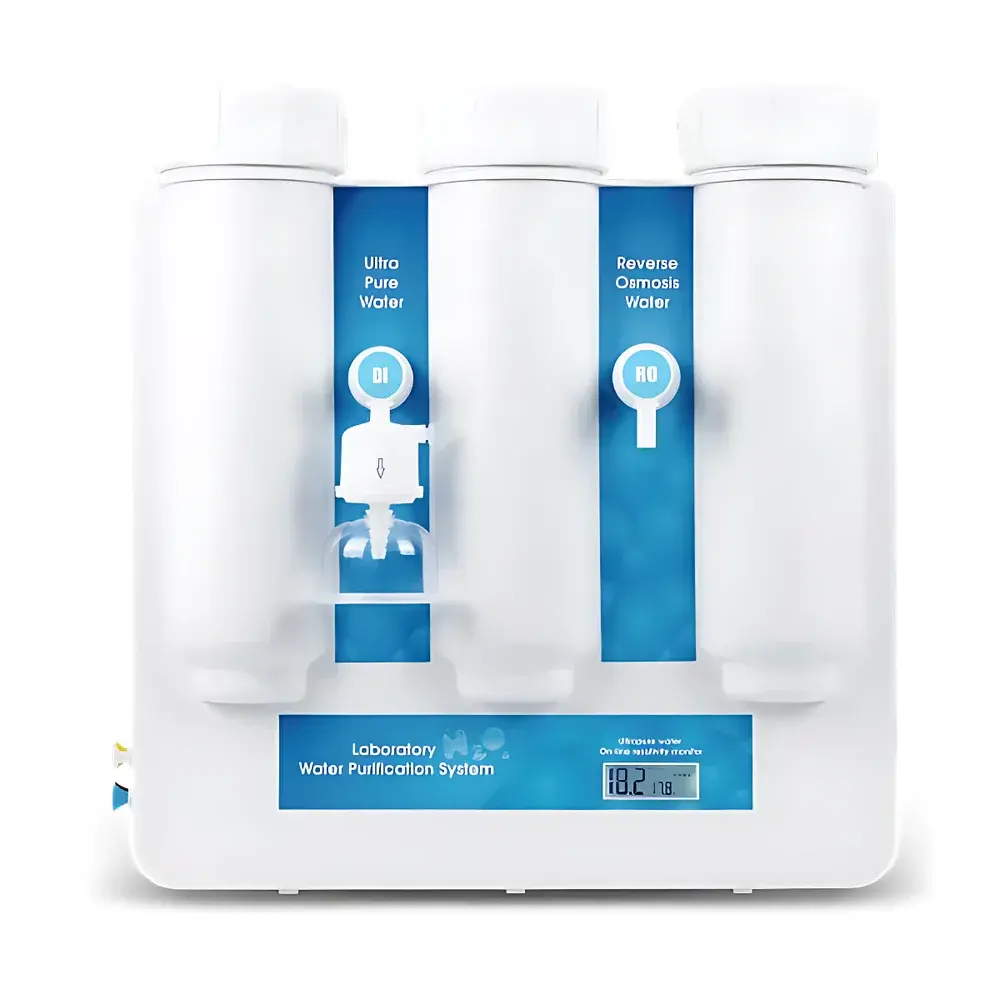
HHitech Smart-Q Ultra Pure Water System
| Brand | HHitech |
|---|---|
| Origin | Shanghai, China |
| Model | Smart-Q |
| Pure Water Output | 15 or 30 L/hour |
| DI Water Output | Up to 2.0 L/min (with pressurized tank) |
| Resistivity | 16–18.2 MΩ·cm |
| Conductivity | 0.067–0.055 µS/cm |
| Bacterial Count | <0.01 CFU/mL |
| Particles (>0.1 µm) | <1/mL |
| RO Salt Rejection | 97–99% (new membrane) |
| Organic Rejection (>200 Da) | >99% |
| Particulate & Bacterial Rejection (RO) | >99% |
| Feed Water | Municipal tap water, 5–45 °C, 1.0–4.0 kgf/cm² |
| Dimensions (L×W×H) | 410×220×420 mm |
| Weight | ~20 kg |
| Electrical | 100–240 V, 50/60 Hz |
| Power Consumption | 48 W (Smart-Q15) / 72 W (Smart-Q30) |
| Certifications | NSF-certified tubing & fittings, DOW RO membranes, PES 0.45 + 0.1 µm terminal filter, dual-wavelength (185/254 nm) UV lamp, MWCO 5000 Da ultrafiltration module |
Overview
The HHitech Smart-Q Ultra Pure Water System is an integrated, modular laboratory water purification platform engineered for precision and regulatory compliance in life science, pharmaceutical, and analytical applications. It employs a multi-stage purification architecture grounded in established physical and electrochemical separation principles: reverse osmosis (RO) for bulk ion and organic removal, followed by electrodeionization (EDI)-compatible dual-stage deionization using nuclear-grade Dow ion-exchange resins, ultraviolet photo-oxidation (185/254 nm), ultrafiltration (MWCO 5000 Da), and final sterile filtration (0.45 + 0.1 µm PES membrane). This sequence ensures consistent production of Type I ultrapure water per ISO 3696:1987 and ASTM D1193-20, with real-time resistivity monitoring (16–18.2 MΩ·cm at 25 °C) and total organic carbon (TOC) suppression below 5 ppb—critical for HPLC mobile phase preparation, cell culture media formulation, and trace elemental analysis.
Key Features
- Monolithic injection-molded housing constructed from medical-grade polypropylene (PP), compliant with USP Class VI biocompatibility standards and resistant to chemical leaching.
- Integrated, tool-free consumables architecture: quick-release prefilter cap enables on-the-fly replacement of sediment/carbon cartridges without cabinet disassembly—supporting GLP-aligned maintenance logging.
- Intelligent microprocessor control with backlit LCD interface displaying real-time parameters including feed pressure, water temperature, system status (standby, producing, flushing, full, low-level), and RO membrane rinse cycles.
- Automated daily RO membrane flush protocol minimizes scaling and biofilm accumulation, extending membrane service life beyond 24 months under typical municipal feed conditions.
- Modular four-cartridge deionization stack utilizing Dow Optipore® and Marathon® nuclear-grade resins—designed for high exchange capacity, low TOC elution, and reproducible resistivity stability across batch-to-batch operation.
- NSF/ANSI 61-certified fluid path components—including all tubing, quick-connect fittings, and pump housings—to ensure minimal extractables and compliance with drinking water safety standards.
- Optional integrated leak detection system with audible alarm and SERVICE flag activation upon moisture sensing, preventing uncontrolled water discharge during maintenance or failure events.
Sample Compatibility & Compliance
The Smart-Q system delivers water meeting or exceeding the stringent specifications required for ISO 13485 quality management systems and FDA 21 CFR Part 11–aligned electronic record environments. Its output is validated for use in USP purified water applications and supports GLP/GMP workflows through audit-trail-capable software integration (via optional RS232/USB interface). Terminal filtration with dual-layer PES membrane (0.45 µm pre-filter + 0.1 µm sterilizing grade) achieves bacterial retention ≥ log 7 reduction, while the 5000 Da ultrafiltration module removes endotoxins to <0.001 EU/mL—enabling safe application in primary neuronal culture, monoclonal antibody production, and qPCR reagent preparation. All wetted materials comply with EP 2.6.12 and JP XVII extractables testing protocols.
Software & Data Management
While the base Smart-Q model operates via embedded firmware with local LCD readouts, optional data logging modules support time-stamped export of resistivity, temperature, and operational event logs (e.g., cartridge change alerts, RO flush initiation) to CSV or XML formats. When paired with HHitech’s LabLink™ PC software (sold separately), users gain access to configurable alarm thresholds, historical trend visualization, and electronic signature-enabled maintenance records—facilitating alignment with Annex 11 and ALCOA+ data integrity principles. All firmware updates are delivered via secure USB key with cryptographic verification to prevent unauthorized modification.
Applications
- HPLC, UHPLC, and LC-MS mobile phase and blank preparation where sub-ppb metal and organic contamination must be controlled.
- Cell and tissue culture media supplementation requiring endotoxin-free, nuclease-free water for stem cell expansion and organoid development.
- Atomic absorption spectroscopy (AAS) and inductively coupled plasma mass spectrometry (ICP-MS) calibration standard dilution.
- Molecular biology workflows including PCR, RT-qPCR, NGS library prep, and CRISPR-Cas9 transfection buffers.
- Pharmaceutical stability testing per ICH Q5C guidelines, where water purity directly impacts degradation kinetics assessment.
- Calibration of conductivity meters and reference electrode storage solutions in metrology laboratories.
FAQ
What is the recommended feed water quality for optimal Smart-Q performance?
Municipal tap water conforming to WHO Guidelines for Drinking-water Quality is required; TDS should remain below 500 ppm, with chlorine concentration ≤ 2 ppm and silica < 10 ppm to maximize RO membrane longevity.
Can the Smart-Q be connected to a central lab water distribution loop?
Yes—via optional stainless-steel or PFA-lined distribution kits supporting up to 10 simultaneous outlets with recirculation-compatible UV loop integration.
How often must the RO membrane be replaced under standard operating conditions?
Typical service life is 24–36 months when operated with prefiltered feed water and maintained per HHitech’s quarterly preventive maintenance schedule.
Is the system compatible with third-party water quality monitoring platforms?
Analog 4–20 mA and digital Modbus RTU outputs are available on the Smart-Q Pro variant; contact HHitech Technical Support for OEM integration documentation.
Does the Smart-Q meet requirements for USP Purified Water (PW) and Water for Injection (WFI) production?
It produces Type I ultrapure water suitable for PW applications; however, WFI requires additional distillation or vapor compression steps not included in this configuration.



