
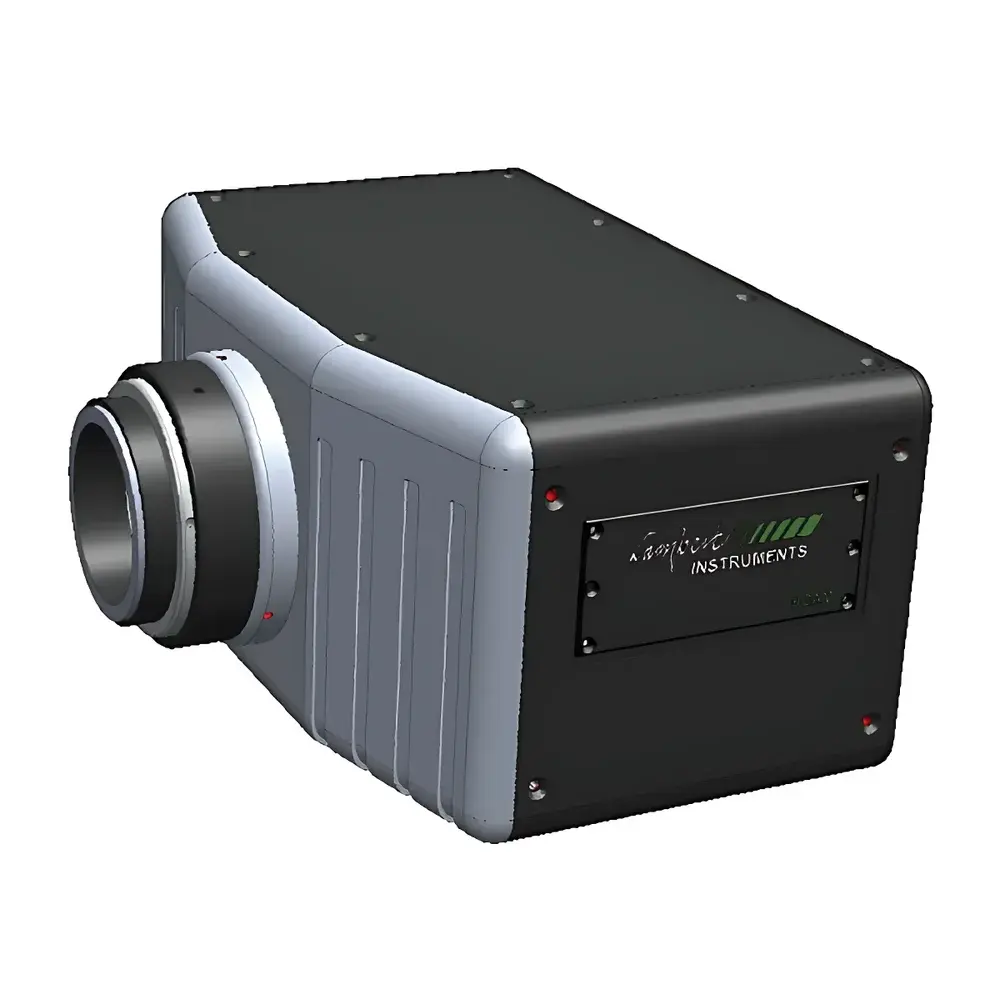
HiCAM Fluo High-Speed Fluorescence Camera (auniontech)
| Brand | auniontech |
|---|---|
| Origin | Imported |
| Manufacturer Type | Authorized Distributor |
| Model | HiCAM Fluo |
| Max Frame Rate | 4000 fps |
| Sensor Resolution | 1280 × 1024 pixels |
| Minimum Exposure Time | 2 µs |
| Gating Pulse Width (FWHM) | 40 ns |
| Gating Repetition Rate | Up to 100 kHz |
| Image Intensifier | Gen III, fiber-optically coupled |
| Cooling | Peltier-cooled intensifier (−30 °C typical operating temperature) |
| Interface | CoaXPress v2.0 (quad-link) |
| Pixel Size | 6.6 × 6.6 µm |
| Software Support | CoaXPress SDK, LabVIEW drivers, optional real-time FPGA-based frame grabber integration |
Overview
The HiCAM Fluo is a high-speed, gated intensified camera engineered for quantitative time-resolved fluorescence microscopy and low-light dynamic imaging. Built around a fiber-optically coupled Gen III image intensifier and a 1.3 MP scientific CMOS sensor, it delivers synchronized ultrafast gating (down to 40 ns FWHM), sub-microsecond exposure control, and thermoelectrically stabilized intensifier operation—enabling photon-starved applications where temporal fidelity, signal-to-noise ratio (SNR), and motion artifact suppression are critical. Unlike conventional EMCCD or sCMOS cameras, the HiCAM Fluo employs optical gain prior to sensor readout, preserving quantum efficiency across UV–NIR spectral bands while eliminating read noise dominance at high frame rates. Its architecture adheres to core principles of stroboscopic imaging: precise electronic shuttering via intensifier gating decouples exposure duration from frame rate, allowing independent optimization of temporal resolution and acquisition speed—essential for capturing transient biochemical events, microfluidic dynamics, or plasma emission bursts.
Key Features
- Gated Intensification: Gen III microchannel plate (MCP) intensifier with fiber-optic coupling ensures high spatial resolution (>50 lp/mm), broad spectral response (185–900 nm), and single-photon sensitivity; Peltier cooling reduces thermal background by >99% versus non-cooled counterparts.
- Ultrafast Temporal Control: Programmable gate width from 40 ns (FWHM) with <1 ns jitter; gate repetition up to 100 kHz supports multi-pulse excitation schemes and time-correlated single-photon counting (TCSPC)-compatible workflows.
- High-Throughput Imaging Interface: Quad-link CoaXPress v2.0 interface sustains sustained 4000 fps @ 1280 × 1024 (16-bit) with zero frame loss; bandwidth exceeds 12.5 Gbps, enabling direct streaming to RAID-optimized storage or FPGA-accelerated on-the-fly processing.
- Modular Microscope Integration: C-mount and F-mount adapter options ensure mechanical and optical compatibility with major upright/inverted microscope platforms (Olympus, Nikon, Zeiss, Leica); back focal plane alignment support enables optimal coupling efficiency and minimal vignetting.
- Deterministic Timing Architecture: Hardware-triggered synchronization with TTL/PECL inputs; programmable delay resolution of 100 ps allows precise alignment with pulsed lasers, Q-switches, or external event markers (e.g., voltage triggers in electrophysiology).
Sample Compatibility & Compliance
The HiCAM Fluo is validated for use with standard fluorophores (e.g., FITC, TRITC, Cy5, DAPI), luminescent nanoparticles, and chemiluminescent substrates. Its intensifier quantum efficiency profile ensures high responsivity under 405 nm, 488 nm, 532 nm, and 640 nm excitation—common in confocal, TIRF, and light-sheet modalities. The system complies with IEC 61000-6-3 (EMC emission limits) and IEC 61000-6-2 (immunity standards). While not certified as medical device hardware, its timing stability, audit-trail-capable firmware logging (via optional SDK extensions), and deterministic trigger behavior align with GLP-compliant experimental documentation requirements per OECD Series on Principles of Good Laboratory Practice.
Software & Data Management
Native drivers include CoaXPress SDK (C/C++, Python bindings) and certified LabVIEW VIs supporting NI Vision Acquisition Software (VAS) integration. Optional real-time analysis packages enable on-FPGA centroid tracking, intensity histogramming, and ROI-based temporal deconvolution—deployable without host CPU bottlenecking. All acquired datasets are saved in vendor-neutral HDF5 format with embedded metadata (exposure, gate delay, sensor temperature, timestamp UTC sync), ensuring FAIR data principles compliance. Export modules support TIFF (16-bit), NRRD, and MATLAB .mat formats. For regulated environments, optional 21 CFR Part 11–compliant audit trail logging and user access controls are available through third-party middleware integration.
Applications
- Cardiac Dynamics Imaging: Capturing zebrafish heartbeats at 2000 fps with DS-red labeling reveals diastolic-systolic transitions, valve kinetics, and arrhythmia onset with sub-millisecond temporal fidelity.
- Laser-Induced Fluorescence (LIF): Quantifying species concentration gradients in combustion chambers or microreactors using nanosecond-pulsed excitation synchronized to 40 ns gate windows.
- Time-Resolved Bioluminescence: Resolving ATP-dependent luciferase decay kinetics in live-cell assays with gated acquisition eliminating ambient light contamination.
- Plasma Diagnostics: Recording spatiotemporal evolution of electron density and excited-state populations in pulsed discharge plasmas.
- Micro-PIV: Tracking fluorescent tracer particles (<500 nm) in laminar/turbulent microfluidic flows with motion blur suppression at 4000 fps.
FAQ
What is the minimum achievable exposure time, and how is it controlled?
The shortest controllable exposure is defined by the intensifier gate width—40 ns FWHM—with timing jitter <1 ns. Exposure is set entirely by the MCP voltage pulse; sensor integration time is decoupled and fixed at frame period.
Does the camera support hardware triggering for synchronization with external lasers?
Yes—TTL and PECL-compatible trigger inputs accept rising/falling edge signals with programmable delay (100 ps resolution) and latency compensation for multi-laser setups.
Can the HiCAM Fluo be used with standard fluorescence filter cubes?
Yes—its C-mount/F-mount adaptability preserves native magnification and working distance; users must verify filter transmission band alignment with intensifier spectral response.
Is real-time image processing supported out of the box?
Basic ROI extraction and intensity profiling are handled in firmware; advanced algorithms (e.g., particle tracking, lifetime fitting) require optional FPGA frame grabber integration or post-acquisition analysis in MATLAB/Python.
How does Peltier cooling improve quantitative accuracy in long-duration acquisitions?
Cooling the intensifier photocathode to −30 °C suppresses thermionic emission, reducing dark current by two orders of magnitude—critical for maintaining SNR during extended time-series experiments (e.g., circadian rhythm studies).



