
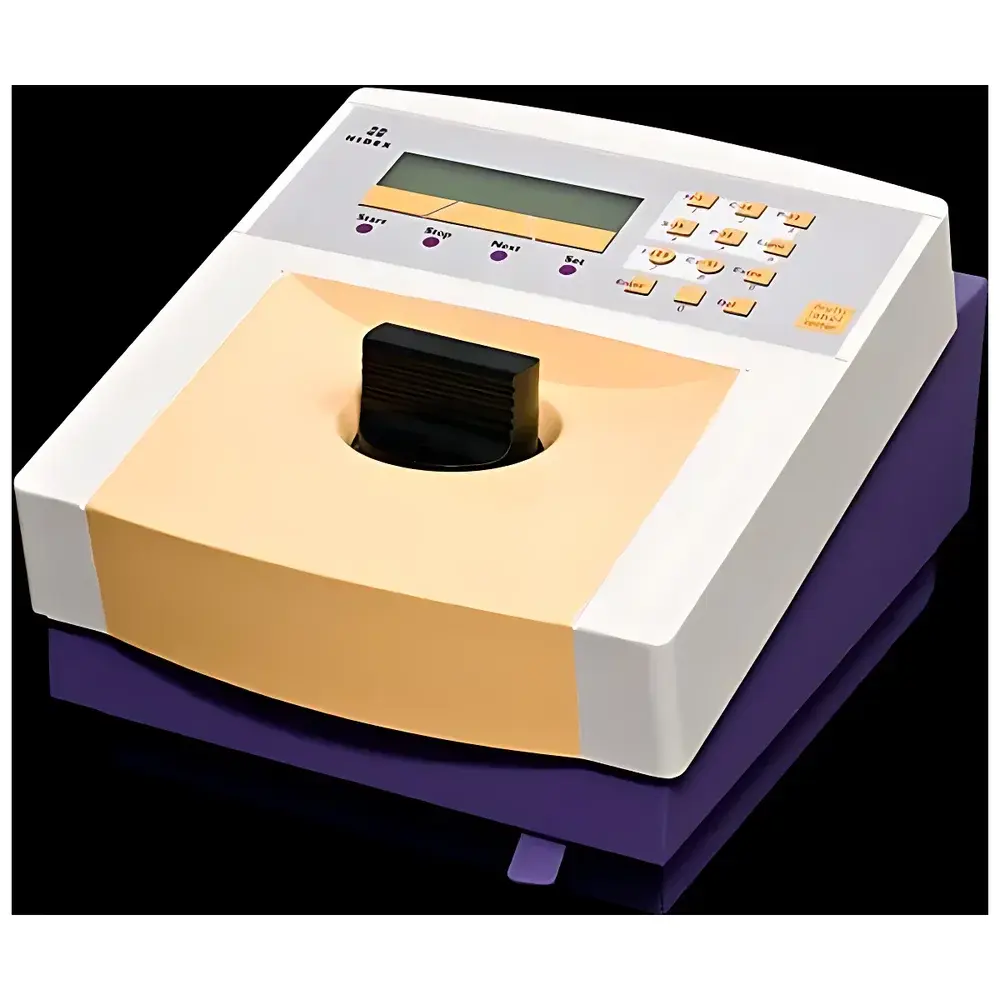
Hidex Triathler Portable Liquid Scintillation Counter
| Brand | Hidex |
|---|---|
| Origin | Shanghai, China |
| Manufacturer Type | Authorized Distributor |
| Country of Origin | China |
| Model | Hidex Triathler |
| Pricing | Upon Request |
| Weight | 9 kg (20 lbs) |
| Power Supply | 110–240 V AC, 12 V DC |
| Sample Formats | LSC vials, test tubes, microcentrifuge tubes |
| Detector | Single-photon-counting photomultiplier tube (PMT) |
| Display | 2×16-character LCD |
| Energy Range | 2 keV – 2,000 keV |
| Counting Time | 0.1 s – 99,999 min |
| Output Interfaces | RS-232C, USB |
Overview
The Hidex Triathler Portable Liquid Scintillation Counter is a compact, field-deployable instrument engineered for quantitative detection of low-energy beta emitters—including 3H and 14C—as well as gamma-emitting radionuclides and bioluminescent/chemiluminescent signals. Based on liquid scintillation counting (LSC) principles, the Triathler employs pulse-height analysis via an integrated multi-channel analyzer (MCA) to discriminate between isotopes by energy signature, enabling accurate disintegration-per-minute (DPM) quantification without external calibration curves in many routine applications. Its design prioritizes operational flexibility in resource-constrained environments—such as environmental field stations, nuclear decommissioning sites, marine research vessels, or biosafety level-2 laboratories—where benchtop LSC systems are impractical. Unlike conventional LSC instruments reliant on dual-PMT coincidence circuitry, the Triathler achieves high specificity and background rejection through optimized single-PMT photon counting with digital pulse processing and real-time spectral deconvolution.
Key Features
- True portability: Weighing only 9 kg with integrated battery-ready 12 V DC input, the Triathler operates independently of fixed mains infrastructure—ideal for remote sampling campaigns or mobile emergency response units.
- Multi-isotope capability: Simultaneous detection and discrimination of 3H, 14C, 32P, 35S, 45Ca, 55Fe, 63Ni, 90Sr/90Y, and 137Cs across a broad energy range (2 keV – 2 MeV).
- Onboard MCA with real-time spectrum display: Enables qualitative assessment of sample composition, identification of contamination events, and verification of quench conditions prior to DPM calculation.
- One-touch isotope protocols: Preconfigured counting methods accessible via membrane keypad reduce operator training requirements and minimize procedural variability.
- Alpha/beta discrimination option: Available firmware-enabled electronic pulse-shape analysis allows separation of alpha and beta events in mixed-emitter samples—critical for environmental soil or sediment assays per ASTM D7283 and ISO 11704.
- Dual interface support: RS-232C and USB connectivity enable direct integration into laboratory information management systems (LIMS) and compliance with FDA 21 CFR Part 11 audit-trail requirements when paired with validated PC software.
Sample Compatibility & Compliance
The Triathler accepts standard 7-mL low-diffusion glass or plastic LSC vials, 12 × 75 mm test tubes, and 0.5–2.0 mL microcentrifuge tubes—eliminating the need for sample repackaging in most environmental and life science workflows. It supports aqueous, organic, and gel-based scintillation cocktails without hardware modification. Instrument performance adheres to ISO 11929 (evaluation of measurement uncertainty in ionizing radiation), and its DPM calculation algorithms incorporate quench correction models aligned with IUPAC-recommended efficiency tracing. For regulated environments, optional PC control software provides electronic signatures, user access logs, and immutable data archiving compliant with GLP and GMP documentation standards.
Software & Data Management
The Triathler operates autonomously using embedded firmware, but optional Hidex WinSpectral PC software extends functionality to full spectral analysis, batch report generation, and automated QC flagging (e.g., spillover detection, count-rate drift alerts). All raw spectra and processed results are stored in vendor-neutral ASCII or CSV formats, facilitating third-party statistical analysis (e.g., R, Python pandas) and long-term archival in institutional repositories. Audit trails include timestamped operator ID, protocol version, detector voltage settings, and MCA calibration history—essential for regulatory submissions under EPA Method 900 series or IAEA Safety Standards Series No. RS-G-1.7.
Applications
- Environmental monitoring: Quantification of tritium in groundwater near nuclear facilities (per EPA 906.0), 14C in soil organic carbon turnover studies, and radionuclide uptake in bioindicators (e.g., mussels, lichens).
- Radiation safety: In-field screening of wipe tests, air filter samples, and surface contamination swabs following ANSI N13.12 protocols.
- Marine radioecology: On-board measurement of 90Sr in seawater particulates during oceanographic cruises, minimizing sample degradation during transit.
- Biomedical research: Low-background 3H-thymidine incorporation assays in primary cell cultures where rapid turnaround reduces metabolic artifact.
- Decommissioning & waste characterization: Rapid sorting of low-level radioactive waste streams using alpha/beta ratio analysis.
FAQ
Does the Triathler require liquid nitrogen or external cooling?
No. The photomultiplier tube is thermally stabilized via passive heat-sink design and operates reliably from 10 °C to 35 °C ambient temperature.
Can it be used for alpha-emitting isotopes like 239Pu or 241Am?
Yes—when equipped with the optional alpha/beta discrimination module and appropriate scintillation cocktail (e.g., Ultima Gold AB), the Triathler resolves alpha peaks above 3 MeV with energy resolution ≤15% FWHM.
Is spectral calibration traceable to national standards?
Yes. Factory calibration uses 133Ba, 152Eu, and 241Am reference sources certified to NIST SRM 4353B, with certificate-of-calibration included.
What is the minimum detectable activity (MDA) for 3H in 10 mL aqueous samples?
Under typical operating conditions (10,000 s counting time, 30% efficiency), MDA is ≤0.5 Bq/L (13.5 dpm/L) at 95% confidence level per Currie equation implementation.
How is data integrity ensured during USB transfer?
All USB transfers use CRC-32 checksum validation; corrupted packets trigger automatic retransmission, and the instrument logs every successful or failed I/O event in internal non-volatile memory.







