
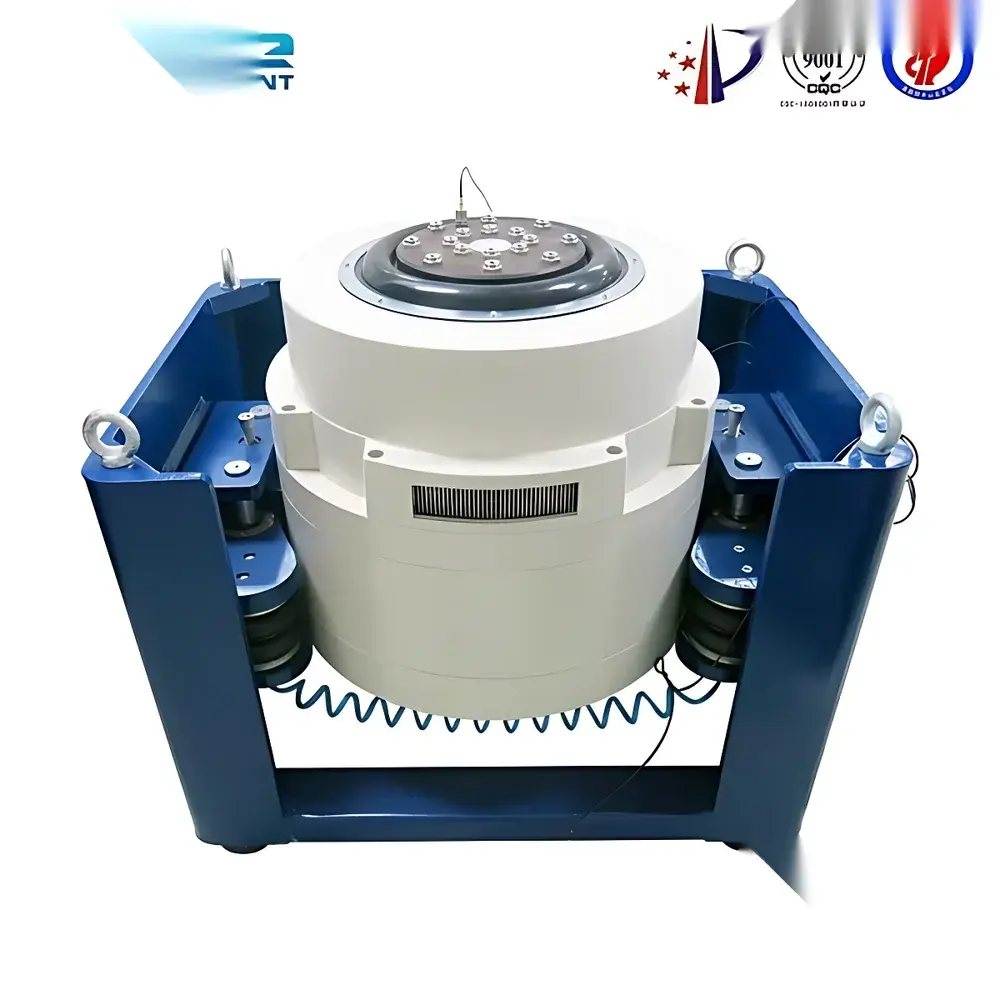
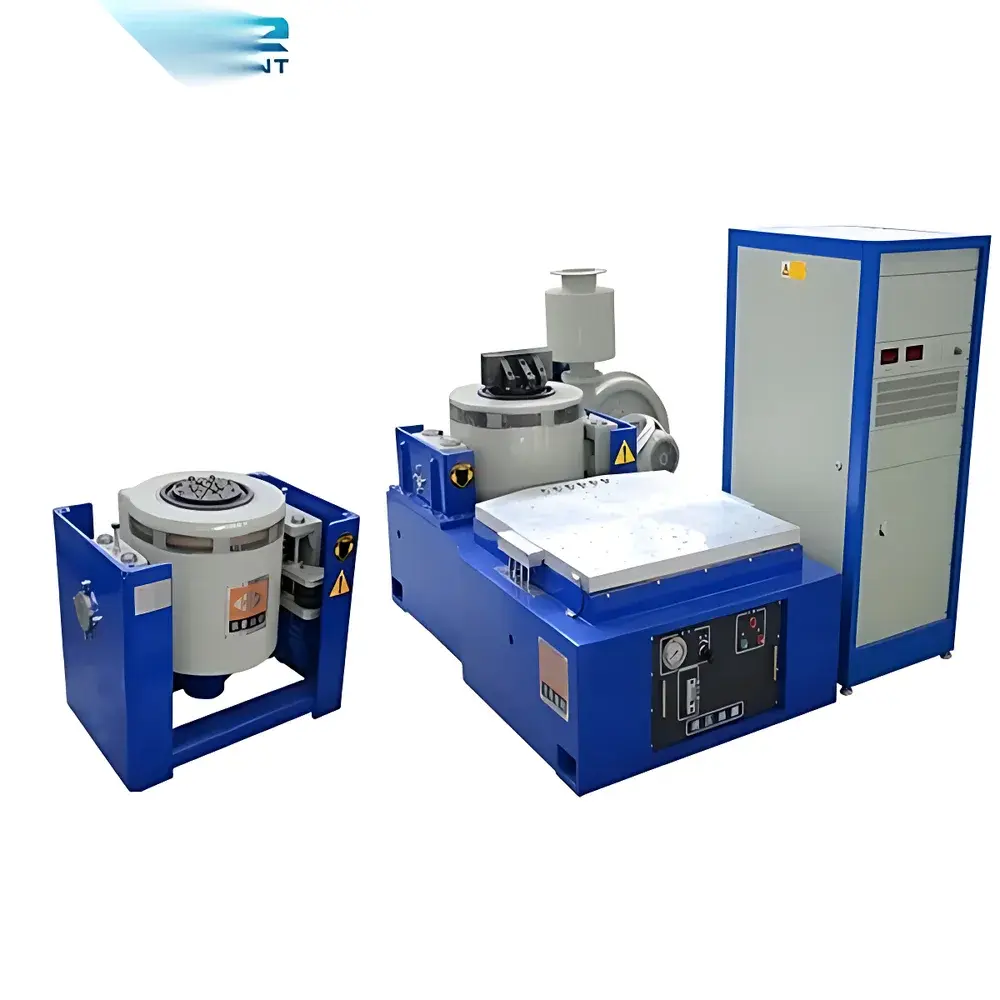
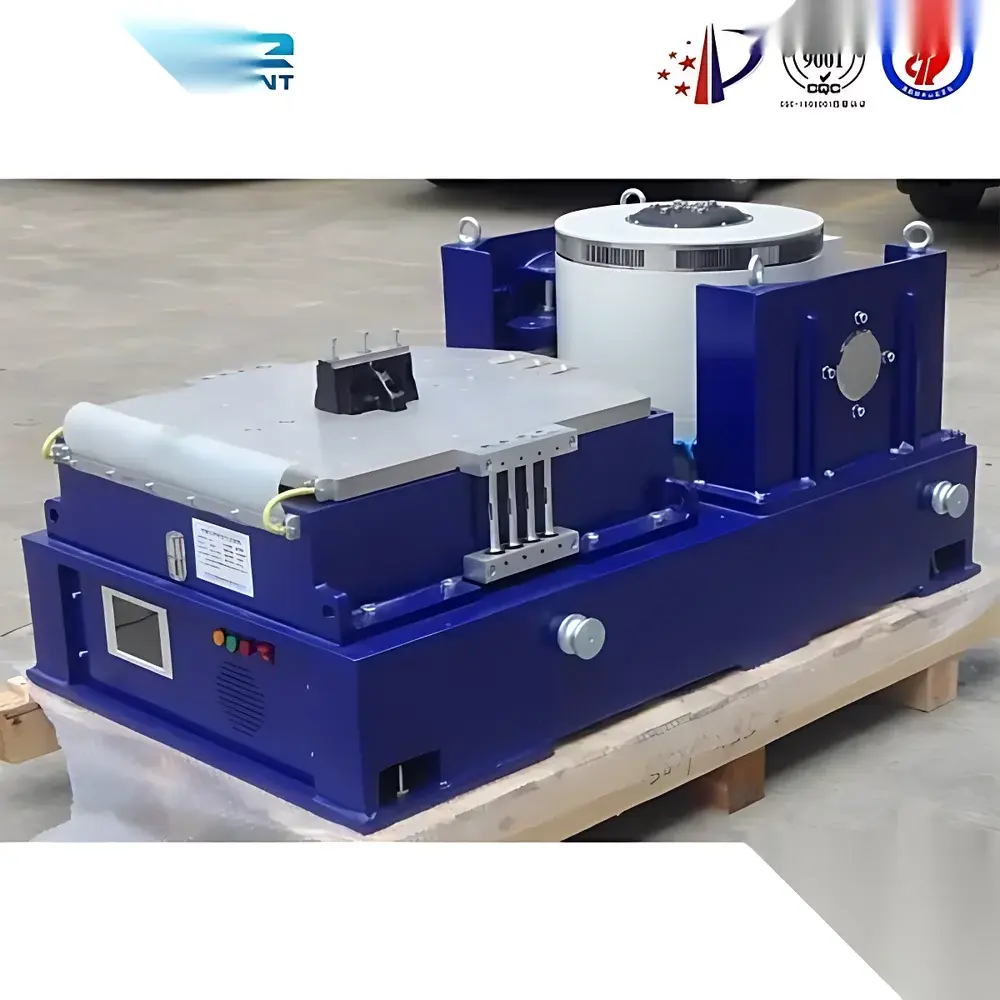
High-Acceleration Vibration Test System
| Brand | Other Brands |
|---|---|
| Origin | Imported |
| Manufacturer Type | Authorized Distributor |
| Price | USD 21,000 (FOB) |
| Frequency Range | 1–5000 Hz (±0.1%) |
| Max. Load Capacity | 100 kg |
| Peak Force Output | 2000 kgf |
| Table Surface Dimensions | 500 × 500 × 6 mm (L × W × H) |
| Table Mounting | 25 × M10 threaded holes + 16 × hook slots (70 mm length) |
| Motion Axes | 6-DOF simultaneous vibration |
| Control Modes | Sine, Random (multi-stage), Road Profile Simulation, Swept Sine, Programmable (15-segment), Octave, Logarithmic, Constant Acceleration, Constant Displacement |
| Display Resolution | 0.01 Hz frequency resolution |
| Communication Interface | RS-485 |
Overview
The High-Acceleration Vibration Test System is an electromechanical shaker platform engineered for accelerated mechanical stress screening of electronic components, automotive modules, aerospace subsystems, and packaged goods subjected to transportation-induced dynamic loads. It operates on the principle of electromagnetic force generation via voice-coil actuators, delivering controlled sinusoidal, random, and synthesized road-simulation excitations across a broad frequency spectrum (1–5000 Hz). Unlike conventional single-axis shakers, this system supports true 6-degree-of-freedom (6-DOF) synchronized motion—enabling realistic replication of multi-directional inertial forces encountered during rail, truck, air, or sea transit. Its structural architecture integrates reinforced base frames, high-stiffness suspension, and precision-balanced moving masses to ensure minimal cross-axis coupling and high reproducibility in acceleration profiles. Designed for compliance with MIL-STD-810H, IEC 60068-2-64, ISO 16750-3, and ASTM D999 test protocols, it serves as a core tool in reliability engineering labs conducting HALT (Highly Accelerated Life Testing), qualification testing, and failure mode analysis.
Key Features
- 6-DOF simultaneous vibration capability—supports coordinated vertical (Z), lateral (Y), and longitudinal (X) axis motion in programmable sequences including sequential two-axis (e.g., Z→Y, Y→X) and full three-axis (Z→Y→X, X→Y→Z) sweeps.
- Multi-mode excitation synthesis: standard sine, swept sine (bidirectional, repeatable), programmable 15-segment waveforms, octave and logarithmic sweep, constant-acceleration and constant-displacement modes, plus multi-stage random vibration with user-defined PSD profiles.
- Realistic road profile emulation: preloaded spectral templates corresponding to Class A–D road surfaces per ISO 8608, enabling direct correlation between lab testing and field durability data.
- High-fidelity actuation: 2000 kgf peak force output with ≤±0.1% frequency accuracy and 0.01 Hz display resolution; optimized resonance management ensures stable operation over extended 720-hour continuous duty cycles.
- Modular table interface: 500 × 500 mm aluminum honeycomb surface featuring 25 × M10 threaded mounting points and 16 × reinforced hook slots (70 mm depth) for secure fixture integration and load distribution.
- RS-485 digital interface enables seamless integration with external data acquisition systems and centralized test management software for remote monitoring and audit-ready logging.
Sample Compatibility & Compliance
The system accommodates test specimens up to 100 kg, with fixture adaptability verified for PCB assemblies, ECUs, battery packs, sensor housings, medical device enclosures, and consumer electronics packaging. All vibration profiles are traceable to international standards including ISO 10326-1 (vibration testing of road vehicles), IEC 60068-2-64 (random vibration), and US Department of Defense standards MIL-STD-810H Method 514.8. The control firmware supports GLP-compliant test execution with timestamped parameter logs, operator ID tagging, and configurable pass/fail thresholds. Optional calibration certificates conforming to ISO/IEC 17025 are available upon request.
Software & Data Management
The embedded controller supports local operation via intuitive touchscreen interface, while optional PC-based software provides advanced waveform design, real-time FFT analysis, transmissibility mapping, and automated report generation (PDF/CSV). Data export includes time-history waveforms, power spectral density (PSD) plots, kurtosis and crest factor metrics, and cycle-count histograms. Audit trails comply with FDA 21 CFR Part 11 requirements when configured with user authentication, electronic signatures, and immutable log archiving. Remote firmware updates and diagnostic telemetry are supported via secure Ethernet connection.
Applications
- Transportation simulation for automotive ECUs, ADAS sensors, and infotainment modules under combined X/Y/Z shock spectra.
- HALT/HASS screening of solder joint integrity, connector retention, and MEMS device stability.
- Package integrity validation per ISTA 3A and ASTM D4169 protocols using synthesized road profiles.
- Structural resonance identification and modal analysis support via swept-sine and transfer function measurement.
- Qualification testing of avionics hardware per RTCA DO-160 Section 8 (vibration).
- Reliability growth testing of industrial IoT gateways and edge computing units deployed in harsh logistics environments.
FAQ
What is the maximum payload capacity without derating performance?
The system maintains full specification compliance (including 2000 kgf peak force and 5000 Hz bandwidth) at loads up to 100 kg when mounted centrally on the 500 × 500 mm table with balanced mass distribution.
Does the system support third-party software integration (e.g., MATLAB, LabVIEW)?
Yes—via RS-485 serial protocol with documented SCPI-style command set; TCP/IP gateway modules are available for Ethernet-based control and data streaming.
How is mechanical cross-talk minimized across axes during 6-DOF operation?
Through proprietary motion coordination algorithms, orthogonal actuator alignment, and real-time feedback compensation using integrated triaxial accelerometers mounted directly on the table surface.
Can road profile tests be customized beyond the built-in ISO 8608 templates?
Yes—users may import custom PSD files in .csv or .sdf format and assign them to specific test segments within programmable sequences.
Is periodic calibration required, and what documentation is provided?
Annual calibration is recommended; factory calibration reports include traceability to NIST standards and uncertainty budgets per ISO/IEC 17025. On-site recalibration services are available globally.



