
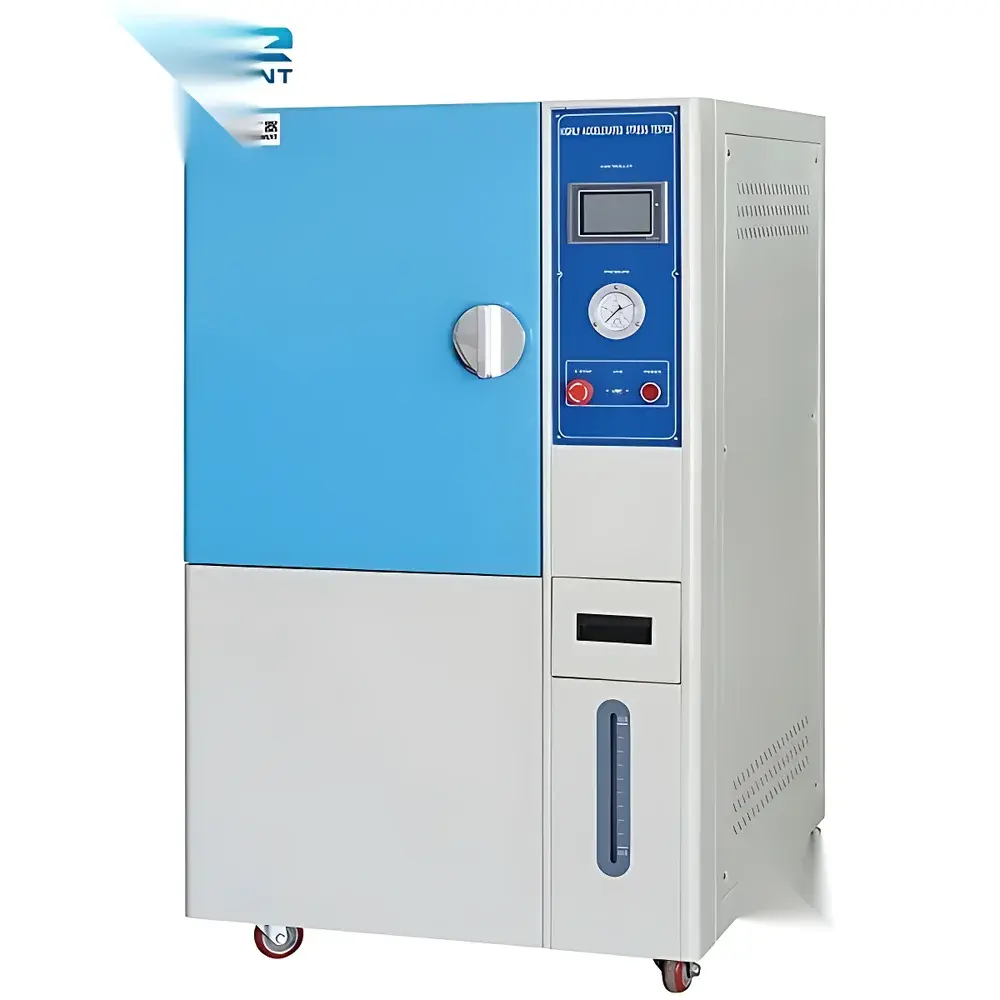
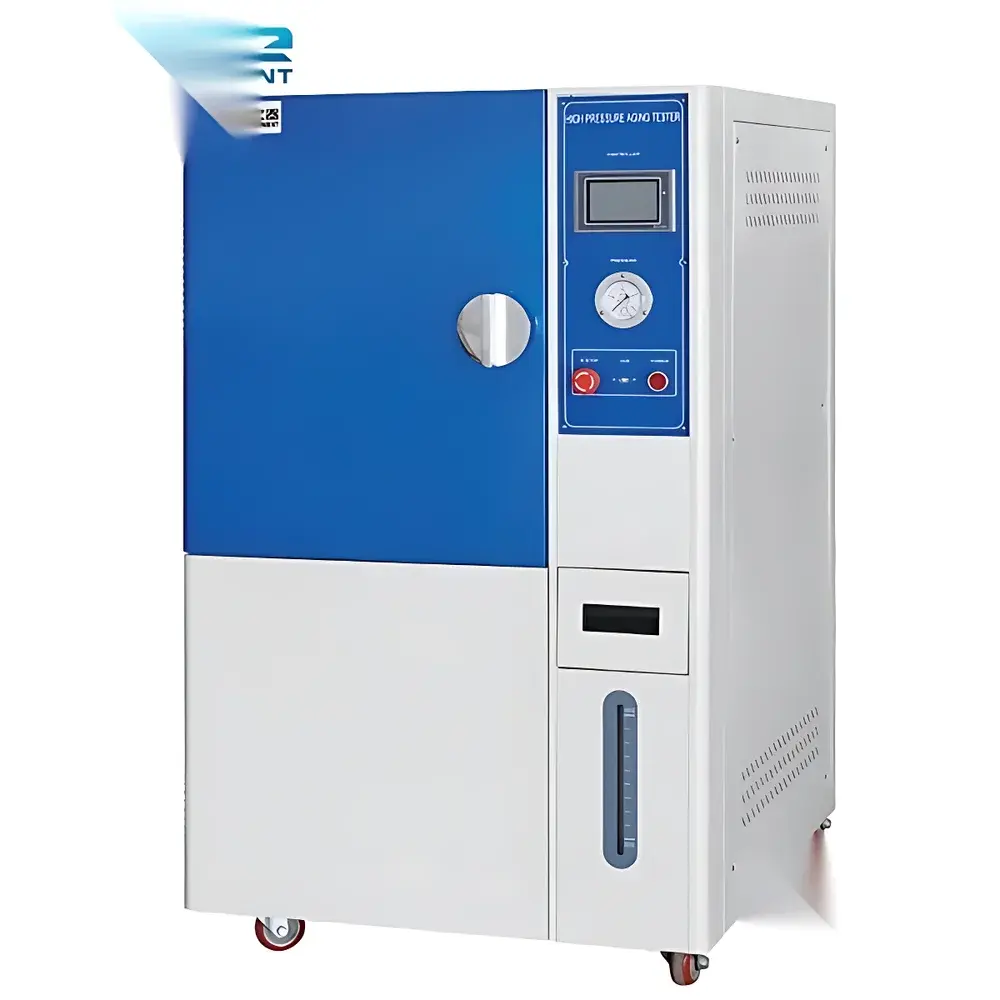
High-Pressure Accelerated Aging Test Chamber (PCT)
| Brand | OEM |
|---|---|
| Origin | Imported |
| Manufacturer Type | Authorized Distributor |
| Price | USD 4,100 (FOB) |
| Internal Dimensions (Φ×D) | 30×45 cm to 60×65 cm |
| Temperature Range | 121°C, 132°C (143°C optional) |
| Saturation Pressure Range | 0–2.0 kg/cm² (abs), up to 3.0 kg/cm² (custom) |
| Humidity | 100% RH (saturated steam) |
| Temp. Uniformity | ≤±2°C |
| Pressure Safety | Overpressure, overtemperature, and low-water interlocks |
| Power Supply | AC 220±5 V / 50±0.5 Hz |
Overview
The High-Pressure Accelerated Aging Test Chamber (PCT) is an engineered environmental stress test system designed to evaluate the long-term reliability and hermetic integrity of electronic components, multilayer PCBs, IC packages, LCD modules, medical device housings, and sealed polymer assemblies under elevated temperature and saturated steam pressure conditions. Operating on the principle of accelerated moisture diffusion under high partial pressure of water vapor, this chamber subjects test specimens to controlled saturated steam environments at temperatures of 121°C, 132°C, or optionally 143°C, combined with absolute pressures ranging from ambient (1 atm) up to 3.0 kg/cm² (≈300 kPa). This replicates and intensifies real-world failure mechanisms—including corrosion of bond wires, delamination at die attach interfaces, popcorning in plastic-encapsulated devices, and hydrolytic degradation of adhesives—within significantly reduced test durations. The PCT chamber conforms to standardized test protocols such as JESD22-A102 (Failure Mechanism and Dielectric Breakdown in Moisture Resistance Testing), MIL-STD-883 Method 1008 (Moisture Resistance), and JEDEC J-STD-020 (Moisture Sensitivity Levels for Nonhermetic Surface-Mount Devices).
Key Features
- Microprocessor-based PID controller for precise regulation of saturated steam temperature, ensuring stability within ±0.5°C during steady-state operation.
- Dual-mode safety interlock system: automatic door locking activated when internal pressure exceeds atmospheric; mechanical anti-blowout door handle design prevents accidental opening under positive pressure.
- Cylindrical stainless-steel inner chamber (AISI 304) engineered to ASME BPVC Section VIII Division 1 pressure vessel standards, minimizing condensate accumulation and eliminating drip onto samples.
- Radially contoured inner liner directs latent heat away from test specimens, reducing thermal shock and improving test repeatability across load configurations.
- Integrated water level monitoring with audible/visual alarm and auto-refill capability; optimized reservoir design supports continuous operation for up to 200 hours per fill cycle.
- LED digital timer with programmable soak duration (0–999 hours), synchronized with pressure ramping and temperature stabilization sequences.
- Front-panel analog pressure gauge (±0.05 kg/cm² resolution) and digital temperature display provide real-time operational verification independent of control logic.
Sample Compatibility & Compliance
This PCT chamber accommodates a broad range of sample geometries—from individual IC trays and SMT component reels to assembled automotive ECUs and medical sensor housings—via customizable stainless-steel sample racks (standard configuration includes two adjustable shelves). All internal surfaces are electropolished and passivated to prevent iron contamination and chloride-induced pitting. The system meets ISO/IEC 17025 calibration traceability requirements when operated with NIST-traceable temperature and pressure transducers. It supports GLP-compliant test documentation when paired with optional audit-trail-enabled data logging software (see Software & Data Management section). Regulatory alignment includes compliance with IEC 60068-2-66 (Test Db: Damp Heat, Steady State, High Pressure), IPC-9701A (Performance Requirements for Lead-Free Solder Attachments), and ASTM F1980 (Accelerated Aging of Sterile Barrier Systems for Medical Devices).
Software & Data Management
While the base unit operates via embedded microcontroller interface, optional Ethernet- or USB-connected data acquisition modules enable real-time recording of chamber temperature, absolute pressure, elapsed time, and water level status at user-defined intervals (1–60 s). Exported CSV files include timestamps aligned to UTC and support post-test statistical analysis using JMP, Minitab, or Python-based reliability modeling (Weibull, Arrhenius, Eyring). Optional software packages provide FDA 21 CFR Part 11-compliant electronic signatures, role-based access control, and automated report generation compliant with ISO 13485 Annex A. All firmware updates are delivered via secure HTTPS and validated against SHA-256 checksums prior to installation.
Applications
- Qualification testing of moisture-sensitive devices (MSL Level 2a–6) per JEDEC J-STD-020.
- Reliability screening of automotive electronics subjected to under-hood thermal cycling and humidity ingress.
- Validation of hermetic seal integrity for implantable medical devices and diagnostic cartridges.
- Accelerated life testing of OLED encapsulation layers and flexible printed circuit laminates.
- Process validation for conformal coating application and reflow soldering parameters.
- Material compatibility assessment of adhesives, potting compounds, and gasket elastomers under steam aging.
FAQ
What pressure units does the chamber display and control in?
The chamber uses kg/cm² (absolute) as the primary pressure unit, with full-scale range selectable between 0–2.0 kg/cm² standard or 0–3.0 kg/cm² for custom configurations. Conversion to kPa (1 kg/cm² = 98.0665 kPa) or psi (1 kg/cm² ≈ 14.22 psi) is supported in data export logs.
Is the chamber suitable for testing lithium-ion battery cells?
No. This PCT system is not certified for testing pressurized electrochemical cells. Battery safety testing requires UL 1642/IEC 62133-compliant explosion-proof enclosures with gas venting and flame arrestors.
Can the chamber be integrated into a factory MES or LIMS environment?
Yes. Optional Modbus TCP or OPC UA server modules allow bidirectional communication with enterprise manufacturing execution systems for automated job dispatch, result upload, and equipment utilization tracking.
What maintenance is required to ensure long-term calibration stability?
Annual verification of temperature sensors (PT100 Class A) and pressure transducers (0.1% FS accuracy) using accredited third-party calibration labs is recommended. Quarterly inspection of door gasket compression force and steam trap functionality is advised per preventive maintenance schedule.



