
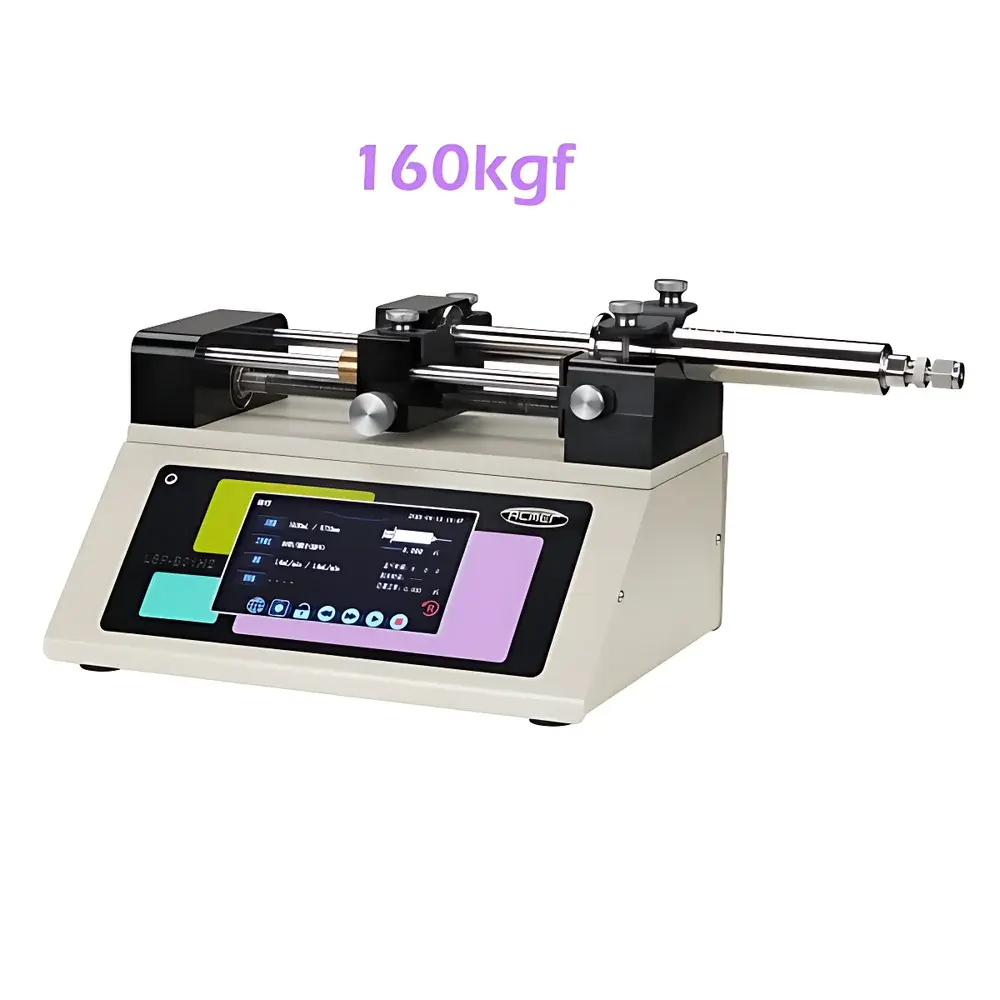
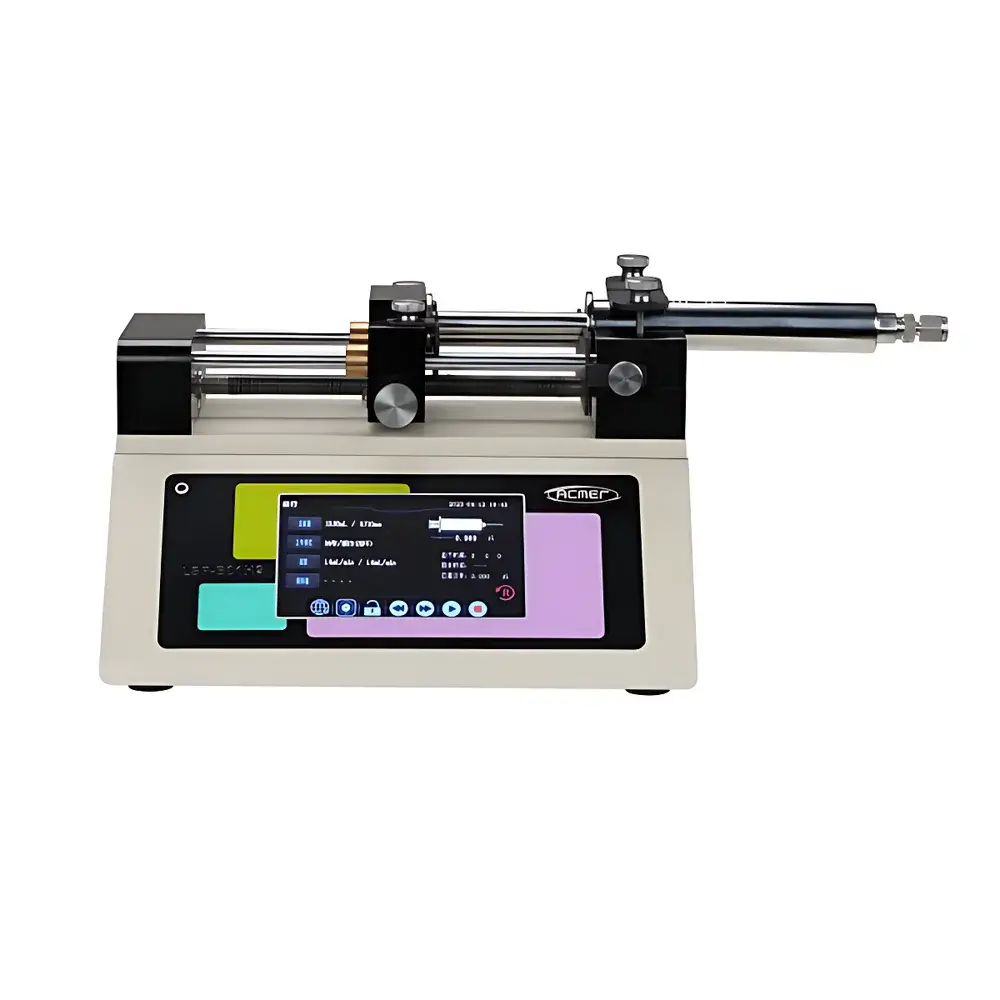
High-Pressure Syringe Pump LSP-B01H2 by Acmer
| Brand | Acmer |
|---|---|
| Model | LSP-B01H2 |
| Type | Micro-syringe Pump |
| Flow Rate Range | 1.426 nL/min to 30.41 mL/min |
| Accuracy | ±0.5% |
| Repeatability | ±0.05% |
| Display | 5-inch HD Touchscreen |
| Calibration | User-performed syringe calibration with parameter storage |
| Control Interface | RS485 or USB (configurable address & baud rate) |
| External Control | TTL-compatible digital input (5–24 V DC or dry contact) |
| Status Outputs | Real-time run/stop and direction signals |
| Power Recovery | Auto-resume from last operational state after power interruption |
Overview
The Acmer LSP-B01H2 High-Pressure Syringe Pump is an engineered precision fluid delivery system designed for demanding laboratory applications requiring stable, low-pulsation, and highly repeatable micro-to-milliliter-scale volumetric dosing. Based on stepper motor-driven linear actuation and closed-loop position feedback, the pump operates on a positive displacement principle—translating precise rotational steps into controlled plunger displacement within standard Luer-lock syringes. Its high-pressure capability (up to 100 MPa, depending on syringe specification and configuration) enables compatibility with viscous fluids, high-backpressure chromatographic systems, microfluidic devices, and capillary electrophoresis setups. The LSP-B01H2 is not intended for clinical or in vivo use; it complies with IEC 61010-1:2010 for safety in laboratory electrical equipment and meets EMC requirements per EN 61326-1:2013.
Key Features
- 5-inch HD capacitive touchscreen interface: Intuitive graphical navigation with real-time visualization of flow rate, infused volume, elapsed time, direction, and system status—optimized for glove-compatible operation in cleanroom or fume hood environments.
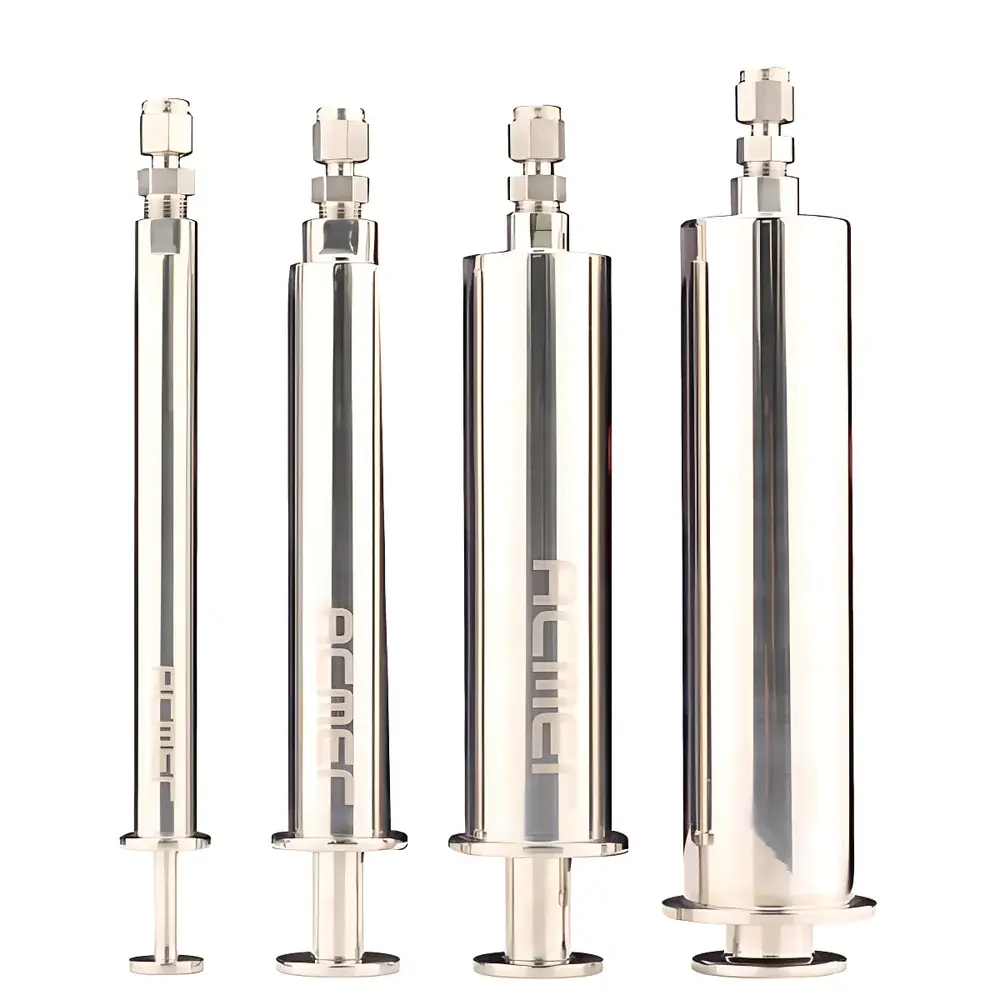
- Comprehensive syringe compatibility: Preloaded profiles for common glass and plastic syringes (e.g., 10 µL to 100 mL); supports user-defined syringe geometry input—including barrel inner diameter and plunger travel length—for accurate volumetric conversion.
- On-device calibration routine: Enables end-user verification and correction of mechanical backlash and step-loss anomalies; calibrated parameters are stored per syringe ID to ensure traceability across multiple instruments or shared lab environments.
- Multi-phase programmable protocol engine: Supports up to 16 sequential steps per program, including infusion, withdrawal, pause, and interval cycles—with independent setting of target volume, flow rate, dwell time, and repetition count for each phase.
- Live flow rate adjustment: Permits dynamic modification of flow rate during active operation without halting the motor or resetting accumulated volume—critical for gradient elution or responsive microinjection protocols.
- Non-volatile operational memory: Automatically saves current position, speed, direction, and phase index upon power loss; resumes execution from the exact point of interruption upon power restoration—eliminating manual repositioning or volume recalibration.
- Dual-mode external control interface: Accepts either voltage-level (5–24 V DC) or isolated dry-contact triggers for start/stop commands; synchronized status outputs (TTL-level) provide hardware-level confirmation of pump state to PLCs or DAQ systems.
Sample Compatibility & Compliance
The LSP-B01H2 accommodates all Luer-lock syringes meeting ISO 8537 and ISO 594 standards. Users must select syringes rated for the intended pressure and chemical compatibility—particularly when handling organic solvents, strong acids/bases, or suspensions. While the pump itself does not impose fluid restrictions, Acmer recommends verifying syringe material (e.g., borosilicate glass, polypropylene, PTFE-coated metal) against application-specific corrosion and leaching requirements. The instrument adheres to GLP documentation principles: all calibration events, parameter changes, and runtime logs can be exported via USB for audit trail generation. Though not FDA 21 CFR Part 11 certified out-of-the-box, its deterministic behavior, parameter locking capability, and timestamped event logging support validation under internal SOPs aligned with ISO/IEC 17025 and ASTM E2500.
Software & Data Management
Local operation requires no PC software—the touchscreen provides full standalone functionality. For integration into automated workflows, the optional RS485 Modbus RTU interface enables bidirectional communication with SCADA systems, LabVIEW VIs, or Python-based control scripts (PySerial + Modbus libraries). USB CDC mode offers virtual COM port emulation for legacy serial command sets (ASCII-based SCPI-like syntax). All configuration changes—including syringe ID assignment, calibration offsets, and protocol uploads—are timestamped and retained in non-volatile memory. Data export (CSV-formatted runtime logs) is supported via USB mass storage mode, with fields including epoch timestamp, commanded vs. actual flow rate, cumulative volume, motor current, and error flags.
Applications
- Controlled reagent delivery in HPLC and UHPLC sample introduction loops
- Steady-state perfusion in organ-on-chip and microphysiological systems
- Precise dopant injection in semiconductor wafer processing R&D
- Calibration fluid dispensing for flow sensor validation (e.g., thermal mass flow meters)
- Time-resolved kinetic studies requiring sub-microliter bolus injection into stopped-flow spectrometers
- Automated solvent exchange in cryo-EM grid preparation workflows
- Multi-syringe coordination in parallel reaction screening platforms
FAQ
What syringe sizes are supported?
Syringes from 10 µL to 100 mL are supported, provided they conform to ISO 8537 dimensions and feature a Luer-lock termination. Custom geometries may be entered manually.
Does the pump support gradient or ramped flow profiles?
Yes—multi-step programs allow discrete flow rate changes between phases; continuous ramping is not implemented, but 16-step linear approximations suffice for most analytical gradients.
Can I integrate this pump into a larger automated system?
Yes—RS485 Modbus RTU and USB CDC interfaces enable deterministic command-response communication with industrial controllers, custom GUIs, or Python-based orchestration frameworks.
Is firmware update capability available?
Firmware updates are performed via USB using Acmer-provided utility software; version history and release notes are published on the official Acmer technical support portal.
What maintenance is required?
Routine inspection of syringe mount alignment and lead screw lubrication every 500 hours of operation; no scheduled replacement parts are required within the first 5,000 operating hours under normal load conditions.



