
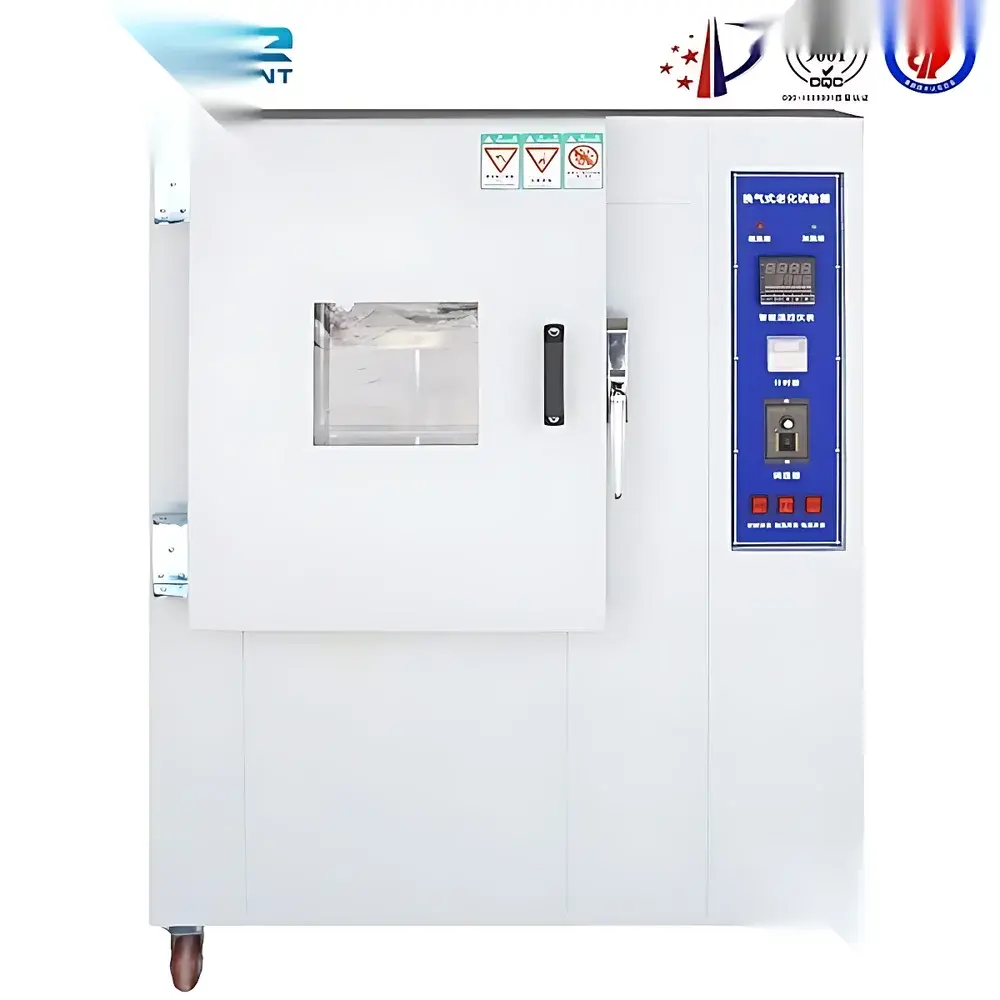
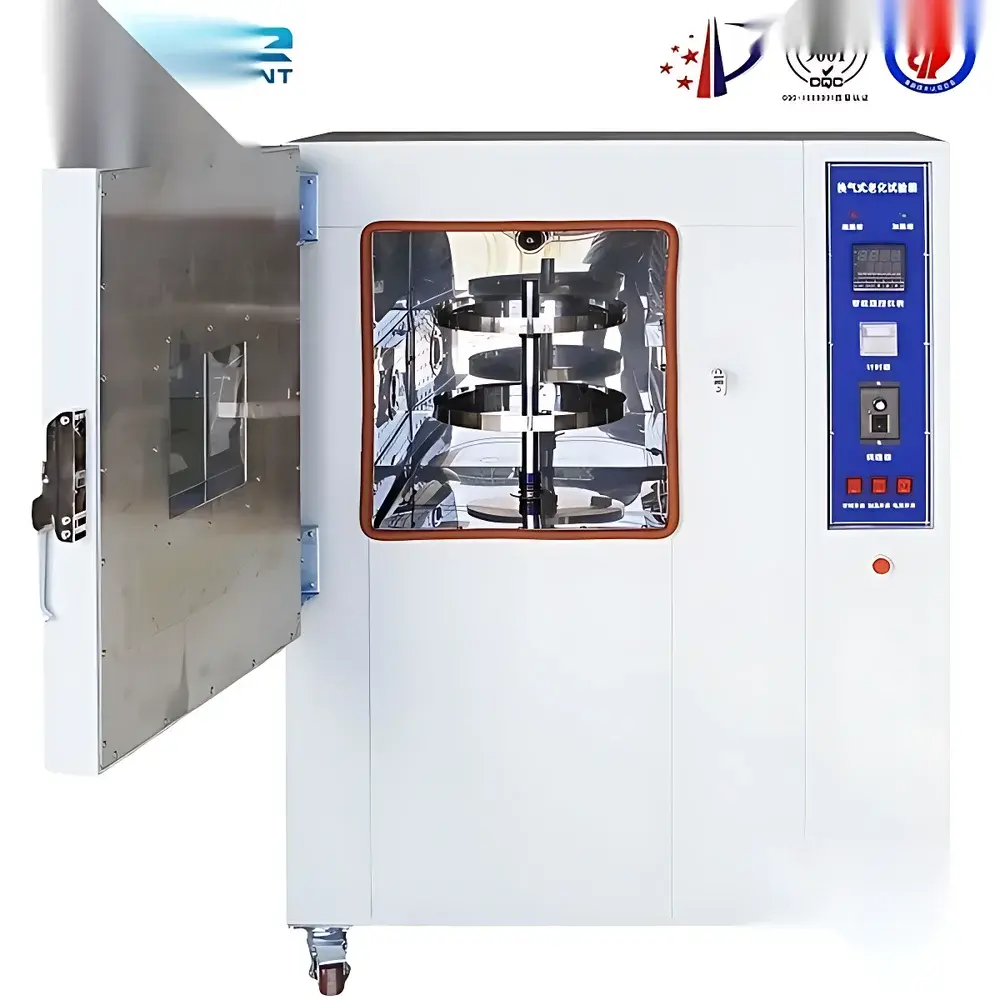
High Temperature Aging Test Chamber OK-HQ Series (ASTM D5423/D5374 Compliant)
| Key | Brand: OEM |
|---|---|
| Origin | Imported |
| Construction | SUS304 Inner Chamber, A3 Steel Outer Casing w/ Powder Coating |
| Temperature Range | RT+10°C to 200°C / 300°C |
| Uniformity | ±2°C |
| Temperature Stability | ±0.5°C |
| Air Exchange Rate | 2–100 cycles/hour |
| Exchange Timing | 1 min – 99 h adjustable |
| Power | 4.0–9.0 kW (model-dependent) |
| Internal Dimensions | 450×450×500 mm to 800×1000×1000 mm |
| Insulation | High-Density Glass Fiber Mat |
| Air Circulation | Horizontal Forced Convection w/ Adjustable Baffles |
| Controller | PID + SSR Microprocessor-Based Digital Controller |
| Timer Range | 1–9999 min |
| Safety Protections | Overtemperature, Overcurrent, Leakage, Motor Overheat, Short-Circuit |
| Compliance | ASTM D5423-09 (Type II), ASTM D5374-05, UL 1581, GB/T 2423.2, IEC 60068-2-2, JIS C 0021, VDE 0470 |
Overview
The OK-HQ Series High Temperature Aging Test Chamber is an engineered environmental test system designed for accelerated thermal aging evaluation of polymeric and elastomeric materials under controlled air exchange conditions. It operates on the principle of forced convection heating with programmable ventilation—enabling precise simulation of real-world oxidative degradation mechanisms induced by elevated temperature and ambient air renewal. Unlike static oven environments, this chamber integrates a calibrated air exchange mechanism compliant with ASTM D5423-09 (Type II) and ASTM D5374-05, making it suitable for standardized aging protocols required in wire & cable insulation qualification (e.g., UL 1581), rubber compound development, and plastic stability assessment per IEC 60068-2-2 and GB/T 2423.2. The chamber maintains stable thermal profiles across its working volume through horizontal airflow distribution, minimizing vertical thermal gradients and ensuring reproducible aging kinetics across multiple samples.
Key Features
- Precision-engineered air exchange regulation system with digital flow calibration capability (2–100 air changes per hour), supporting quantitative aging rate studies;
- Horizontal forced-air circulation architecture with adjustable internal baffles and high-temperature-rated centrifugal blower—ensuring ±2°C temperature uniformity and ±0.5°C stability at setpoint;
- SUS304 stainless steel inner chamber (mirror-finish or argon arc welded) and powder-coated A3 steel outer casing—resistant to oxidation, corrosion, and long-term thermal cycling;
- Microprocessor-based PID + SSR temperature controller with 0.1°C resolution for both setpoint and display; integrated timer (1–9999 minutes) with auto-stop and alarm functions;
- Double-layer tempered observation window with built-in LED lighting—enabling continuous visual monitoring without thermal disturbance;
- Energy-efficient insulation using high-density, low-conductivity glass fiber mat (≥80 mm thickness), minimizing standby heat loss and operational power demand;
- Standardized 50 mm diameter test port on left sidewall for external sensor feedthrough, power supply routing, or data acquisition line integration;
- Optional rotating sample platform (Φ250–Φ700 mm) for uniform exposure of asymmetric specimens during extended aging cycles.
Sample Compatibility & Compliance
The OK-HQ chamber accommodates a broad range of non-volatile, thermally stable specimens including insulated wires, elastomeric seals, textile laminates, molded plastic components, and coated fabrics. Its design supports pre- and post-aging mechanical property correlation (e.g., tensile strength retention, elongation at break, hardness shift) as defined in ASTM D412, ISO 37, and GB/T 528. Regulatory alignment includes full conformance with ASTM D5423-09 (Type II laboratory oven specification for electrical insulating materials), ASTM D5374-05 (standard practice for oven aging of electrical insulation), UL 1581 Section 1060, and harmonized national standards (GB/T 2951.12, JIS C 0021, VDE 0470-1). All models undergo factory verification per ISO/IEC 17025 traceable procedures for temperature uniformity and air exchange rate accuracy prior to shipment.
Software & Data Management
While the base configuration employs a standalone LED/PID controller, optional RS485/Modbus RTU interface enables integration into centralized laboratory data acquisition systems (e.g., LabVIEW, WinCC, or custom SCADA platforms). Real-time temperature logging, event-triggered alarms (e.g., overtemperature, door open, fan failure), and audit-trail-capable parameter change records can be implemented via third-party software compliant with FDA 21 CFR Part 11 requirements when paired with validated electronic signature modules. Calibration certificates—including as-found/as-left temperature mapping reports—are provided with each unit, supporting GLP/GMP documentation workflows.
Applications
- Accelerated aging of PVC, PE, XLPE, EPR, and silicone-insulated cables per UL 1581 and IEC 60811-501;
- Oxidative stability screening of automotive rubber hoses, gaskets, and under-hood components;
- Thermal endurance classification of insulating varnishes and impregnating resins (IEC 60216);
- Pre-compliance testing for RoHS-compliant material decomposition behavior at elevated temperatures;
- Validation of shelf-life predictions for medical device polymer housings (ISO 11607-1);
- Material selection support for aerospace wiring harnesses operating in sustained thermal environments.
FAQ
What standards does the OK-HQ chamber specifically meet for wire insulation testing?
It fully satisfies ASTM D5423-09 (Type II), ASTM D5374-05, UL 1581 Section 1060, and GB/T 2951.12 for forced-air thermal aging of electrical insulation.
Can the air exchange rate be verified independently after installation?
Yes—each unit includes calibrated airflow measurement ports and supports validation using traceable anemometry or tracer gas dilution methods per ASTM E742.
Is the chamber suitable for testing volatile organic compounds (VOCs)?
No—this system is not equipped with exhaust scrubbing or VOC containment; it is intended for non-emissive solid polymer aging only.
What maintenance intervals are recommended for long-term reliability?
Blower motor lubrication every 12 months, filter inspection quarterly, and annual temperature uniformity mapping per ISO/IEC 17025 guidelines.
Does the controller support multi-segment ramp-soak profiles?
The standard LED/PID controller supports single-setpoint operation with timer-based hold; multi-step profiling requires optional PLC upgrade with HMI interface.



