
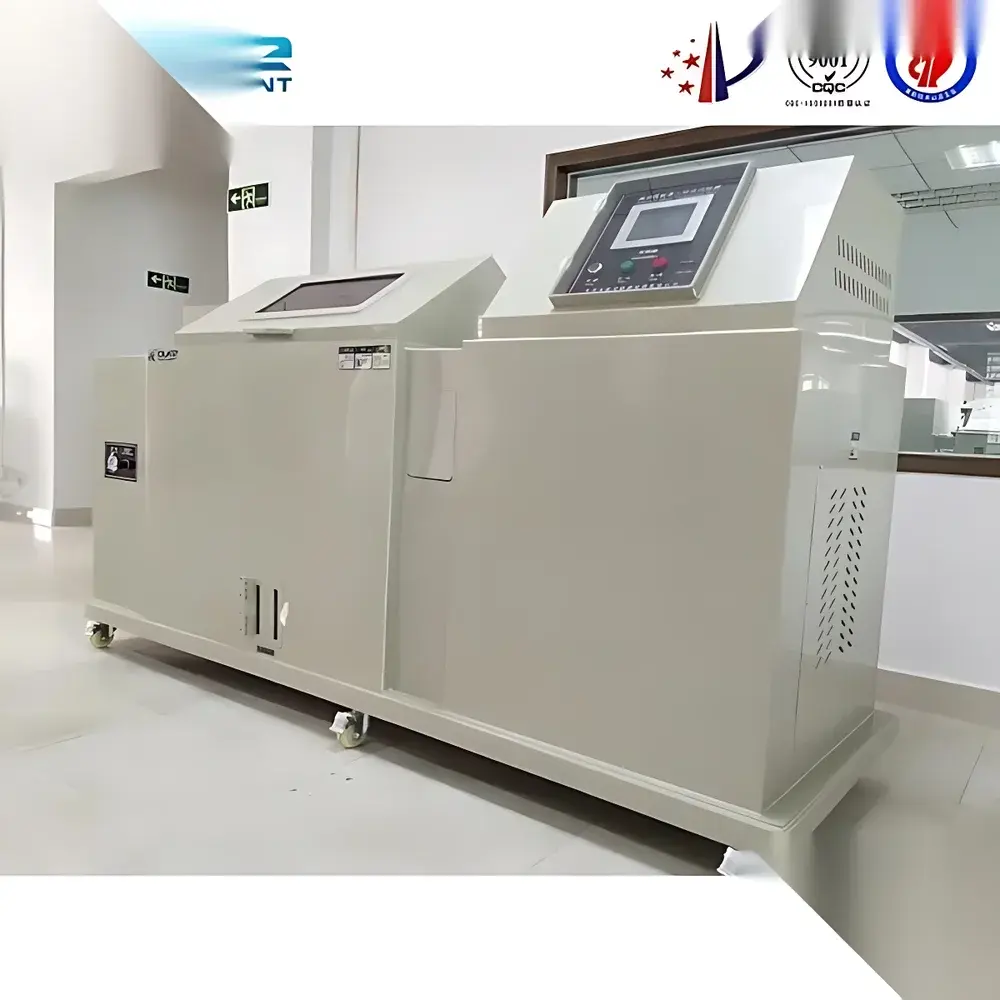
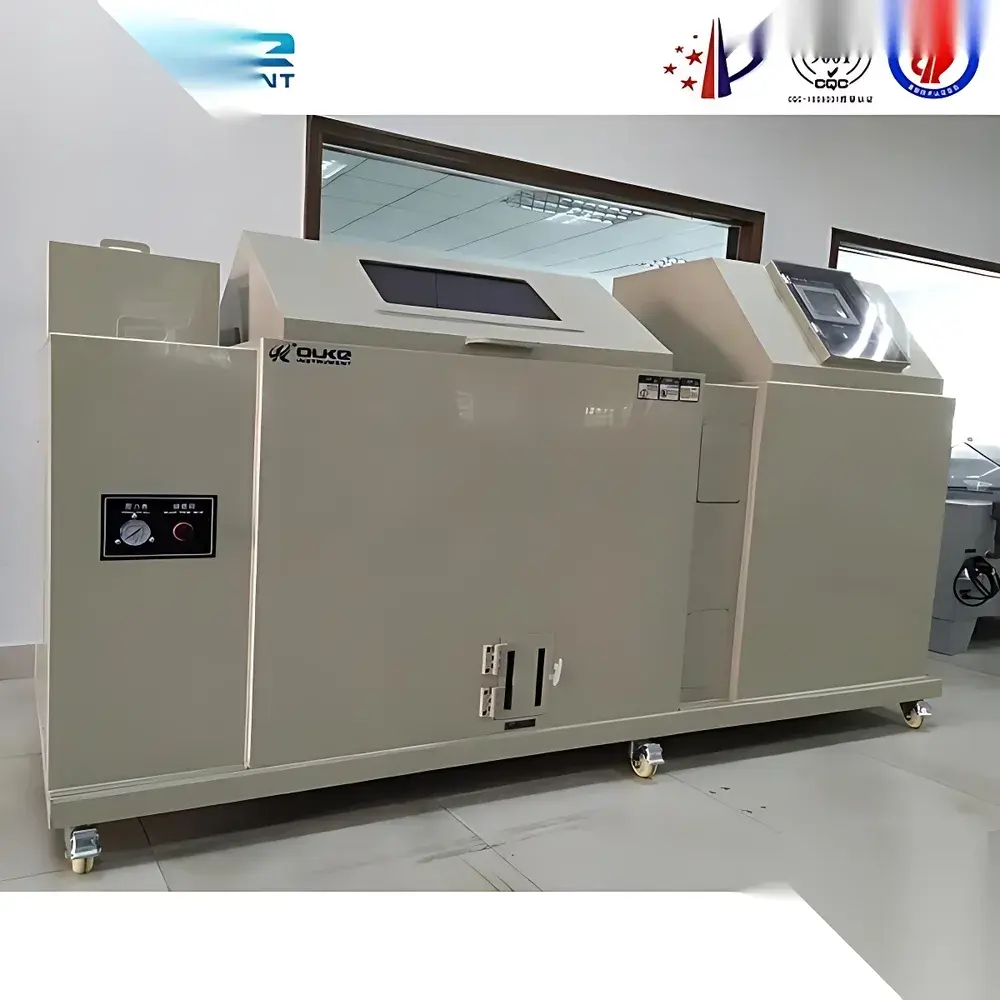
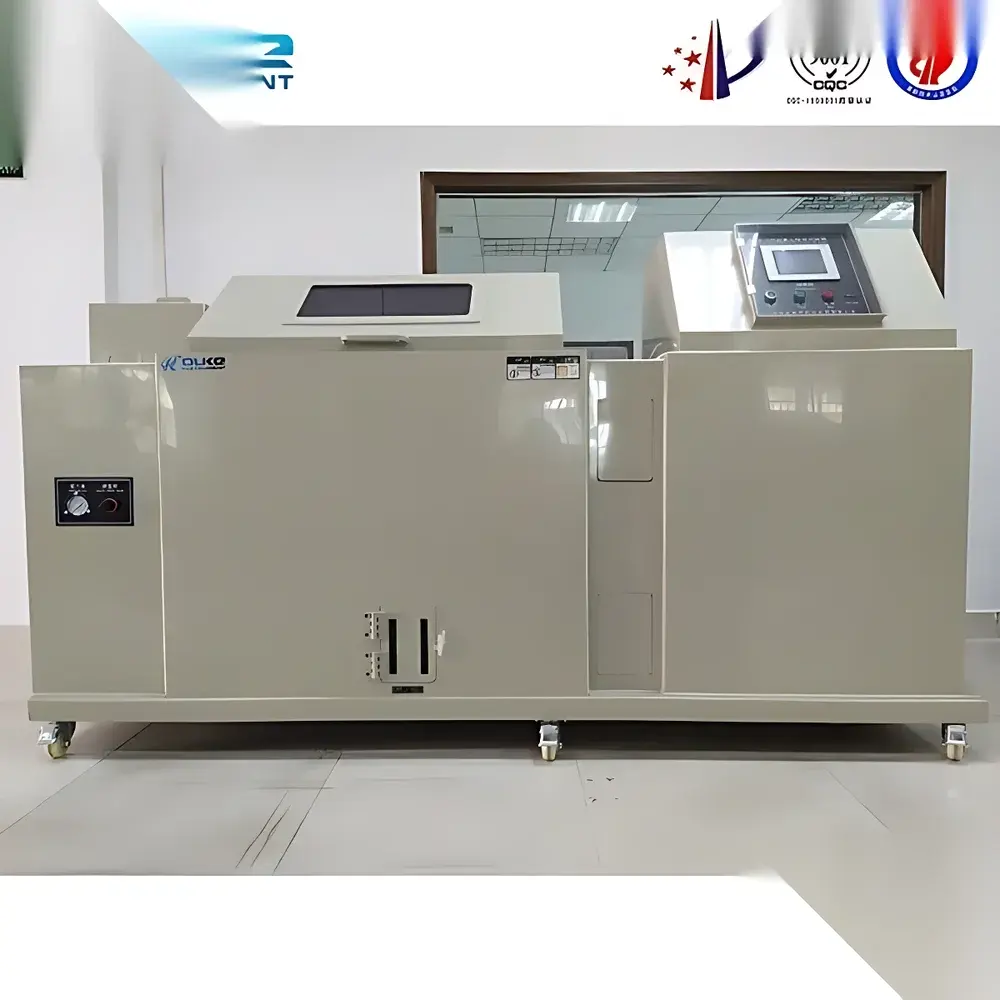
High-Temperature High-Humidity Corrosion Test Chamber
| Brand | OEM |
|---|---|
| Origin | Imported |
| Manufacturer Type | Authorized Distributor |
| Price | USD 21,000 (FOB) |
| Internal Chamber Dimensions (W×D×H) | 600 × 450 × 400 mm |
| Test Temperature Range | 35–50 °C (Chamber), 47–63 °C (Saturated Air Tank) |
| Temperature Uniformity | ±0.5 °C |
| Temperature Control Accuracy | ±0.1 °C (PID Digital Controller) |
| Humidity Control Method | Saturated Air Tank (Henry’s Law Principle) |
| Spray Nozzle Material | Borosilicate Glass (PYREX®) |
| Spray Mode | Continuous (ASTM B117) or Cyclic (GB/T 2423.17, GJB 150.11A, DIN 50021) |
| Safety Features | Dual Over-Temperature Protection, Auto Water-Level Detection & Refill, Crystallization-Free Fog Distribution |
| Heating System | Jacketed Water Bath with Titanium-Sheathed Infrared Heaters (Ni-Cr Core) |
| Compliance | GB/T 2423.17, GB/T 10587, GJB 150.11A, ASTM B117, ISO 9227, DIN 50021 |
Overview
The High-Temperature High-Humidity Corrosion Test Chamber is an engineered environmental simulation system designed to accelerate corrosion mechanisms under controlled, repeatable conditions—specifically targeting synergistic degradation pathways induced by elevated temperature, high relative humidity, and chloride-laden aerosol exposure. Unlike standalone salt spray chambers, this chamber integrates precise thermal-hygrometric coupling via a saturated air tank operating per Henry’s Law principles, enabling stable and traceable humidity generation at elevated temperatures (up to 63 °C in the saturation vessel). The chamber conforms to internationally recognized test standards including ASTM B117 (continuous salt fog), ISO 9227 (neutral salt spray), GB/T 2423.17 (Ka test for electrical products), GJB 150.11A (military-grade cyclic corrosion), and DIN 50021 (condensation-controlled salt mist). Its primary function is to evaluate material resistance to combined thermal, hygric, and electrochemical stress—critical for validating coatings, metallic substrates, electronic enclosures, aerospace fasteners, and marine-grade components prior to field deployment.
Key Features
- Integrated dual-zone thermal control: independently regulated test chamber (35–50 °C) and saturated air tank (47–63 °C) for precise humidity setpoint reproducibility.
- PYREX® borosilicate glass spray nozzles ensure uniform, non-crystallizing fog distribution with natural gravitational deposition—eliminating nozzle clogging and ensuring consistent salt deposit morphology per ISO 9227 Annex A.
- Water-jacketed heating system with titanium-sheathed infrared heating elements (Ni-Cr core) delivers rapid thermal response (<15 min to stabilize at 50 °C), superior temperature uniformity (±0.5 °C across working volume), and ~50% lower energy consumption versus traditional fiberglass-insulated jacketed chambers.
- Digital PID temperature controller with ±0.1 °C accuracy and real-time logging capability; supports both continuous (ASTM-compliant) and programmable cyclic salt fog protocols (e.g., wet/dry/humidity phases per GJB 150.11A).
- Automated water-level management: capacitive level sensing triggers auxiliary reservoir refill without interrupting test cycles—ensuring uninterrupted long-duration testing up to 1,000 hours.
- Dual independent over-temperature protection circuits (mechanical and electronic) plus visual/audible alarms for saturation tank dry-run prevention and chamber thermal runaway mitigation.
Sample Compatibility & Compliance
The chamber accommodates standard test specimens up to 600 × 450 × 400 mm (W×D×H), supporting flat panels, assembled PCBs, coated fasteners, and small mechanical assemblies. Fixtures are compatible with ASTM D610-rated scribe lines and ISO 10289 evaluation grids. All operational parameters—including spray rate (1.0–2.0 mL/80 cm²/h), pH (6.5–7.2 for neutral salt solution), and collection uniformity (verified via 5-collector array per ASTM B117)—are fully adjustable and documented for audit readiness. The system supports GLP-compliant test execution when paired with validated software: full traceability of setpoints, deviations, alarm events, and manual interventions satisfies FDA 21 CFR Part 11 requirements for electronic records and signatures.
Software & Data Management
Equipped with embedded RS-485/Modbus RTU interface and optional Ethernet module, the chamber integrates into centralized laboratory monitoring systems (e.g., LabVantage, Siemens Desigo, or custom SCADA). Local touchscreen HMI logs all critical parameters at 10-second intervals, stores ≥30 days of compressed data onboard, and exports CSV/Excel reports with UTC timestamps. Optional validation package includes IQ/OQ documentation templates aligned with ISO/IEC 17025 and ASTM E2500-22 guidelines. Audit trails record user logins, parameter changes, and calibration events—enabling full compliance with GMP, IATF 16949, and AS9100 revision D quality management systems.
Applications
- Accelerated corrosion screening of automotive under-hood components (brackets, sensors, wiring harnesses) per ISO 16750-4 and SAE J2334.
- Qualification of conformal coatings on military avionics per MIL-STD-810H Method 509.6.
- Comparative evaluation of zinc-nickel vs. trivalent chromium plating performance under combined thermal-hygric-chloride stress.
- Reliability assessment of consumer electronics housings (e.g., IP67-rated enclosures) subjected to coastal/marine service environments.
- Validation of sealant adhesion integrity on aluminum extrusions used in architectural curtain walls (per AAMA 2604/2605).
FAQ
What standards does this chamber support for cyclic corrosion testing?
It natively executes GB/T 2423.17 (Ka), GJB 150.11A (Method II), and ISO 14993 protocols—each configurable via the built-in cycle editor with up to 99 phase steps.
Is the saturated air tank temperature independently controllable?
Yes—the saturation vessel features dedicated PID control with separate sensor feedback, enabling precise decoupling from chamber temperature for accurate RH derivation.
Can the chamber be validated for ISO/IEC 17025 accredited testing?
Absolutely—factory-provided temperature mapping reports (per ASTM E2297), spray uniformity verification kits, and IQ/OQ documentation packages are available upon request.
What maintenance intervals are recommended for long-term reliability?
Daily visual inspection of nozzle integrity and water level; quarterly calibration of temperature sensors and spray rate verification using ASTM-certified collectors; annual thermocouple replacement and saturation tank descaling per manufacturer SOP.
Does the system meet electromagnetic compatibility (EMC) requirements for lab integration?
Yes—it complies with EN 61326-1:2013 for laboratory equipment emissions and immunity, with CE marking and RoHS 3 certification included in delivery documentation.



