
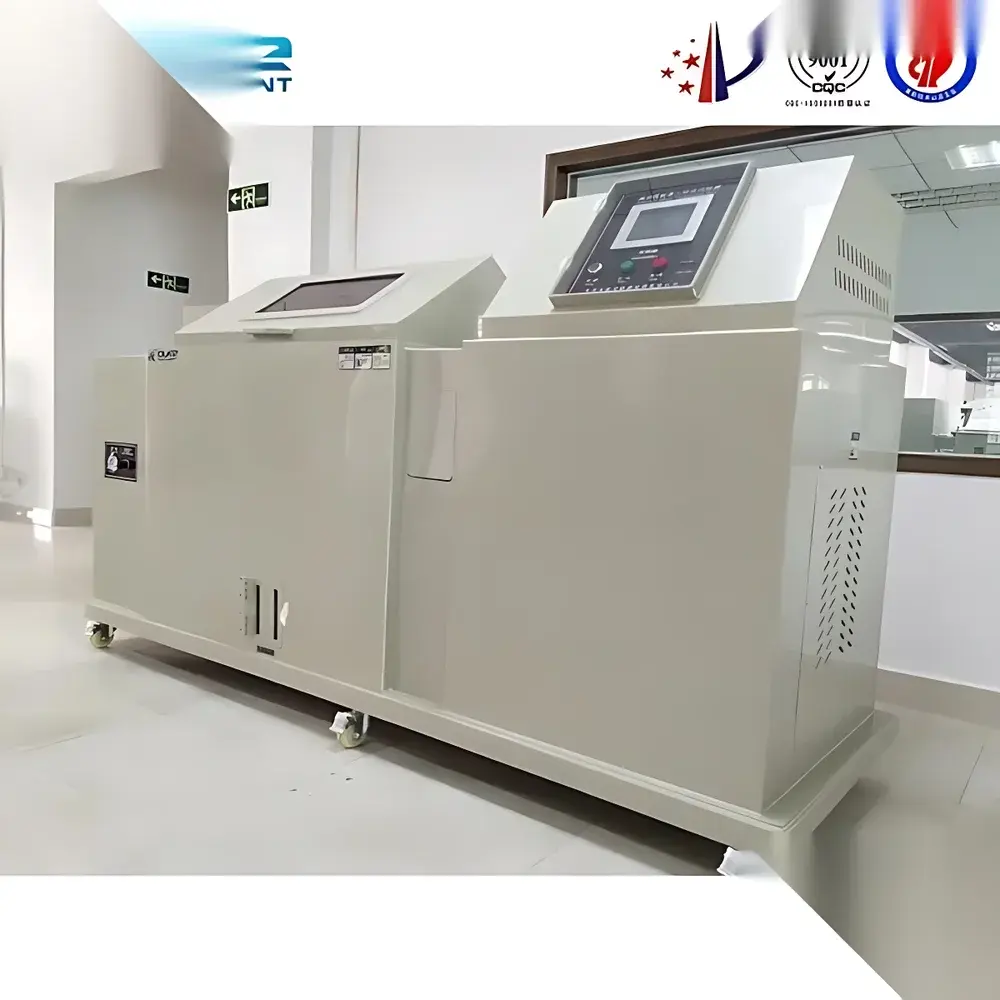
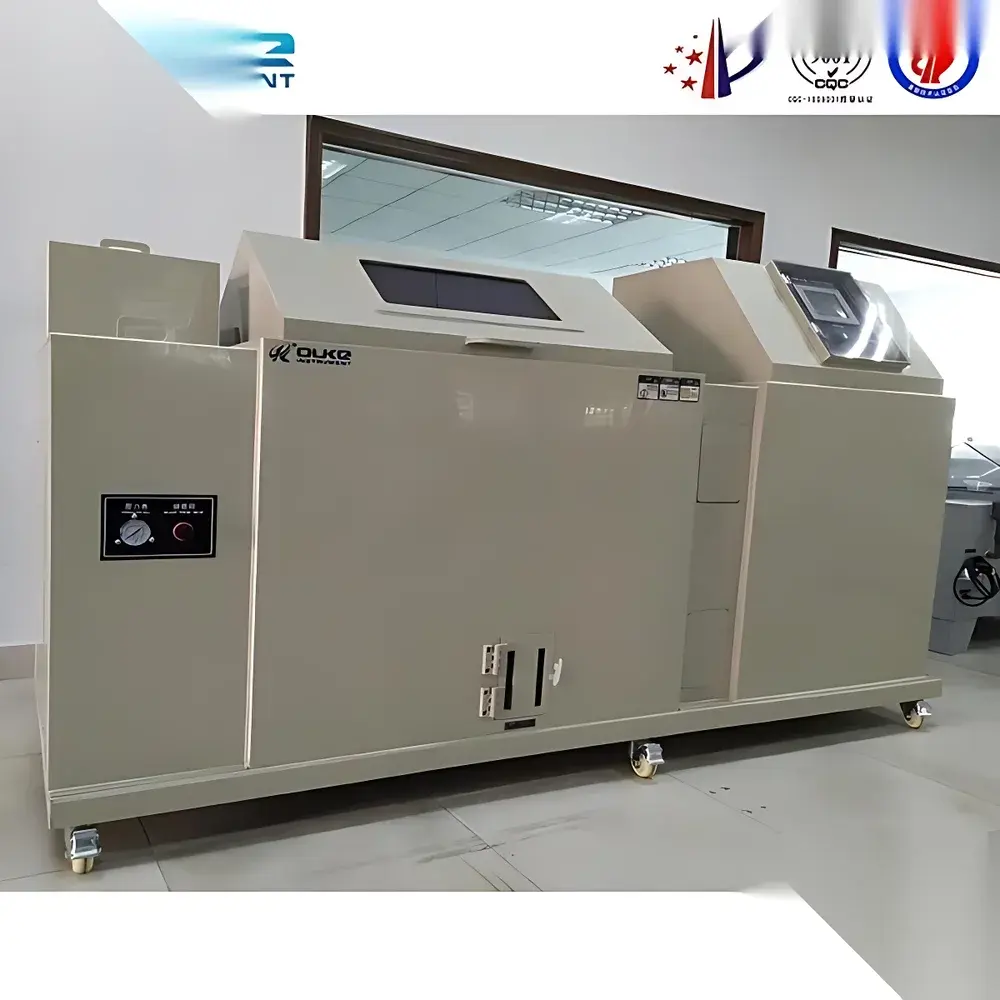
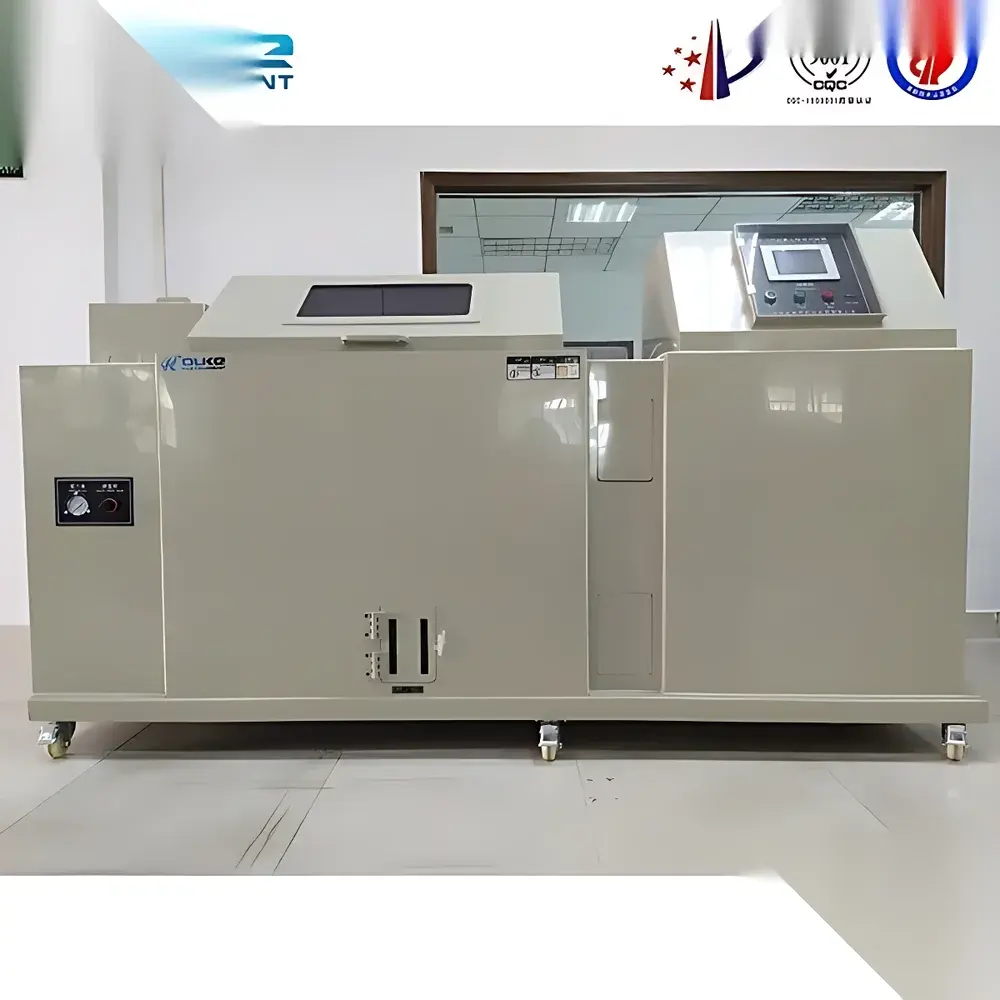
High-Temperature, High-Humidity, and High-Salinity Corrosion Test Chamber
| Brand | OEM |
|---|---|
| Origin | Imported |
| Manufacturer Type | Authorized Distributor |
| Price | USD 21,500 (FOB) |
| Temperature Range | RT+10 °C to 70 °C |
| Salt Solution Circulation | Dual-pump alternating system |
| Dwell Time Control | Adjustable up/down immersion intervals (0.01 s–9999 hr) |
| Total Test Duration | Programmable 0.01 s–9999 hr |
| Cycle Counter | 0–99999 cycles (resettable) |
| Compliance | GB/T 2423.17, GB/T 10587, GJB 150.11A, DIN 50021, ISO 9227 (as applicable) |
Overview
The High-Temperature, High-Humidity, and High-Salinity Corrosion Test Chamber is an engineered environmental simulation system designed for accelerated corrosion evaluation of metallic components, coatings, and electronic enclosures under rigorously controlled cyclic salt-spray conditions. Unlike conventional static salt fog chambers, this chamber integrates dynamic immersion cycling—alternating between saline immersion, humid air exposure, and thermal stabilization—to replicate real-world service environments where materials are subjected to combined thermal stress, hygroscopic chloride ingress, and intermittent wet/dry transitions. Its operational principle relies on precise regulation of solution temperature (via titanium-sheathed heating elements), continuous saline circulation (dual redundant pumps), and programmable dwell timing logic to enforce repeatable test sequences per internationally recognized corrosion standards.
Key Features
- Titanium alloy heating elements embedded in the sump ensure long-term chemical resistance and stable temperature control from RT+10 °C to 70 °C, minimizing contamination risk and thermal drift.
- Dual independent centrifugal pumps operate in alternating duty cycles to maintain uninterrupted saline flow across the test zone, preventing stagnation, sedimentation, and localized pH deviation.
- Korean-made TEMI880 touchscreen controller with embedded PID algorithms enables granular programming of immersion duration, air-dwell time, total cycle count, and termination logic—including auto-shutdown upon completion or fault detection.
- Integrated mechanical lift mechanism—driven by a maintenance-free AC motor and precision gear train—executes vertical sample movement with adjustable stroke limits and positional repeatability within ±0.5 mm.
- Real-time cycle counter (0–99999, resettable) provides auditable traceability of cumulative immersion events, supporting GLP-compliant reporting and internal QA documentation requirements.
- Front-access sump drain valve and sealed reservoir design simplify solution replenishment and reduce operator exposure during routine maintenance.
Sample Compatibility & Compliance
This chamber accommodates flat coupons (up to 150 mm × 150 mm), cylindrical fasteners, PCB assemblies, and small enclosure subassemblies mounted on standardized test racks or custom fixtures. It is fully compatible with ASTM B117–22 (neutral salt spray), ISO 9227:2022 (NSS, AASS, CASS variants), and supports method adaptation for modified cyclic tests per ISO 16701 or SAE J2334. The unit meets structural and safety requirements outlined in IEC 60068-2-11 and conforms to electromagnetic compatibility (EMC) Class B per EN 61326-1. All controller firmware logs—including setpoints, actual temperatures, pump status, and cycle timestamps—are retained for ≥30 days, facilitating 21 CFR Part 11–aligned audit trails when paired with validated data export protocols.
Software & Data Management
The TEMI880 controller supports USB-based data logging (CSV format) and optional RS485/Modbus RTU integration for SCADA-level monitoring. Logged parameters include sump temperature (±0.3 °C accuracy), elapsed test time, immersion count, and fault codes (e.g., low-level alarm, overtemperature lockout). Exported datasets retain ISO 8601 timestamping and are compatible with common LIMS platforms and statistical process control (SPC) software. No cloud connectivity or proprietary software installation is required; configuration remains fully local and deterministic—ensuring data sovereignty and alignment with ITAR and GDPR boundary constraints.
Applications
- Corrosion resistance validation of automotive under-hood components exposed to road de-icing salts and elevated underhood temperatures.
- Qualification of marine-grade fasteners, aluminum alloys, and zinc-nickel electroplated surfaces per MIL-DTL-16232 and DEF STAN 00-137.
- Accelerated aging of conformal-coated PCBs and sensor housings operating in coastal or offshore infrastructure.
- Pre-compliance screening for electronics per IEC 60068-2-52 (cyclic salt mist) prior to formal certification testing.
- Research into synergistic degradation mechanisms involving chloride-induced pitting, crevice corrosion, and hygrothermal swelling of polymer composites.
FAQ
What salt solution concentration is recommended for standard testing?
A 5 wt% NaCl solution (50 g NaCl per 950 mL deionized water, conductivity ≤5.0 µS/cm) is specified in ISO 9227 and ASTM B117. Adjustments may be made per material-specific protocols such as ASTM G85 Annex A5 (acidified salt spray).
Can the chamber operate continuously without manual intervention?
Yes—once programmed, the system executes fully autonomous cycles including solution circulation, temperature regulation, mechanical actuation, and end-of-test shutdown. Scheduled maintenance (e.g., sump cleaning, nozzle inspection) is recommended every 200 operational hours.
Is calibration traceable to national standards?
Temperature sensors are factory-calibrated against NIST-traceable references. Users may perform field verification using a calibrated PT100 probe; calibration certificates and uncertainty budgets are provided with each unit shipment.
Does the system support custom test profiles beyond standard norms?
The TEMI880 allows user-defined multi-step programs with up to 99 segments, enabling complex sequences that combine variable temperature ramps, staggered dwell times, and conditional branching based on elapsed cycles or time thresholds.
What safety protections are built into the control architecture?
Hardware interlocks include dry-run prevention for pumps, overtemperature cutoff (75 °C hard limit), sump level monitoring, and emergency power-off via front-panel mushroom button compliant with IEC 60204-1.



