
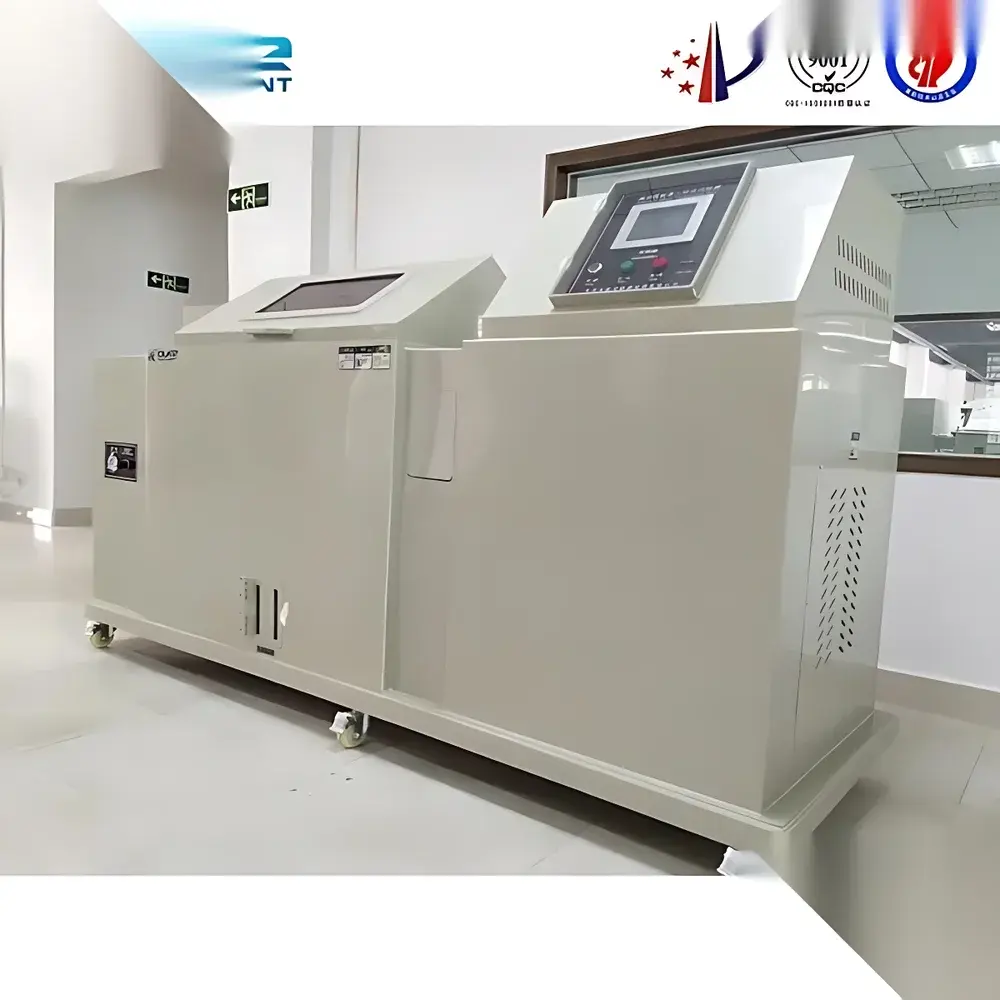
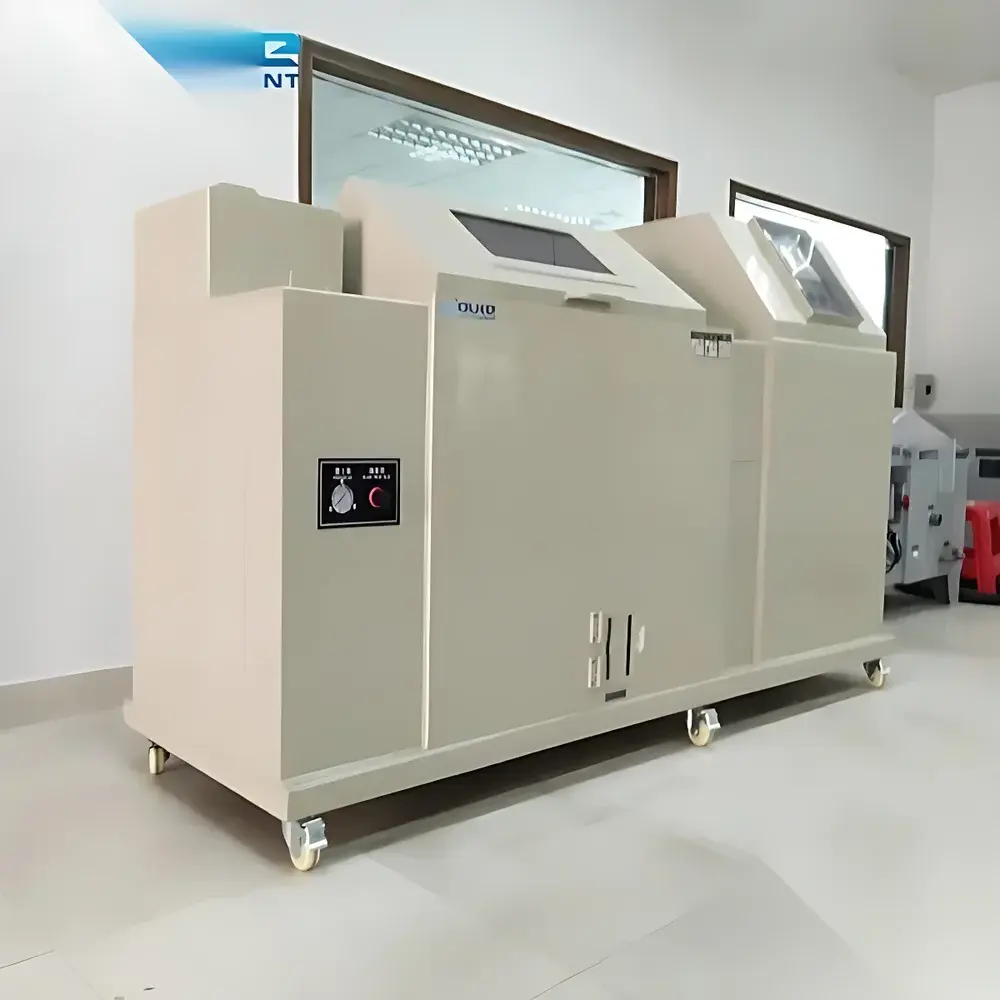
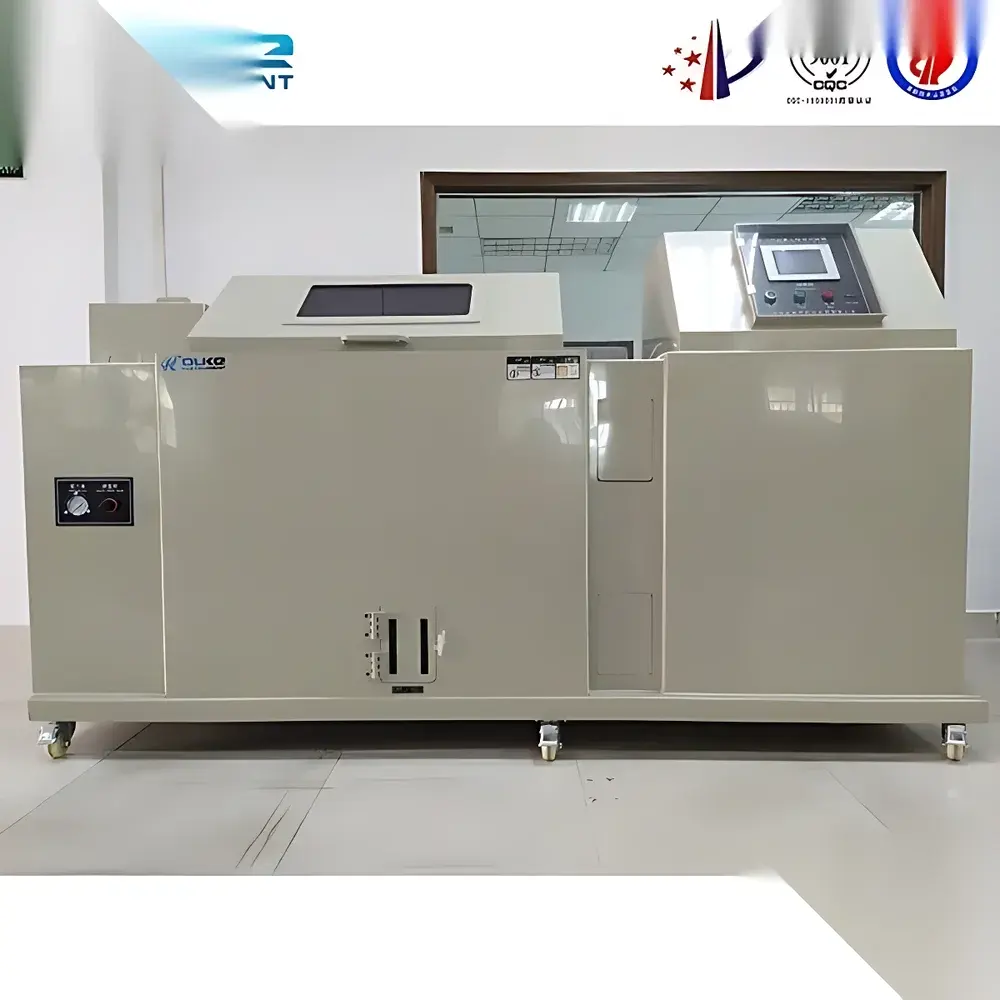
High-Temperature, High-Humidity, and High-Salinity Environmental Test Chamber for Corrosion Resistance Evaluation
| Brand | Other Brands |
|---|---|
| Origin | Imported |
| Manufacturer Type | Authorized Distributor |
| Temperature Range | RT+5°C to 55°C |
| Temperature Uniformity | ±2°C |
| Temperature Fluctuation | ±0.5°C |
| Salt Spray Deposition Rate | 1–2 mL / 80 cm²·h |
| Spray Mode | Air-Atomized (Continuous or Cyclic) |
| Internal Dimensions | 600 × 450 × 400 mm (L×W×H) |
| External Dimensions | Approx. 1075 × 1185 × 630 mm (L×W×H) |
| Saturated Air Heater Range | RT+47°C to 63°C |
| Power Supply | 220 V, 1.5 kW, 50 Hz |
Overview
The High-Temperature, High-Humidity, and High-Salinity Environmental Test Chamber is an engineered solution for accelerated corrosion resistance evaluation of metallic substrates, coated components, and surface-treated materials under rigorously controlled saline atmospheric conditions. Based on the fundamental principles of electrochemical corrosion acceleration—where chloride ion penetration, elevated temperature, and sustained humidity synergistically promote anodic dissolution and cathodic reduction—the chamber replicates aggressive coastal/marine environments to assess long-term durability of protective systems. Designed in strict alignment with ASTM B117, ISO 9227, JIS Z2371, and GB/T 2423.17 standards, it supports both continuous salt spray (NSS) and cyclic corrosion testing (CCT) protocols. Its dual-condition capability—simultaneous control of elevated temperature (up to 55°C), high relative humidity (≥95% RH), and precisely metered sodium chloride aerosol—enables realistic simulation of real-world degradation mechanisms in automotive under-hood assemblies, aerospace fasteners, marine hardware, and electronic enclosures. The chamber’s structural integrity and metrological stability are validated for extended operational cycles required in QC laboratories and R&D validation workflows.
Key Features
- Integrated glass-fiber-reinforced polymer (GFRP) monocoque construction—resistant to chloride-induced stress cracking, impact, and thermal cycling; fully cleanable interior surfaces
- Tower-type air-atomized spray system with precision-engineered nozzles—eliminates salt crystallization, ensures uniform fog distribution (±10% spatial consistency across test zone), and enables continuous adjustment of deposition rate (1–2 mL/80 cm²·h)
- Dual-pressure regulation circuit—maintains stable atomization pressure and saturated air chamber equilibrium, preventing pressure surges that compromise test repeatability
- Digital PID temperature controller with auto-tuning algorithm—guarantees long-term thermal stability (±0.5°C fluctuation) and uniformity (±2°C across working volume) over 1,000+ hour test durations
- Water-sealed hinged lid mechanism—prevents salt fog leakage during operation and ensures operator safety per IEC 61000-6-3 EMC requirements
- Modular air saturator operating at RT+47°C to 63°C—optimizes droplet size distribution and minimizes dry-out effects during prolonged cyclic tests
- Over-temperature protection with independent mechanical cut-off—complies with UL 61010-1 Class II safety architecture
Sample Compatibility & Compliance
The chamber accommodates standard test specimens up to 600 mm × 450 mm × 400 mm (L×W×H), supporting flat panels, threaded fasteners, stamped parts, and assembled subcomponents. It is routinely deployed for qualification of zinc-nickel electroplated steel, chromate-passivated aluminum alloys, epoxy-powder-coated chassis, and conformally coated PCBs. All operational parameters—including temperature setpoint, spray duration, rest intervals, and saturation temperature—are configurable to meet ASTM G85 Annex A5 (Prohesion), ISO 14993 (cyclic corrosion testing), and VW PV1210 requirements. Data logging and parameter traceability align with GLP/GMP documentation practices and support FDA 21 CFR Part 11-compliant audit trails when integrated with validated third-party software platforms.
Software & Data Management
While the base unit operates via embedded digital controller with local parameter storage (100+ test profiles), optional RS485/Modbus RTU or Ethernet interface enables integration into centralized laboratory information management systems (LIMS). Real-time monitoring of chamber temperature, saturation heater status, and spray cycle timing is supported. Exported CSV logs include timestamped environmental readings, alarm events, and operator-initiated mode changes—facilitating root-cause analysis of coating failure modes and statistical process control (SPC) charting per ISO/IEC 17025 calibration management frameworks.
Applications
- Accelerated corrosion screening of automotive body panels, brake calipers, and exhaust system components
- Validation of anti-corrosion performance for aerospace aluminum alloys (e.g., 2024-T3, 7075-T6) following MIL-STD-810H Method 509.6
- Quality conformance testing of electroplated connectors and PCB edge connectors per IPC-STD-001 and IPC-A-610
- Comparative evaluation of organic coatings (epoxy, polyurethane, PVDF) under combined thermal-hygrometric-saline stress
- Supplier qualification audits requiring reproducible NSS exposure per customer-specific material specifications (e.g., Ford WSK-M2G323-A2, GMW14872)
FAQ
What standards does this chamber comply with for salt spray testing?
It meets ASTM B117, ISO 9227, JIS Z2371, and GB/T 2423.17 for neutral salt spray (NSS) testing, and supports cyclic protocols aligned with ASTM G85 Annex A5 and ISO 14993.
Can the chamber perform both continuous and cyclic corrosion tests?
Yes—its programmable controller allows user-defined sequences of spray, humidification, drying, and recovery phases, enabling full implementation of Prohesion and other CCT methodologies.
Is the internal chamber volume sufficient for large automotive components?
The internal dimensions (600 × 450 × 400 mm) accommodate most bracket assemblies, sensor housings, and small subassemblies; larger items require custom chamber variants with extended height or modular expansion options.
How is temperature uniformity verified and maintained?
Uniformity is ensured through optimized airflow design, insulated double-wall construction, and calibrated PT100 sensors placed at nine standardized locations per ISO 16750-4 Annex C—verified during factory acceptance testing and recommended for annual recalibration.
Does the system include data export capabilities for regulatory reporting?
Standard configuration provides USB-based log export; optional network interface enables automated transfer to LIMS or ERP systems with time-stamped, tamper-evident records compliant with ISO/IEC 17025 clause 7.7.



