
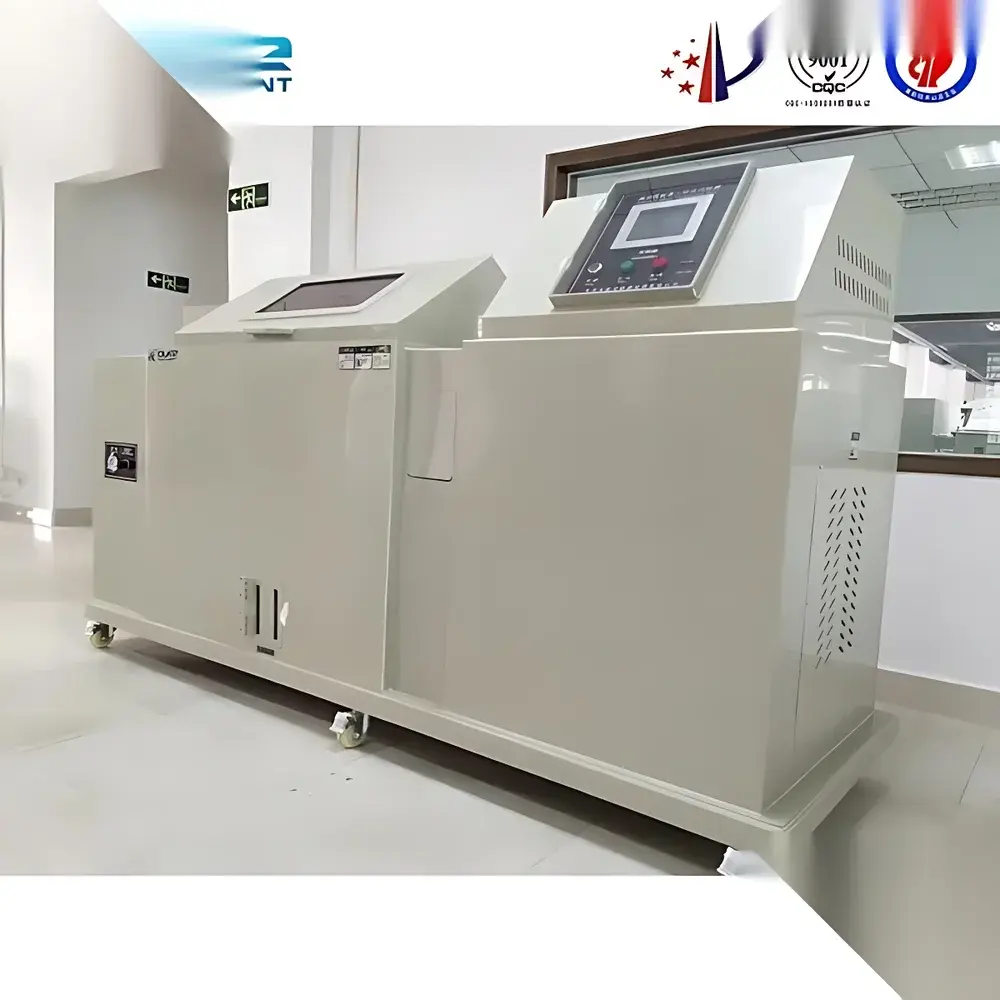
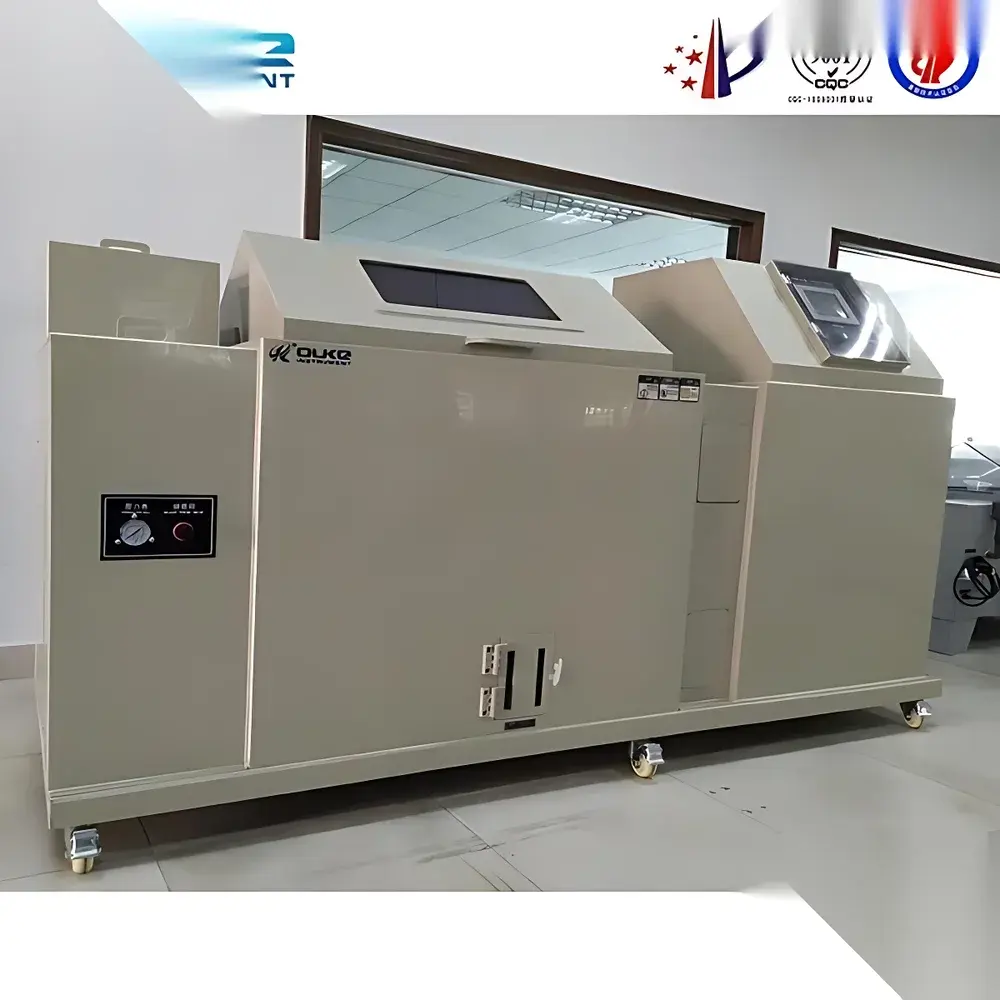
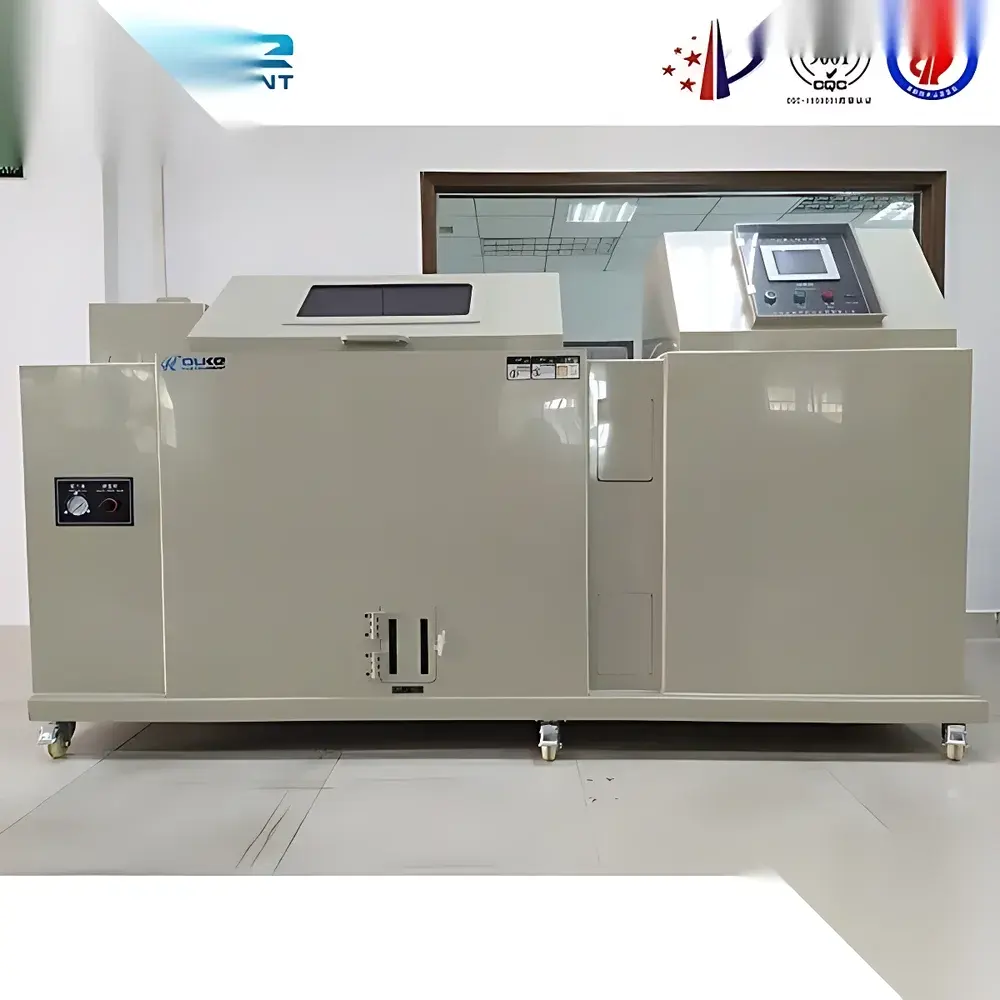
High-Temperature High-Humidity Salt Spray Test Chamber with Electrochemical Thickness & Potential Difference Measurement Capability
| Brand | Other Brands |
|---|---|
| Origin | Imported |
| Manufacturer Type | Authorized Distributor |
| Price | USD 12,500 (FOB) |
| Thickness Measurement Range | 0.03 µm – 99 µm |
| Potential Difference Range | −100 mV to +400 mV |
| Thickness Accuracy | ±10% |
| Potential Difference Accuracy | ±5% |
| Reproducibility | <5% RSD |
| Standard Measuring Apertures | Ø2.5 mm and Ø1.7 mm rubber gaskets |
| Chamber Temperature Control Range | 0–99.9 °C (PID-controlled, resolution ±0.3 °C) |
| Saturated Air Chamber Temperature Control Range | 0–99.9 °C (PID-controlled, resolution ±0.3 °C) |
| Heating Tank Safety Cut-off | 0–120 °C |
| Saturated Air Tank Safety Cut-off | 0–120 °C |
| Timer Range | 9.9 s – 9990 h |
| Elapsed Time Meter | 0–9999.9 h |
| Pressure Gauge | 0–2.5 kg/cm² (accuracy ±0.01 kg/cm²) |
| Toggle Switch | Illuminated, rated for ≥20,000 actuations |
Overview
The High-Temperature High-Humidity Salt Spray Test Chamber with Electrochemical Thickness & Potential Difference Measurement Capability is a dual-function environmental test system engineered for accelerated corrosion evaluation and quantitative electrochemical analysis of metallic coatings. Unlike conventional salt spray chambers limited to pass/fail corrosion assessment per ASTM B117 or ISO 9227, this integrated platform combines standardized cyclic salt fog exposure (including elevated temperature and humidity conditioning per ISO 14993 and ASTM G85 Annex A5) with in-situ anodic stripping-based thickness measurement and interlayer potential difference quantification. It operates on the principle of controlled electrolytic dissolution—applying a calibrated current across a localized electrode interface defined by precision rubber gasket apertures—to determine coating thicknesses of single-layer and multi-layer electroplated systems (e.g., Cu/Ni/Cr, Ni/Cu/Ni, Sn/Cu) without destructive cross-sectioning. The chamber’s thermal and humidification subsystems are independently PID-regulated to ensure strict compliance with test sequence requirements for automotive, aerospace, and electronics component validation under real-world service conditions.
Key Features
- Dual-mode operation: Simultaneous or sequential salt spray exposure and electrochemical thickness/potential measurement within the same test enclosure
- Microprocessor-controlled electrochemical analyzer embedded in the chamber base, featuring automatic calibration routines and real-time digital display of layer thickness (µm) and interlayer potential (mV)
- Two standardized measuring apertures (Ø2.5 mm and Ø1.7 mm rubber gaskets) enabling selective area analysis compliant with ISO 2177 and ASTM B504 for thin-film coatings
- Independent dual PID temperature controllers—one for laboratory chamber air, one for saturated air reservoir—with resolution of ±0.3 °C and auto-tuning capability
- Redundant mechanical safety cut-offs for heating tanks (0–120 °C range) preventing thermal runaway during extended test cycles
- Precision air pressure regulation system including particulate filter, calibrated pressure gauge (±0.01 kg/cm²), and stable compressed air delivery for uniform fog generation
- Integrated thermal printer and RS-232/USB interface for direct data export to LIMS or QA documentation systems
Sample Compatibility & Compliance
This chamber accommodates planar and moderately contoured metallic substrates up to 300 × 300 mm. It supports quantitative analysis of common electroplated systems: copper, nickel, chromium, zinc, silver, gold, and tin—both as monolayers and multilayer stacks (e.g., semi-bright Ni/ bright Ni/Cr; Cu/Ni/Cr). For multi-layer nickel systems, it resolves individual layer thicknesses and calculates interlayer potential differences critical for corrosion resistance evaluation per ASTM B764 and ISO 1456. All operational parameters align with regulatory testing frameworks requiring traceable environmental control—including ISO 9001-certified laboratories, IATF 16949 automotive audits, and GLP-compliant R&D environments. The system meets mechanical and electrical safety standards per IEC 61000-6-2 (EMC) and IEC 61010-1 (lab equipment safety).
Software & Data Management
The included PC software (Windows-compatible, no runtime license required) enables full test protocol definition—including temperature ramp profiles, humidity setpoints, salt concentration gradients, and dwell times—per ASTM D5894 and ISO 11997-2. Measurement data is timestamped, annotated with operator ID and sample ID, and stored with full audit trail functionality supporting FDA 21 CFR Part 11 compliance when configured with user authentication and electronic signature modules. Export formats include CSV, PDF reports, and XML for integration into enterprise quality management systems (QMS). Raw electrochemical waveforms and derivative curves (dI/dt vs. time) are retained for root-cause failure analysis of coating delamination or porosity.
Applications
- Corrosion performance validation of decorative and functional plating on automotive trim, fasteners, and connectors
- Quality assurance of printed circuit board (PCB) surface finishes (ENIG, ENEPIG, immersion Sn/Pb) prior to solderability testing
- R&D of corrosion-inhibiting duplex coatings for aerospace hydraulic components
- Supplier qualification audits requiring quantitative thickness verification alongside salt fog endurance (e.g., GMW14872, Ford CETP 00.00-L-467)
- Failure analysis labs assessing galvanic coupling effects in dissimilar metal assemblies
FAQ
Can this chamber perform both salt spray testing and electrochemical measurement simultaneously?
Yes—the chamber’s architecture isolates the fog generation zone from the electrochemical cell interface, allowing concurrent exposure and measurement without cross-contamination or signal interference.
Is the system compliant with ASTM B117 and ISO 9227?
It exceeds core requirements of both standards for temperature uniformity, fog collection rate, and pH control; additional features such as programmable humidity cycling extend its scope to advanced cyclic corrosion tests.
What calibration standards are supported?
Certified reference samples traceable to NIST or PTB are supplied with each unit; on-site calibration verification can be performed using certified thickness standards per ISO/IEC 17025-accredited procedures.
Does the software support automated report generation for ISO/IEC 17025 accreditation?
Yes—templates comply with ILAC P14 requirements, including uncertainty budgeting fields, instrument calibration status flags, and revision-controlled test method references.
What maintenance intervals are recommended for long-term reproducibility?
Daily: Fog nozzle inspection and pH verification; Quarterly: Electrode refurbishment and PID controller recalibration; Annually: Full system metrological verification against accredited reference standards.



