
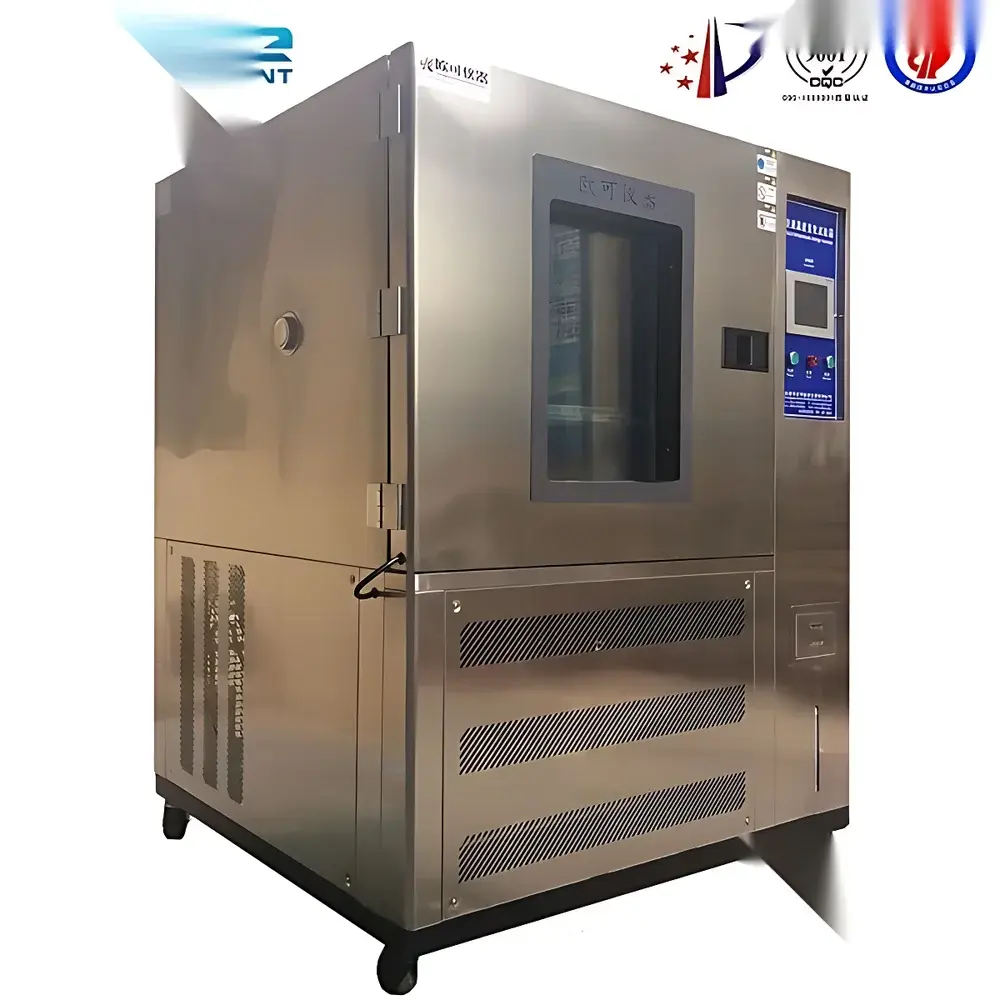
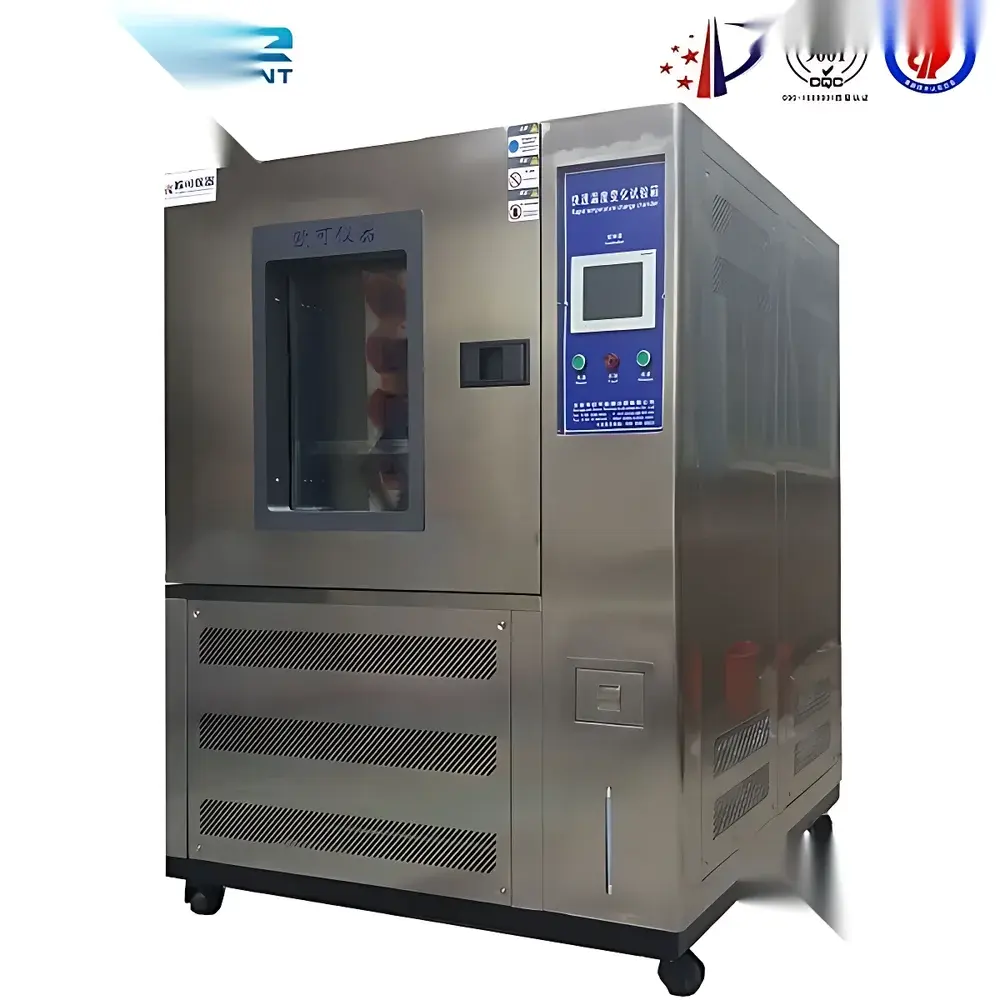
High-Temperature & High-Pressure Rapid Thermal Cycling Chamber
| Brand | OEM / Custom-Built |
|---|---|
| Origin | Imported |
| Manufacturer Type | Authorized Distributor |
| Price | USD 2,650 (FOB) |
| Temperature Range | −70 °C to +150 °C |
| Rapid Thermal Cycling Range | −45 °C to +85 °C |
| Max Linear Ramp Rate | 15 °C/min |
| Humidity Range (Optional) | 5–98% RH |
| Temp. Resolution/Accuracy | 0.1 °C / ±0.5 °C |
| Humidity Resolution/Accuracy | 0.1% RH / ±2.5% RH |
| Uniformity | ±2.0 °C / ±3.0% RH |
| Construction | Interior & Exterior – SUS304 Stainless Steel (Brushed Finish) |
| Insulation | High-Density Polyurethane Foam with Closed-Cell Structure |
| Cooling Options | Air-Cooled or Water-Cooled Condensing System |
| Refrigerant | R-404A & R-507 (EPA SNAP-Approved, Non-Ozone-Depleting) |
| Compressor | Tecumseh (France) |
| Control Interface | LCD Touchscreen with Multi-Segment Programmable Logic |
| Compliance | ASTM D3574, IEC 60068-2-1/2/14/30, MIL-STD-810H (Thermal Shock), ISO 16750-4 |
Overview
The High-Temperature & High-Pressure Rapid Thermal Cycling Chamber is an engineered environmental stress screening (ESS) system designed for accelerated reliability testing of electronic components, aerospace subsystems, automotive ECUs, and advanced packaging materials under dynamically controlled thermal and hygrothermal conditions. Unlike conventional thermal chambers, this unit implements a dual-mode control architecture—linear ramping and non-linear profiling—enabling precise replication of real-world transient thermal loads, including rapid thermal shock events defined in MIL-STD-810H Method 503.5 and IEC 60068-2-14. Its core thermal actuation system integrates high-efficiency compressors (Tecumseh), low-GWP refrigerants (R-404A/R-507), and optimized heat exchanger geometry to achieve programmable ramp rates from 3 °C/min up to 15 °C/min across the full −45 °C to +85 °C operational envelope—while maintaining temperature stability within ±0.5 °C and humidity accuracy within ±2.5% RH when equipped with optional humidity control.
Key Features
- Programmable linear and non-linear thermal profiles with adjustable ramp rates (3–20 °C/min) and dwell times—fully compliant with JEDEC JESD22-A104D thermal cycling specifications.
- Dual-wall construction using brushed-finish SUS304 stainless steel with high-density polyurethane insulation (λ ≤ 0.022 W/m·K) ensuring minimal thermal leakage and long-term dimensional stability.
- Integrated observation window featuring heated anti-condensation film and high-lumen PL fluorescent lighting—enabling real-time visual monitoring without compromising chamber integrity.
- Front-access test ports (φ50 mm × 4) with silicone gasket seals support external power/signal feedthrough for in-situ electrical characterization during thermal stress.
- Self-diagnostic controller with alarm logging, freeze protection logic, and compressor performance dashboard—including real-time discharge pressure, suction temperature, and refrigerant saturation diagnostics.
- Mobility system with heavy-duty casters and locking bolts facilitates repositioning in shared lab environments while meeting ISO 14644-1 Class 8 cleanroom compatibility requirements.
Sample Compatibility & Compliance
This chamber accommodates standard test specimens up to 600 mm (W) × 600 mm (D) × 600 mm (H), with customizable internal fixtures for PCB arrays, battery modules, and MEMS devices. It meets essential regulatory and industry standards for qualification testing: ASTM D3574 (flexible cellular materials), IEC 60068-2-1 (cold), -2 (dry heat), -14 (change of temperature), and -30 (damp heat cyclic); ISO 16750-4 (road vehicles—electrical disturbances); and MIL-STD-810H (Method 503.5 for temperature shock). Optional humidity control extends compliance to IEC 60068-2-78 (damp heat, steady state) and USP for pharmaceutical packaging validation. All firmware and data logs are structured to support GLP/GMP audit trails per FDA 21 CFR Part 11 when paired with validated software configuration.
Software & Data Management
The embedded controller runs a real-time OS with multi-segment programming capability (up to 999 steps per profile), supporting both Quick Mode (single-step ramp/dwell) and Slope Mode (continuous gradient control). Data logging occurs at user-selectable intervals (1 s to 60 min), storing timestamped temperature/humidity values, alarm events, and system status flags in CSV format via USB export. Optional Ethernet connectivity enables remote monitoring through secure HTTPS API endpoints compatible with LabVIEW, MATLAB, and enterprise MES platforms. Audit trail functionality records all parameter changes, user logins, and calibration actions with digital signatures—ensuring traceability for ISO/IEC 17025 accredited laboratories.
Applications
- Qualification of semiconductor packages (QFN, BGA, CSP) per JEDEC J-STD-020 and AEC-Q200.
- Thermal fatigue evaluation of solder joints and underfill materials under repeated expansion/contraction cycles.
- Validation of battery thermal management systems (BTMS) under extreme ambient transients (−40 °C to +85 °C).
- Environmental stress screening (ESS) of avionics hardware prior to HALT/HASS campaigns.
- Accelerated aging studies of polymer-based medical device housings per ISO 10993-12.
- Material coefficient of thermal expansion (CTE) correlation testing using integrated strain gauge interfaces.
FAQ
What is the maximum allowable internal pressure differential for this chamber during rapid thermal transitions?
The chamber is rated for static internal pressure differentials up to ±1.5 kPa relative to ambient—sufficient to accommodate minor vapor expansion during humidified ramping without compromising seal integrity or structural safety.
Can the unit be integrated into a centralized facility monitoring network?
Yes—via optional Modbus TCP or EtherNet/IP communication modules, enabling integration with building management systems (BMS) and centralized alarm dashboards.
Is NIST-traceable calibration documentation available upon delivery?
Standard delivery includes factory calibration certificates (temperature/humidity sensors, controller inputs) traceable to NIST standards; on-site recalibration services are available under annual service contracts.
Does the controller support user-defined failure criteria triggering automatic shutdown?
Yes—the system allows configurable limit alarms (e.g., “if T > +152 °C for >10 s, initiate emergency cooldown and notify operator”) with configurable relay outputs for external safety interlocks.
What maintenance intervals are recommended for the refrigeration system?
Compressor oil analysis and refrigerant purity verification are recommended every 2,000 operating hours or annually—whichever occurs first—with full system evacuation and recharge advised after 10,000 hours or major component replacement.



