
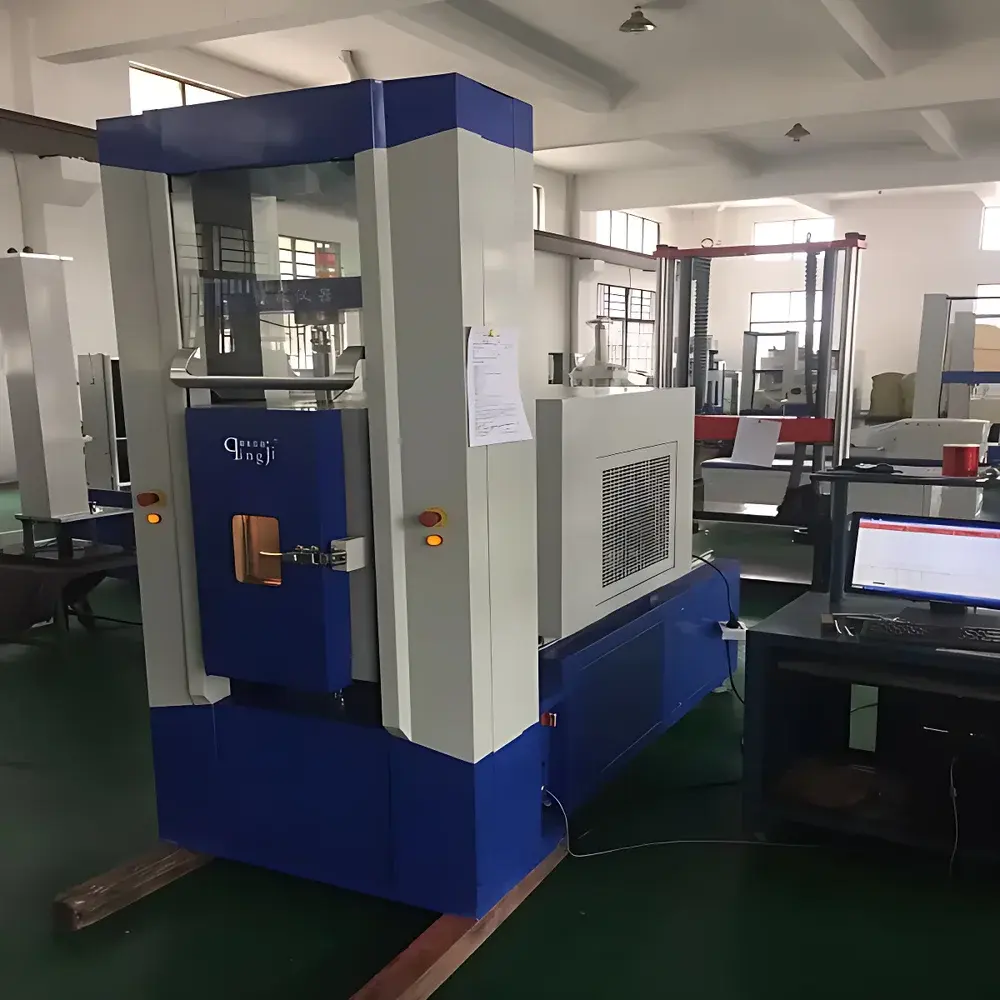
High-Temperature Tensile Testing Machine QJ211B
| (Origin | Shanghai, China |
|---|---|
| Manufacturer Type | Authorized Distributor |
| Origin Category | Domestic (PRC) |
| Model | QJ211B |
| Instrument Type | Electromechanical Universal Testing Machine |
| Max Test Load | 30 kN |
| Load Range | 0–30 kN (fully adjustable) |
| Load Accuracy | ±1% FS or ±0.5% FS |
| Crosshead Travel | 420 mm |
| Displacement Resolution | ±0.5% of reading |
| Temperature Range | −70 °C to +350 °C (isothermal hold capability at 350 °C) |
| Heating/Cooling Rate | ≥5 °C/min |
| Temperature Controller Resolution | 0.1 °C |
| Test Speed Range | 0.001–500 mm/min (optional extension to 1000 mm/min) |
| Speed Accuracy | ±0.5% |
| Displacement Measurement Accuracy | ±0.5% |
| Strain Measurement Accuracy | ±0.5% |
| Safety Features | Electronic end-limit protection, emergency stop button |
| Machine Weight | 135 kg) |
Overview
The QJ211B High-Temperature Tensile Testing Machine is an electromechanical universal testing system engineered for precise mechanical property characterization of metallic, polymeric, ceramic, and composite materials under controlled thermal environments. It integrates a high-stiffness dual-column frame with a servo-controlled AC motor drive and a calibrated load cell (0.01% internal resolution), enabling static and quasi-static tensile, compression, flexure, peel, tear, shear, puncture, and low-cycle fatigue tests across a wide temperature spectrum—from cryogenic (−70 °C) to elevated (350 °C) conditions. The system employs a modular furnace-chamber design: the environmental chamber can be physically detached during ambient-temperature testing to maximize workspace clearance and facilitate multi-purpose use—such as high-speed dynamic testing or large-sample evaluation. Its architecture complies with fundamental mechanical metrology principles defined in ISO 7500-1 (static uniaxial testing machines), ASTM E4 (load verification), and ASTM E8/E21 (tensile testing of metals at elevated temperatures).
Key Features
- Full-range programmable load capacity: 0–30 kN with selectable calibration points and dual accuracy modes (±1% FS or ±0.5% FS per ISO 7500-1 Class 1/Class 0.5 compliance)
- Integrated high-temperature chamber with rapid thermal response (≥5 °C/min ramp rate) and stable isothermal control at 350 °C (±1 °C uniformity over central 50 mm zone)
- Precision displacement measurement via high-resolution encoder (±0.5% of reading) and optional extensometer support for true strain acquisition
- Wide test speed range: 0.001–500 mm/min (extendable to 1000 mm/min), with closed-loop speed regulation accuracy of ±0.5%
- Dual-control interface: Windows-based PC software for full automation + front-panel digital controller for manual operation and quick setup
- Comprehensive safety architecture: hardware-based electronic limit switches, redundant emergency stop circuitry, and real-time overload cutoff
- Structural rigidity optimized for minimal frame deflection (<0.05 mm/kN), ensuring measurement fidelity during high-load, high-temperature tests
Sample Compatibility & Compliance
The QJ211B accommodates standard specimens per ASTM E8, ISO 6892-1, GB/T 228.1, JIS Z 2241, and DIN 50125—including flat, round, notched, and miniature geometries up to 420 mm effective width and 800 mm vertical gauge length (extendable). Specimen heating is achieved via resistive furnace elements with thermocouple feedback (Type K or S, depending on max temperature), and thermal shielding minimizes heat transfer to the load train. The system supports GLP/GMP-aligned documentation workflows and meets essential requirements for ISO/IEC 17025-accredited laboratories when paired with validated calibration certificates traceable to NIM (China National Institute of Metrology) or NIST-equivalent standards. Environmental chamber validation follows ISO 17025 Annex A.3 guidelines for temperature uniformity and stability assessment.
Software & Data Management
Control and analysis are executed via proprietary WinTestPro v5.x software—a Windows 10/11 compatible application supporting multi-channel synchronized acquisition (load, displacement, temperature, strain). Raw data is stored in ASCII CSV and binary .WTP formats with embedded metadata (operator ID, test date/time, calibration ID, environmental settings). Software features include automated test sequence scripting, real-time stress–strain curve generation, modulus calculation (secant, tangent, chord), yield point detection (0.2% offset method), and fracture energy integration. Audit trail functionality complies with FDA 21 CFR Part 11 requirements when configured with user role management, electronic signatures, and immutable log files. Export options include PDF reports (customizable templates), Excel-compatible spreadsheets, and image exports (PNG/SVG) for publication-grade figures.
Applications
- Creep and stress-rupture behavior of aerospace alloys (e.g., Inconel 718, Ti-6Al-4V) at 300–350 °C
- Thermal degradation onset in high-performance thermoplastics (PEEK, PPS, PI) under tensile load
- Interfacial adhesion strength of metal-ceramic brazed joints evaluated across thermal cycling profiles
- Low-cycle fatigue life prediction of turbine blade coatings subjected to thermo-mechanical loading
- Validation of ASTM D638/D695/D790 protocols for polymer composites under non-ambient conditions
- Quality assurance of weldments per AWS D1.1 and ISO 15614-1, including post-weld heat treatment effect quantification
FAQ
What temperature uniformity can be expected at 350 °C within the test zone?
At 350 °C isothermal hold, radial and axial temperature deviation remains ≤±1 °C over a 50 mm × 50 mm central volume, verified per ISO 17025-compliant chamber mapping procedures.
Is the system compatible with extensometers for high-temperature strain measurement?
Yes—the machine includes mounting interfaces and signal conditioning for clip-on or contacting high-temperature extensometers (up to 1000 °C), with analog voltage output (±10 V) and digital RS-422 support.
Can test data be exported for third-party statistical analysis (e.g., Weibull modeling)?
All raw channel data is exportable in time-synchronized CSV format with millisecond timestamp resolution, fully compatible with MATLAB, Python (NumPy/Pandas), Minitab, and JMP.
What maintenance intervals are recommended for long-term accuracy retention?
Load cell recalibration is advised annually or after 10,000 cycles; thermal chamber thermocouple verification every 6 months; mechanical alignment check every 2 years per manufacturer’s service protocol.
Does the system support automated batch testing with pass/fail criteria?
Yes—WinTestPro allows definition of acceptance thresholds (e.g., ultimate tensile strength ≥ X MPa, elongation at break ≥ Y%) and auto-flagging of outliers with configurable email alerts.



