
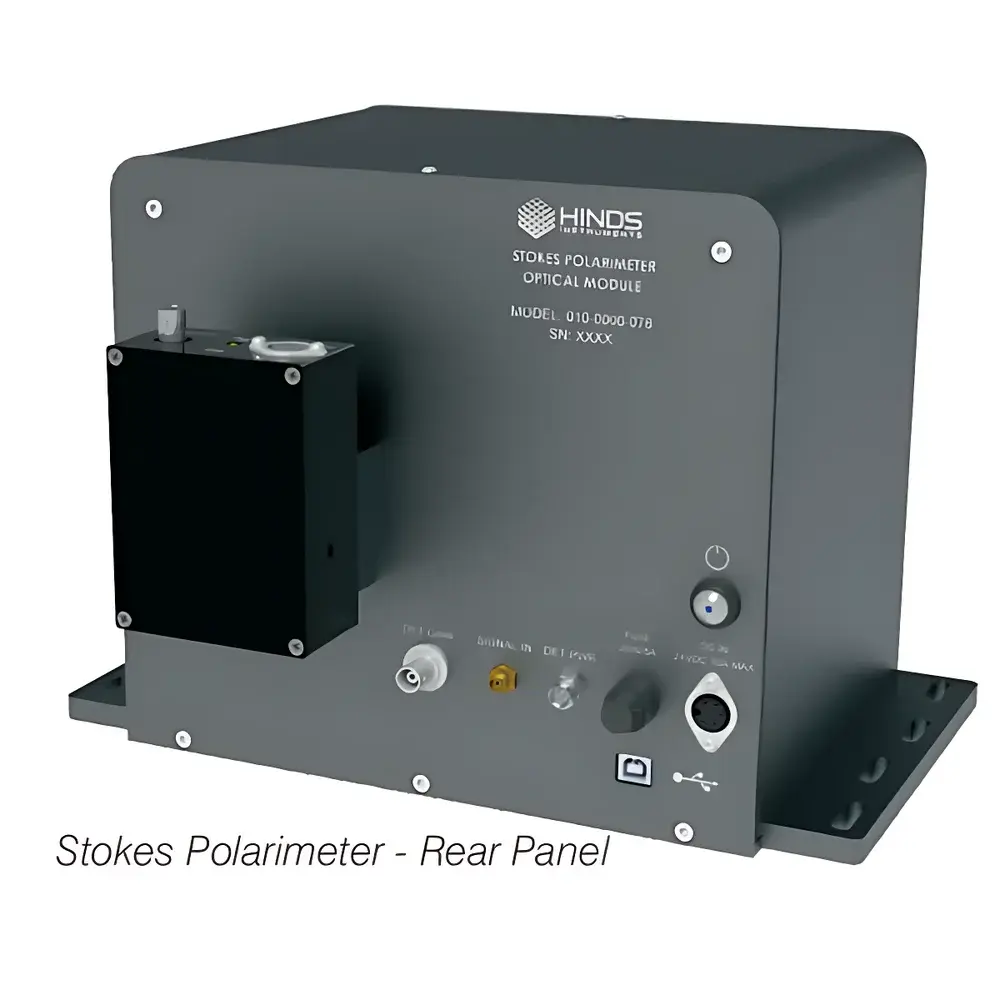
Hinds Instruments PEM-Based Deep-UV Stokes Polarimeter DV-193
| Brand | Hinds Instruments |
|---|---|
| Origin | USA |
| Model | DV-193 |
| Wavelength Range | 180–200 nm (optimized at 193 nm) |
| Measurement Principle | Dual-PEM Modulated Photoelastic Polarimetry |
| Stokes Parameter Acquisition Rate | >100 Hz |
| Accuracy (180–200 nm) | ±1% |
| Sensitivity | <0.0005 |
| Repeatability (3σ, 180–200 nm) | ≤0.01 |
| Repeatability (3σ, 200–400 nm) | ≤0.0035 |
| PEM Resonant Frequency | 37–100 kHz |
| Compliance | ASTM E284, ISO 15382, USP <857>, GLP/GMP-ready data audit trail |
Overview
The Hinds Instruments PEM-Based Deep-UV Stokes Polarimeter DV-193 is a research-grade, solid-state polarimetric measurement system engineered for high-fidelity quantification of the complete Stokes vector in the deep-ultraviolet spectral region—specifically optimized for 193 nm excimer laser wavelengths and operable across 180–200 nm. Unlike conventional rotating-element or liquid-crystal-based polarimeters, the DV-193 employs a dual photoelastic modulator (PEM) architecture operating in resonant mode, enabling full four-parameter Stokes measurement (S₀, S₁, S₂, S₃) without mechanical motion. This eliminates hysteresis, thermal drift, and alignment sensitivity inherent in moving-part systems, resulting in metrological stability suitable for semiconductor lithography tool qualification, optical component certification, and fundamental UV photonics research. The instrument’s core optical path is vacuum-compatible and constructed with high-purity fused silica and MgF₂ optics to minimize absorption and birefringence at sub-200 nm wavelengths. Its design conforms to traceable radiometric calibration practices aligned with NIST-traceable standards for polarization state characterization.
Key Features
- Dual-resonant PEM architecture enabling simultaneous, real-time acquisition of all four Stokes parameters at rates exceeding 100 Hz
- Deep-UV-optimized optical train with broadband anti-reflection coatings (180–200 nm), vacuum-compatible housing, and UV-grade transmissive elements
- Stokes accuracy of ±1% within the 180–200 nm band and ±0.5% from 200–400 nm, validated per ASTM E284 Annex B protocols
- Sensitivity better than 5×10⁻⁴ in normalized Stokes parameter units (δSᵢ/S₀), supporting detection of weak depolarization and subtle retardance shifts
- Repeatability (3σ) ≤0.01 in the deep-UV band—demonstrated over 8-hour continuous operation under controlled thermal environment (±0.1°C)
- No moving parts: eliminates mechanical wear, vibration-induced error, and recalibration cycles associated with motorized waveplate or analyzer rotation
- Modular wavelength scalability: optional configuration available for 157 nm (F₂ laser) and 126 nm (Ar excimer) with custom PEM crystal selection and coating specification
Sample Compatibility & Compliance
The DV-193 interfaces with free-space UV beams (collimated or focused), fiber-coupled UV sources (e.g., hollow-core photonic crystal fiber outputs), and integrated optical benches used in lithographic stepper illumination systems. It supports both intensity-normalized (relative) and absolute irradiance-referenced measurements when paired with NIST-calibrated UV photodiodes. The system meets functional requirements for ISO 15382 (polarization measurement instrumentation), complies with USP <857> guidelines for polarimetric assay validation in pharmaceutical UV spectroscopy, and provides full audit-trail logging compatible with FDA 21 CFR Part 11 for regulated QC environments. All firmware and calibration metadata are digitally signed and timestamped; raw Stokes time-series data are stored in HDF5 format with embedded metadata per IEEE 1857.1 recommendations.
Software & Data Management
Control and analysis are executed via PolarSoft™ v5.3—a platform-independent application built on Qt and Python 3.11, supporting Windows, Linux (RHEL 8+), and macOS 13+. The software implements real-time Fourier demodulation of PEM-synchronized detector signals, automatic phase compensation for wavelength-dependent PEM retardance, and dynamic baseline correction using dark-reference interleaving. Export options include CSV (for MATLAB/Python post-processing), XML (for LIMS integration), and PDF reports conforming to GLP documentation templates. Raw data buffers support ring-buffer streaming at 1 kHz sampling for transient polarization dynamics studies. Remote API access (REST/HTTPS) enables integration into automated metrology workflows and factory-floor SPC systems.
Applications
- Photolithography source and projection optic polarization uniformity mapping in 193 nm ArF immersion scanners
- Characterization of UV-grade waveplates, polarizers, and antireflection coatings under operational fluence conditions
- Depolarization analysis of UV laser amplifiers and harmonic generation crystals (e.g., BBO, CLBO)
- Astronomical polarimetry of solar UV spectral lines using sounding rocket or balloon-borne payloads
- Quality control of UV-curable resins and photoresists via time-resolved Stokes monitoring during exposure
- Fiber-optic polarization mode dispersion (PMD) and differential group delay (DGD) assessment in fluorine-doped UV-transmitting fibers
- Validation of Mueller matrix reconstruction algorithms in computational polarimetry research
FAQ
What vacuum or purging requirements apply to operate the DV-193 below 190 nm?
The instrument requires either nitrogen purge (O₂ < 1 ppm) or vacuum operation (<10⁻² mbar) for stable transmission below 190 nm; standard configuration includes sealed purge ports and Viton-sealed O-rings.
Can the DV-193 be integrated into an existing cleanroom lithography tool?
Yes—modular beam input/output flanges (CF-35 or KF-25) and RS-422/USB-C industrial I/O enable direct integration with ASML, Nikon, and Canon scanner diagnostic ports.
Is NIST-traceable calibration provided with shipment?
Each unit ships with a certificate of calibration against NIST SRM 2085 (UV polarizing film) and SRM 2086 (depolarizing diffuser), including uncertainty budget per GUM Supplement 1.
Does the system support Mueller matrix inversion?
While the DV-193 measures Stokes vectors only, PolarSoft™ includes optional plug-ins for sequential Stokes acquisition under known input states to reconstruct 4×4 Mueller matrices—validated per ISO 15382 Annex D.
What maintenance intervals are recommended for long-term operational stability?
PEMs require no routine maintenance; annual verification of detector linearity and PEM resonance tracking is advised using the included reference lamp module and calibration kit.




