
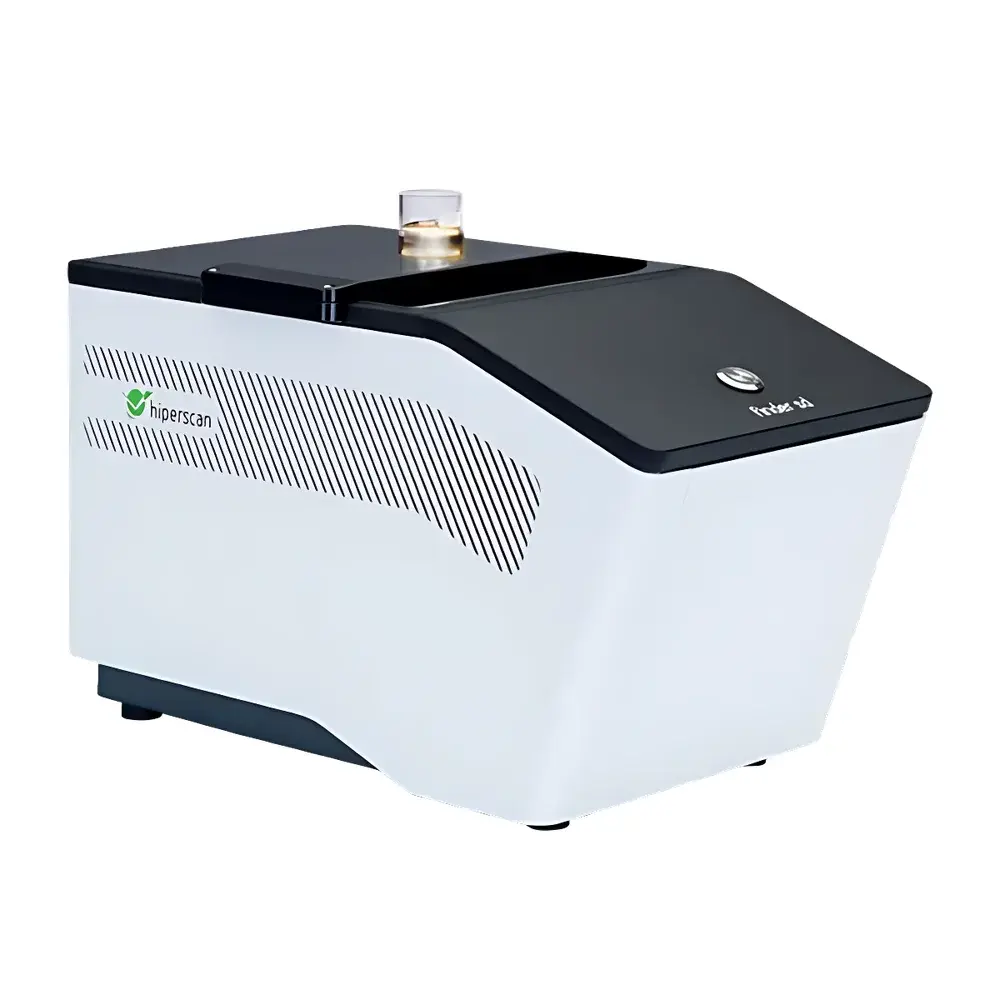
HiperScan Finder SD Near Infrared Spectrometer
| Brand | HiperScan |
|---|---|
| Origin | Germany |
| Model | Finder SD |
| Spectral Range | 1000–1900 nm |
| Spectral Resolution | 10 nm |
| Stray Light | ≤0.20% |
| Measurement Time | <5 s (average of ≥500 scans), configurable from 1–15 s |
| Detector | Single-element uncooled InGaAs |
| Wavelength Accuracy | ±0.5 nm |
| Wavelength Repeatability | ±0.2 nm |
| Photometric Reproducibility | ±0.1% |
| SNR | >2000:1 (≥2000 scans), >1000:1 (≥500 scans) |
| Photometric Linearity (max/RMS) | ≤1% / <1% |
| Light Source | Tungsten-halogen lamp |
| Sampling Interface | Diffuse reflectance probe (23 mm aperture) |
| Thermal Stability | Yes |
| Dimensions (W×D×H) | 225 × 235 × 385 mm |
| Weight | 9 kg |
| Interface | USB Type-B (with optional auxiliary I/O for motor control or sensor input) |
| Operating Temperature | 15–35 °C (Type 55) or 5–30 °C (Type 50) |
| Storage Temperature | −20 to +60 °C (non-condensing) |
| IP Rating | IP65 |
| Power Supply | 100–240 VAC ±10%, 50–60 Hz |
| Power Consumption | 78 W (warm-up), 36 W (operation), 5 W (standby) |
Overview
The HiperScan Finder SD Near Infrared Spectrometer is a benchtop-grade, CE-compliant NIR analyzer engineered for rapid, non-destructive identification and verification of pharmaceutical raw materials and finished dosage forms in regulated pharmacy and manufacturing environments. It operates on the principle of diffuse reflectance near-infrared spectroscopy (NIRS) in the 1000–1900 nm spectral region—covering key overtones and combination bands of C–H, O–H, and N–H functional groups—enabling robust qualitative and semi-quantitative analysis without sample preparation. Designed to meet the stringent operational and documentation requirements of European pharmacies and GMP-compliant facilities, the Finder SD delivers pharmacopeial compliance with EP 2.2.40 (Identification of Substances by Spectrophotometry) and §6 & §11 of the German Apothekenbetriebsordnung (ApBetrO). Its rugged, IP65-rated enclosure ensures reliable performance in ambient pharmacy settings—including counter-side use—and its battery-independent architecture supports offline operation across multiple locations without internet dependency.
Key Features
- Pharmacopeia-aligned measurement protocol: Fully compliant with EP 2.2.40 and German ApBetrO §§6/11 for identity testing of APIs and excipients.
- Validated pharmaceutical reference library: Contains >1,100 fully verified substances—including solids, semi-solids, liquids, suspensions, granules, and ointments—with traceable validation documentation (4,000+ page PDF audit trail).
- Zero-cross-contamination design: Optical path and sampling interface are physically isolated; no contact between successive samples; no carryover risk.
- Automated system self-validation: Built-in wavelength and photometric calibration routines execute at startup and on-demand, ensuring continuous traceability per ISO/IEC 17025 and GLP principles.
- Batch-centric workflow engine: Supports sequential batch testing with auto-generated container records, PZN (Pharmazentralnummer) tagging, operator ID logging, and timestamped result archiving.
- Ruggedized field-ready construction: IP65 ingress protection, thermal stability across 5–35 °C operating range, and compact footprint (225 × 235 × 385 mm) for integration into pharmacy labs or production QC stations.
Sample Compatibility & Compliance
The Finder SD accommodates diverse pharmaceutical matrices via two standardized optical interfaces: a 23 mm diffuse reflectance probe for direct surface scanning of tablets, capsules, or bulk powders, and a 32 mm sample cup for homogenous slurries, gels, or low-viscosity liquids. All measurement protocols adhere to the acceptance criteria defined in EP 2.2.40 for spectral similarity metrics (e.g., correlation coefficient, Euclidean distance, or Mahalanobis distance thresholds). The instrument’s photometric linearity (<1% RMS deviation) and wavelength repeatability (±0.2 nm) satisfy the reproducibility requirements for identity testing under USP , Ph. Eur. 2.2.40, and FDA guidance on NIR-based release testing. Full traceability is maintained through embedded audit trails compliant with 21 CFR Part 11 (electronic signatures, event logs, and immutable data storage).
Software & Data Management
The embedded HiperScan AnalyzeSuite software provides a locked-down, role-based interface optimized for pharmacy personnel—not spectroscopists. It features batch-oriented navigation, PZN-driven search, and exhaustive metadata capture (batch number, expiry date, supplier code, analyst ID). Search functionality includes both exact-match and similarity-based retrieval using spectral fingerprinting algorithms. All results—including raw spectra, match scores, reference spectra overlays, and validation reports—are exportable in PDF/A-1b format for regulatory submission. Audit logs record every user action, calibration event, and database update with time stamps, user credentials, and hash-verified integrity checks. No cloud dependency: all data resides locally on the device’s encrypted internal storage, supporting air-gapped deployment per GDPR and national pharmacy data sovereignty requirements.
Applications
- Raw material identity verification upon receipt (APIs, lactose, microcrystalline cellulose, povidone, etc.)
- Finished product screening for counterfeit detection and packaging integrity verification
- In-process monitoring of wet granulation endpoints and blend uniformity (via representative sampling)
- Stability-indicating assays for moisture content and polymorphic form tracking
- Regulatory documentation support for EU GDP/GMP audits and German state pharmacy inspections
- Multi-site deployment across decentralized pharmacy networks with synchronized database updates via secure USB transfer
FAQ
Does the Finder SD require annual recalibration by a certified service provider?
No. The instrument performs automated internal wavelength and intensity calibration at startup and before each measurement series. External recalibration is only required if physical damage occurs or after major component replacement—documented per ISO/IEC 17025 Annex A.3.
Can the reference library be extended with proprietary compounds?
Yes. Custom substance entries may be added using the validated method development module, which enforces EP 2.2.40-compliant spectral acquisition, replicate testing (n ≥ 3), and statistical confidence reporting (p < 0.01). All additions generate full validation dossiers.
Is the USB interface sufficient for integration with LIMS or ERP systems?
The USB-B port supports mass-storage mode for manual data export. For automated bidirectional integration, an optional RS-485 or Ethernet module (sold separately) enables HL7 v2.x or ASTM E1384-compliant messaging.
What environmental conditions invalidate measurement validity?
Measurements performed outside the specified operating temperature range (Type 50: 5–30 °C; Type 55: 15–35 °C) or in condensing humidity (>80% RH) are flagged as invalid in the audit log and excluded from report generation.
How is data integrity ensured during power interruption?
All spectral acquisitions and metadata are written to non-volatile flash memory with journaling file system (JFFS2). Power-loss recovery preserves partial scans and maintains cryptographic checksums for all stored records.
Related Products





