
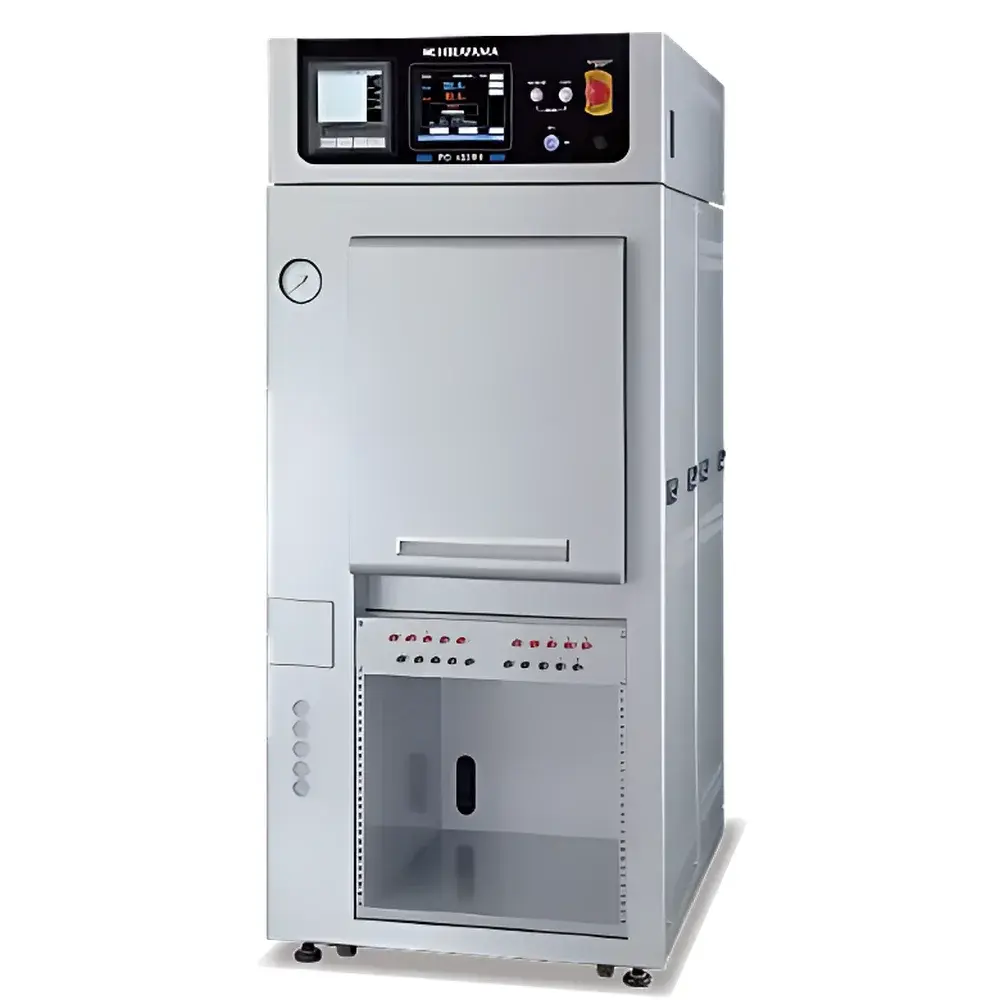
Hirayama PC-R9 Series High-Accelerated Stress Test (HAST) Chamber
| Brand | Hirayama |
|---|---|
| Origin | Japan |
| Model | PC-R9 Series (PC-304R9, PC-422R9, PC-304R9D, PC-422R9D) |
| Control Interface | Color Touch Panel with Remote Application Support |
| Data Storage | External USB Memory |
| Communication | RS-485 / Ethernet (Optional) |
| Cooling System | Integrated Drainable Chilled Water Tank |
| Chamber Configuration | Dual-Chamber Design |
| Optional Features | Air Purge Function, External Pressure Supply, Auto-Cleaning for Electrochemical Migration (ECM) Evaluation |
Overview
The Hirayama PC-R9 Series High-Accelerated Stress Test (HAST) Chamber is an engineered environmental reliability testing system designed to replicate and accelerate failure mechanisms in electronic components and printed circuit board (PCB) assemblies under highly controlled elevated temperature, high humidity, and pressurized conditions. Unlike traditional Temperature-Humidity-Bias (THB) testing, HAST applies saturated steam at elevated pressure (typically 100–150 kPa gauge) and temperature (110–130 °C), significantly increasing the diffusion rate of moisture into encapsulants, conformal coatings, and interfacial layers. This enables detection of latent defects—including dielectric breakdown, corrosion at metallization interfaces, and electrochemical migration (ECM)—in days rather than weeks or months. The PC-R9 series complies with industry-standard test protocols including JEDEC JESD22-A110 (HAST), JESD22-A118 (Unbiased HAST), and IEC 60068-2-66, supporting qualification and process validation in accordance with AEC-Q200, IPC-9701, and ISO/IEC 17025-accredited laboratory practices.
Key Features
- Dual-chamber architecture minimizes thermal and vapor gradient inconsistencies, ensuring uniform stress distribution across sample arrays and enabling comparative testing of control vs. experimental units within a single cycle.
- Programmable operation modes: Standard HAST, Unbiased HAST, and Pressure-Only mode—each configurable via intuitive color touch panel interface with real-time graphical monitoring of chamber pressure, temperature, and relative humidity.
- Integrated auto-cleaning function mitigates ionic residue accumulation during ECM evaluation by periodically flushing condensate pathways and chamber walls using deionized water, reducing cross-test contamination and improving repeatability.
- External pressure supply option supports dynamic overpressure control up to 200 kPa(g), facilitating custom stress profiles aligned with proprietary reliability models or extended qualification requirements.
- Modular communication interface (standard RS-485; optional Ethernet) enables integration into centralized test management systems, supporting remote parameter setting, real-time data streaming, and alarm notification via SNMP or Modbus TCP.
- Drainable chilled water tank ensures stable condensation management during extended cycles (>96 h), preventing thermal drift and maintaining compliance with JEDEC-defined dew point stability criteria (±0.5 °C).
Sample Compatibility & Compliance
The PC-R9 accommodates standard PCB test coupons (up to 422 mm × 304 mm in PC-422R9 variant), bare dies, packaged ICs, automotive ECUs, and flexible hybrid circuits. Chamber interior materials—316L stainless steel walls, PTFE-coated shelves, and EPDM-free sealing gaskets—resist hydrolytic degradation and chloride-induced stress corrosion cracking. All operational firmware and calibration records adhere to GLP/GMP documentation standards, with full audit trail capability for FDA 21 CFR Part 11-compliant environments when paired with validated software packages. Test reports generated include timestamped environmental logs, pressure ramp profiles, and pass/fail status per IEC 61215 (for PV modules) or AEC-Q100 stress acceptance criteria.
Software & Data Management
Local operation is managed through the embedded Hirayama HAST Control Suite (v3.2+), supporting up to 99 programmable test sequences with nested step logic (ramp-hold-dwell-depressurize). All run logs—including sensor timestamps, setpoint deviations, and door-open events—are automatically archived to USB storage in CSV and PDF formats compliant with ISO/IEC 17025 clause 7.5.2. Optional cloud-connected gateway enables secure TLS 1.2 upload to LIMS platforms, with role-based access control and electronic signature support for SOP-driven workflows. Calibration certificates traceable to NMIJ (National Metrology Institute of Japan) are provided with each unit shipment.
Applications
- Qualification of solder mask adhesion and underfill integrity in advanced packaging (e.g., SiP, Fan-Out WLP)
- Failure analysis root cause isolation for field-return units exhibiting intermittent opens/shorts
- Process window validation for conformal coating application (acrylic, silicone, parylene)
- Reliability screening of automotive ADAS sensors operating in humid tropical climates
- Accelerated aging studies for medical electronics subject to ISO 14971 risk management frameworks
FAQ
What is the maximum allowable test duration for continuous HAST operation?
The PC-R9 series supports uninterrupted operation up to 1,000 hours, contingent upon scheduled maintenance intervals and coolant replenishment per Hirayama Technical Bulletin TB-HAST-07.
Does the system meet JEDEC JESD22-A110 Rev. E requirements for pressure stabilization time?
Yes—the dual-chamber design and PID-controlled steam injection achieve ≤60 seconds pressure stabilization after door closure, verified per Section 4.2.1 of JESD22-A110E.
Can external humidity sensors be integrated for independent verification?
The chamber includes two calibrated capacitive RH sensors (Vaisala HUMICAP®); third-party probes may be installed via the auxiliary analog input port (0–10 VDC) with user-defined scaling in firmware.
Is depressurization rate programmable?
Yes—depressurization profiles (linear, stepwise, or exponential) are fully configurable to prevent mechanical shock to sensitive substrates during post-test handling.
What maintenance is required between test cycles?
Daily visual inspection of O-rings and drain lines; monthly cleaning of steam generator chamber and ultrasonic bath reservoir; annual recalibration of pressure transducers and PT100 temperature sensors by authorized service centers.



