
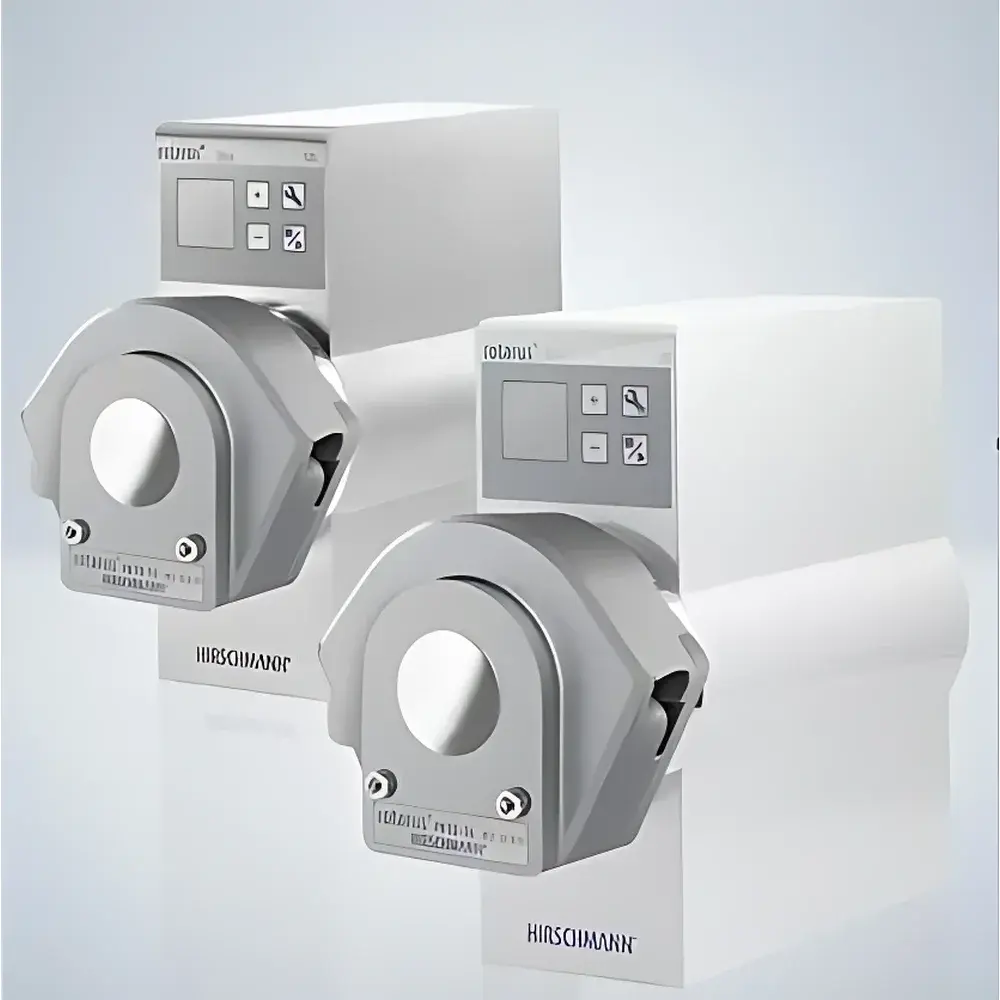
Hirschmann rotarus® Smart Dispensing Workstation (Peristaltic Pump)
| Brand | Hirschmann (Germany) |
|---|---|
| Origin | Germany |
| Model | rotarus® |
| Drive Speed Range | 0.2–500 rpm |
| Motor Options | 50 W / 100 W |
| Enclosure Ratings | IP54 (Laboratory) / IP65 (Industrial) |
| Flow Rate Range | 0.0009–5400 mL/min |
| Control Interfaces | RS232, USB |
| Channel Configurations | 1-, 4-, 8-, and 12-channel pump heads |
| Calibration Method | Gravimetric, with 0.0001 mL resolution |
| Pump Tube Recognition | RFID-enabled |
| Pump Head Compatibility | Interchangeable, tool-free installation |
| Compliance | Designed for ISO/IEC 17025, GLP, and GMP-aligned workflows |
Overview
The Hirschmann rotarus® Smart Dispensing Workstation is a precision-engineered peristaltic pump system designed for reproducible, traceable, and contamination-free liquid handling in regulated and high-throughput environments. Based on the well-established principle of peristaltic displacement—where rollers compress flexible tubing to generate positive displacement—the rotarus® platform eliminates fluid contact with mechanical components beyond the pump tube itself. This design ensures absolute chemical compatibility, zero risk of cross-contamination, and full compliance with Good Laboratory Practice (GLP) and Good Manufacturing Practice (GMP) requirements. Engineered in Germany and manufactured to DIN-certified quality standards, the rotarus® workstation supports both standalone operation and integration into automated laboratory workflows, including LIMS-connected systems and production-line control architectures.
Key Features
- Three dedicated control variants: flow-series (flow-rate prioritized), volume-series (volumetric accuracy focused), and fast-series (high-speed dispensing optimized), each equipped with an integrated TFT touchscreen interface and front-panel smart control panel.
- Dual-motor architecture: 50 W and 100 W brushless DC motors deliver continuous speed control from 0.2 to 500 rpm, enabling stable handling of low-viscosity solvents and highly viscous media—including gels, slurries, and suspensions containing particulates up to 1 mm in diameter.
- IP54-rated enclosures for standard laboratory use and IP65-rated housings for industrial environments exposed to dust, moisture, or aggressive cleaning agents.
- RFID-based pump head and tubing identification: automatically detects installed components, validates calibration history, and prevents configuration errors during method transfer.
- Real-time tube integrity monitoring: algorithms analyze torque signatures and pressure differentials to detect early-stage tube fatigue, micro-cracks, or occlusion events—triggering audible/visual alerts before failure occurs.
- Tool-free, modular pump head mounting: supports rapid interchange between single-channel, 4-channel, 8-channel, and 12-channel configurations; compatible with third-party pump heads meeting ISO 8536-4 and DIN 13022 dimensional specifications.
Sample Compatibility & Compliance
The rotarus® system interfaces exclusively with certified peristaltic tubing—available in >15 chemically resistant materials (e.g., Viton®, Tygon® E-3603, PharMed® BPT, C-Flex®)—validated against USP Class VI, FDA 21 CFR Part 11, and ISO 10993 biocompatibility standards. Its tubing selection matrix enables safe handling of aggressive reagents including hydrofluoric acid (HF), concentrated sulfuric acid (H₂SO₄), aqua regia, and organic solvents. All models support gravimetric calibration protocols aligned with ISO 8655-4 (piston pipettes) and ASTM D1193 (reagent water specifications), ensuring volumetric accuracy traceable to national metrology institutes (e.g., PTB, NIST). Audit trails, electronic signatures, and user-access-level controls meet requirements for regulated environments under EU Annex 11 and FDA 21 CFR Part 11.
Software & Data Management
The rotarus® workstation operates via embedded firmware supporting four dispensing modes: constant-flow (fixed mL/min), volume-controlled (target volume at defined speed), time-controlled (fixed duration at fixed speed), and volume/time-synchronized (dual-parameter constraint). Calibration data—including tube ID, inner diameter, wall thickness, and gravimetric correction factors—is stored in non-volatile memory with timestamped revision history. Remote operation is enabled through RS232 serial or USB virtual COM port interfaces, allowing seamless integration with LabVIEW, Python-based automation scripts, or MES/SCADA platforms. Optional software packages provide CSV export of dispense logs, trend analysis of tube wear over time, and batch-report generation compliant with ISO/IEC 17025 clause 7.7.
Applications
The rotarus® platform serves as a core liquid-handling engine across analytical, microbiological, and process-development laboratories. Typical use cases include: preparation of culture media and dilution series in ISO 11133-compliant microbiology labs; filtration and sample conditioning prior to HPLC or ICP-MS analysis; metering of adhesives, sealants, and ceramic slurries in electronics manufacturing; dispensing of pH-sensitive buffers in cell-culture workflows; and continuous feeding of reagents into bioreactors or inline UV-Vis flow cells. Its ability to maintain accuracy across 6 orders of magnitude in flow rate (from 0.0009 to 5400 mL/min) makes it suitable for both nanoliter-scale assay setup and bulk solution transfer in pilot-scale operations.
FAQ
What tubing materials are certified for use with the rotarus® system?
Hirschmann provides a validated tubing compatibility matrix covering fluoropolymers, silicone elastomers, and thermoplastic elastomers—each tested for extractables, leachables, and long-term compression set per ISO 8536-4.
Can the rotarus® be integrated into a LIMS or ELN environment?
Yes—via ASCII command protocol over RS232 or USB CDC, enabling bidirectional communication for method upload, dispense log retrieval, and instrument status polling.
How is volumetric accuracy verified and maintained over time?
Gravimetric calibration is performed using certified analytical balances (≥0.01 mg readability); correction factors are applied per tube lot and stored in the device’s secure memory with cryptographic hash verification.
Is remote firmware update supported?
Firmware updates are delivered as signed binary packages via USB stick; update integrity is verified using SHA-256 checksums and ECDSA signature validation before installation.
Does the system support multi-step dispensing sequences?
While native sequencing is limited to single-step protocols, external controllers (e.g., PLCs or Python-driven PCs) can orchestrate complex multi-dispense routines using the rotarus®’s command set and real-time status feedback.



