
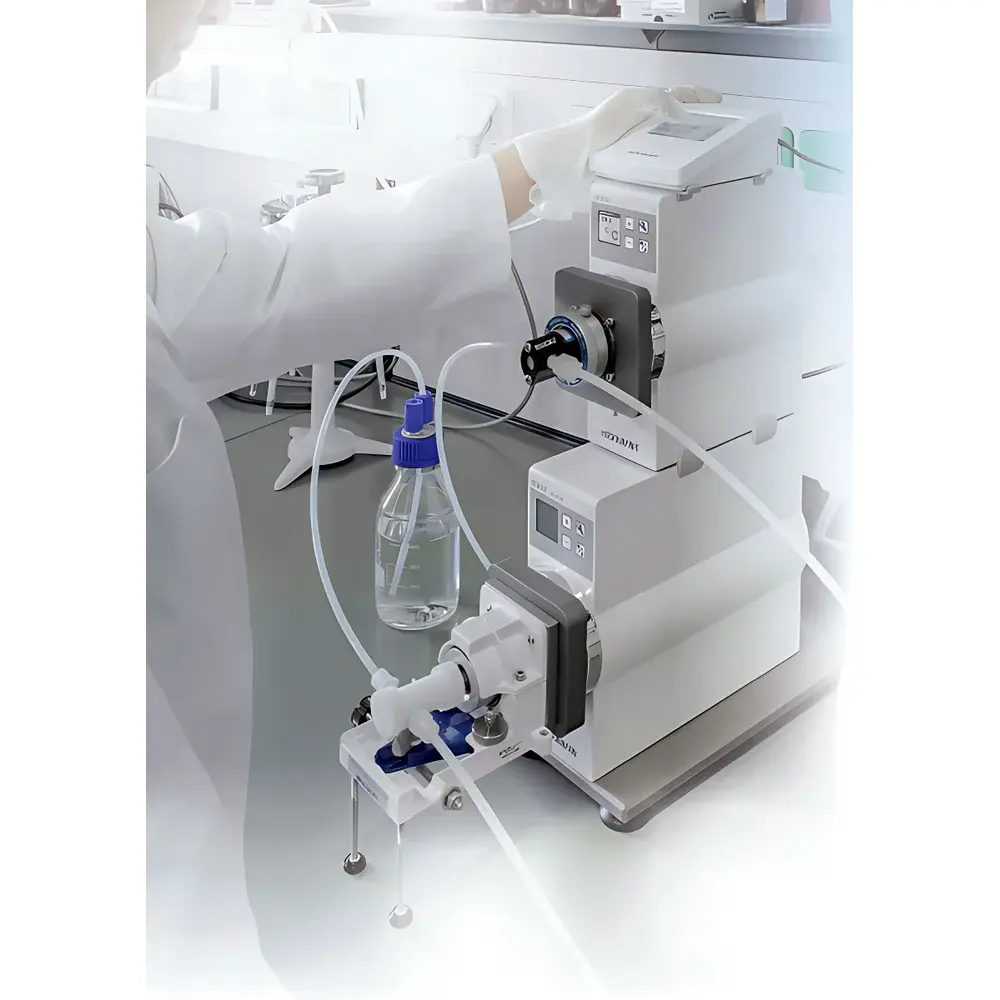
Hirschmann rotarus® Smart Dispensing Workstation (Piston Pump)
| Brand | Hirschmann (Germany) |
|---|---|
| Origin | Germany |
| Model | rotarus® |
| Pump Type | Precision Piston Dispenser |
| Flow Rate Range | 0.0026 – 2304 mL/min |
| Speed Range | 0.1 – 9999.9 rpm |
| Motor Options | 50 W / 100 W |
| Enclosure Ratings | IP54 (Lab) / IP65 (Industrial) |
| Piston Volume Range | 2.5 µL – 1280 µL per stroke |
| Wetted Materials | Ceramic, PTFE, FEP, ETFE |
| Communication Interfaces | RS232, USB |
| Calibration Method | Gravimetric, 4-decimal-place resolution |
| Dispensing Modes | Continuous Flow, Fixed Volume/Fixed Speed, Fixed Time/Fixed Speed, Fixed Volume/Fixed Time |
Overview
The Hirschmann rotarus® Smart Dispensing Workstation is a high-precision, motor-driven piston pump system engineered for repeatable, gravimetrically validated liquid handling across research laboratories, quality control environments, and industrial production lines. Unlike peristaltic or syringe-based dispensers, the rotarus® employs a patented oblique-angle piston drive mechanism—where axial rotation couples with angular displacement to convert rotational motion into precise linear piston strokes. This mechanical architecture ensures constant volumetric displacement per revolution, independent of fluid viscosity, pressure backflow, or temperature drift. The system operates on a true positive-displacement principle, eliminating pulse artifacts and compressibility errors common in diaphragm or gear-driven pumps. Designed for long-term stability under continuous operation, it supports both low-flow microdispensing (down to 2.5 µL/stroke) and high-throughput bulk transfer (up to 2304 mL/min), making it suitable for applications ranging from analytical sample preparation to chemical synthesis scale-up.
Key Features
- Three dedicated control configurations: base model with integrated smart panel; flow-series with real-time flow-rate monitoring; volume-series with volumetric endpoint validation; fast-series optimized for rapid cycle times and multi-step protocols.
- Dual-motor platform (50 W and 100 W) enables consistent torque delivery across the full speed range (0.1–9999.9 rpm), ensuring reliable aspiration and ejection of viscous media—including glycerol, polymer solutions, and molten salts—without slippage or stalling.
- IP54-rated enclosure for standard laboratory use; IP65-rated variant certified for washdown environments and integration into GMP-compliant manufacturing cells.
- RFID-enabled pump head identification prevents misconfiguration and ensures traceability during instrument qualification (IQ/OQ/PQ). Automatic diagnostics detect tubing rupture, occlusion, and seal wear via real-time torque profiling.
- Gravimetric calibration routine compliant with ISO 8655-3 and ASTM E2758, supporting four-digit resolution (e.g., 0.0001 mL/rev) and full traceability of calibration parameters including density correction, temperature compensation, and tare stabilization thresholds.
- Tool-free, modular pump head mounting allows sub-30-second head swaps. Compatible with third-party piston assemblies meeting DIN 12781 geometric specifications.
Sample Compatibility & Compliance
The rotarus® accommodates aggressive chemistries through fully inert wetted-path materials: alumina ceramic pistons, PTFE-sealed cylinders, FEP/ETFE fluid paths, and chemically resistant O-rings. It has been validated for repeated use with hydrofluoric acid (49%), concentrated sulfuric acid (98%), aqua regia, chlorosulfonic acid, and anhydrous solvents such as THF and pyridine. All configurations meet IEC 61000-6-2/6-3 for electromagnetic compatibility and are CE-marked per Machinery Directive 2006/42/EC. For regulated environments, firmware supports audit trail logging (21 CFR Part 11–compliant when paired with validated LIMS), electronic signature capture, and user-level access control (admin/operator/technician tiers).
Software & Data Management
The workstation communicates via ASCII-based RS232 protocol and USB virtual COM port, enabling native integration with LabVIEW, Python (PySerial), MATLAB, and SCADA systems. Optional Hirschmann ControlSuite software provides graphical workflow builder, method storage (≥1000 protocols), batch reporting (CSV/PDF), and GLP-compliant electronic lab notebook (ELN) export. All dispense events—including timestamp, volume delivered, motor current, error codes, and RFID-read ID—are logged with SHA-256 hash integrity verification. Remote firmware updates preserve configuration history and support delta-patch deployment without full reinstallation.
Applications
- Automated reagent addition in ICP-MS, HPLC, and titration workflows requiring sub-µL precision and acid resistance.
- High-viscosity formulation dosing in pharmaceutical excipient blending and battery electrolyte filling.
- Standardized sample dilution series generation for ISO/IEC 17025-accredited testing labs.
- In-line process analytics where pump output feeds directly into flow cells or reaction calorimeters.
- Cell culture media preparation with sterility-preserving non-contact dispensing using autoclavable pump heads.
- Calibration standard preparation for metrology labs adhering to ISO/IEC 17025 Clause 6.4.10 (volumetric equipment verification).
FAQ
What distinguishes the rotarus® from conventional peristaltic or syringe pumps?
The rotarus® uses a mechanically synchronized piston stroke driven by angular rotation—not compression or plunger translation—delivering inherently pulse-free, viscosity-independent volumetric accuracy without recalibration between fluid types.
Can the system be validated for GMP production use?
Yes. Full IQ/OQ documentation packages are available, including factory-as-tested calibration certificates, material compliance declarations (FDA 21 CFR 177, USP Class VI), and electronic record retention protocols aligned with Annex 11 and ALCOA+ principles.
Is gravimetric calibration required before each use?
No. Calibration is performed periodically per SOP (typically every 6–12 months or after maintenance); however, daily performance checks using reference weights are recommended and supported by built-in verification routines.
Does the system support multi-channel parallel dispensing?
Not natively—but multiple rotarus® units can be synchronized via external PLC or master controller using TTL trigger signals and shared clock inputs, enabling coordinated multi-stream delivery with ±10 ms timing alignment.
How is tubing or pump head wear monitored?
Real-time motor current profiling detects deviations exceeding ±3% RMS from baseline, triggering alerts for seal degradation or piston scoring; RFID tags log cumulative operational hours per component for predictive maintenance scheduling.



