
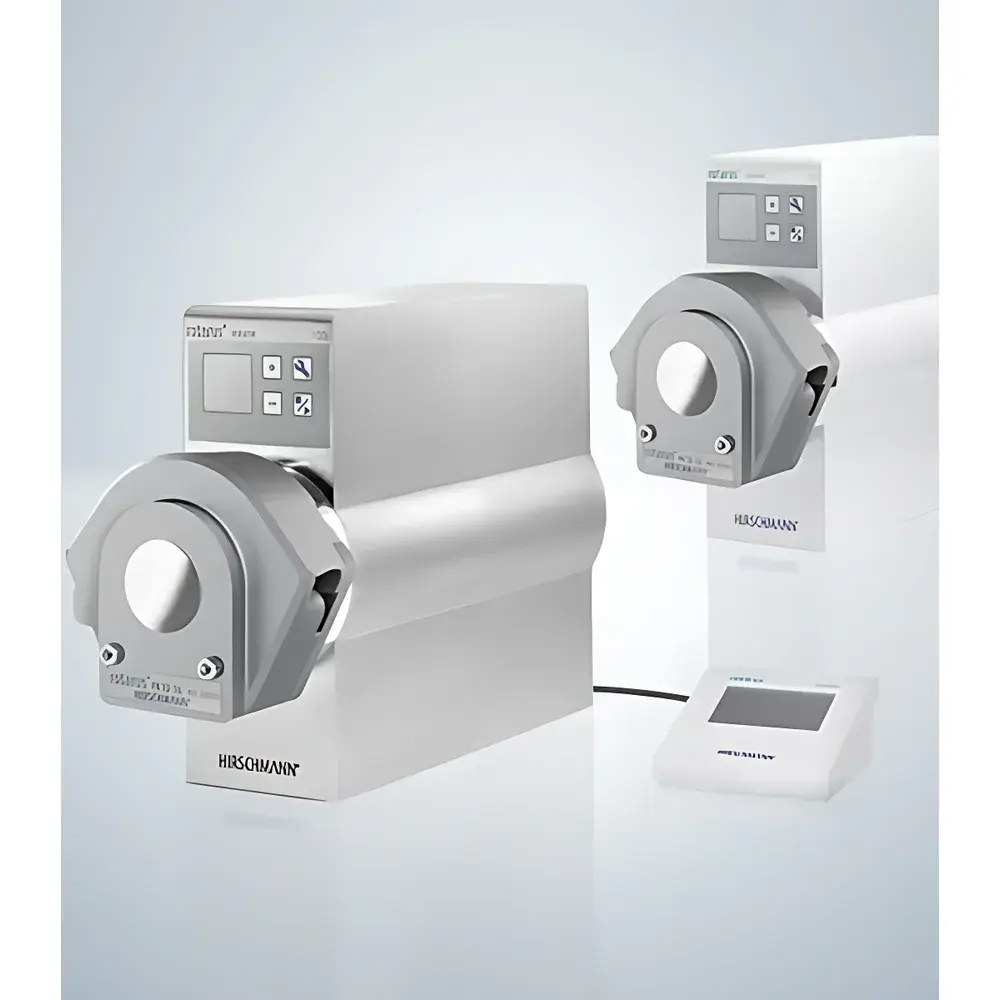
Hirschmann rotarus® volume 100 High-Precision Intelligent Peristaltic Dispensing Pump
| Brand | Hirschmann |
|---|---|
| Origin | Germany |
| Model | rotarus® volume 100 |
| Drive Speed Range | 0.2–500 rpm |
| Motor Type | 0-Watt Brushless DC Motor |
| Protection Rating | IP54 (lab version), IP65 (stainless steel industrial version) |
| Control Interface | Integrated TFT Touchscreen + Front Panel Keypad |
| Communication | RS232, USB |
| Power Supply | 24 V DC |
| Compliance | IEC 61000-6-2/6-4, EN 61326-1 (EMC for laboratory equipment) |
Overview
The Hirschmann rotarus® volume 100 is a high-precision, microprocessor-controlled peristaltic dispensing pump engineered for repeatable, traceable, and programmable liquid handling in regulated laboratory and industrial environments. Operating on the principle of positive displacement via roller compression of elastomeric tubing, it delivers accurate volumetric transfer without fluid contact with internal mechanical components—ensuring contamination-free operation and compatibility with aggressive, viscous, or particulate-laden media. Unlike conventional peristaltic pumps limited to fixed-speed operation, the rotarus® volume 100 integrates closed-loop speed control and real-time torque monitoring to maintain consistent flow dynamics across variable load conditions. Its core architecture supports both continuous delivery and discrete dispensing modes, with programmable parameters including rotational speed, dispensing interval, total volume, cycle count, and ramped acceleration/deceleration profiles—enabling precise replication of complex fluidic protocols required in QC testing, bioprocessing, reagent preparation, and inline dilution workflows.
Key Features
- Brushless DC motor with zero-watt standby power consumption and extended low-speed resolution (0.2–100 rpm), enabling ultra-fine metering down to microliter-per-second ranges.
- Dual protection rating options: white powder-coated housing certified to IP54 (dust-protected, splash-resistant) for general laboratory use; stainless-steel enclosure rated IP65 (dust-tight, low-pressure water jet resistant) for harsh production floor or cleanroom environments.
- RFID-based pump head and tubing identification system—automatically detects installed components, validates compatibility, and prevents misconfiguration during method execution.
- Real-time occlusion and tubing rupture detection via dynamic current signature analysis, triggering immediate pause and audible/visual alerts to prevent process deviation or sample loss.
- Integrated 4.3-inch TFT touchscreen controller with intuitive icon-driven UI, complemented by physical keypad for gloved-hand operation and redundant parameter entry.
- Tool-free, one-click pump head exchange mechanism supporting single-channel (1–4 channels) and multi-channel (up to 8 parallel lines) configurations—minimizing downtime during method changeovers.
- Onboard calibration routine with traceable reference standards, supporting gravimetric or volumetric verification per ISO 8655-4 and ASTM E2772 guidelines.
Sample Compatibility & Compliance
The rotarus® volume 100 accommodates a broad spectrum of liquids—including aqueous buffers, organic solvents (e.g., acetonitrile, ethanol), cell culture media, glycerol-based formulations, and suspensions containing particles ≤100 µm—when paired with chemically resistant tubing (e.g., PharMed® BPT, Tygon® LFL, or silicone alternatives). Its design conforms to electromagnetic compatibility requirements per EN 61326-1 (Class A, laboratory use) and IEC 61000-6-2/6-4. The firmware supports audit trail generation and user-access control levels, aligning with GLP and GMP documentation expectations. While not inherently 21 CFR Part 11 compliant out-of-the-box, the device’s method storage, electronic signature-ready parameter logs, and exportable CSV/Excel reports facilitate integration into validated systems when deployed with appropriate IT infrastructure and procedural controls.
Software & Data Management
All operational parameters—including speed profiles, dispensing sequences, cycle counts, and calibration history—are stored internally in non-volatile memory with timestamped metadata. Methods can be saved, recalled, duplicated, and password-protected directly via the touchscreen interface. Remote configuration and monitoring are enabled through RS232 serial or USB virtual COM port communication, allowing integration with LIMS, MES, or SCADA platforms using standard ASCII command protocols. Exported data files include full execution logs with start/stop times, actual vs. setpoint speed deviations (<±0.5% full scale), and event flags for tubing alerts. Firmware updates are performed via USB stick with SHA-256 checksum validation to ensure integrity.
Applications
- Automated buffer and reagent dispensing in molecular biology labs (e.g., PCR setup, ELISA plate filling).
- In-line dilution and feed control in bioreactor inoculation and perfusion systems.
- Continuous dosing of catalysts or pH adjusters in chemical synthesis reactors.
- High-throughput sample preparation for ICP-MS, HPLC, or titration workflows requiring sub-milliliter accuracy.
- Pharmaceutical QC testing where tubing-based fluid paths eliminate cross-contamination risks inherent in piston-driven systems.
- Environmental lab applications involving corrosive digestants (e.g., nitric/hydrochloric acid mixtures) compatible with fluoropolymer-lined tubing.
FAQ
Does the rotarus® volume 100 support regulatory-compliant data integrity practices?
Yes—it provides time-stamped method logs, user access levels, and immutable execution records exportable for review. When integrated into a validated environment with controlled change management, it meets ALCOA+ principles.
Can third-party pump heads be used with this system?
The rotarus® volume 100 accepts standardized peristaltic pump heads conforming to DIN 32676 geometry; however, RFID recognition and automatic parameter optimization are only guaranteed with genuine Hirschmann-certified heads.
What is the minimum dispensing volume achievable with this pump?
Minimum repeatable dispense volume depends on tubing inner diameter, rotation speed, and dwell time—but typical gravimetric validation yields ≤50 µL with CV <2.5% (n=6) using 0.5 mm ID PharMed® tubing at 2 rpm.
Is calibration traceable to national standards?
Calibration is performed against NIST-traceable mass standards (e.g., Mettler Toledo balances) per internal SOP; certificate of calibration includes uncertainty budget per ISO/IEC 17025 requirements.
How often does tubing require replacement under continuous operation?
Lifespan varies with pressure, speed, and chemical exposure—typically 500–1,000 hours for silicone tubing at ≤100 rpm; fluoropolymer variants extend service life up to 3,000 hours under equivalent conditions.



