
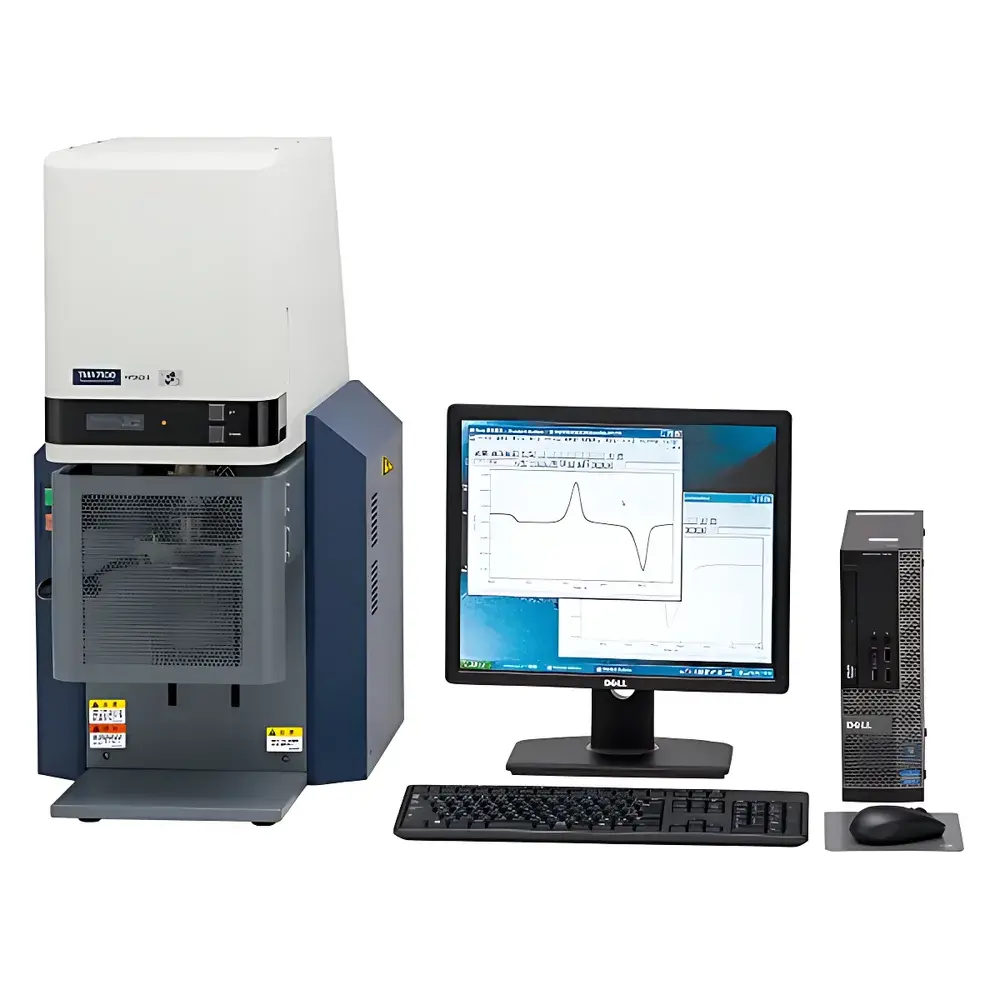
Hitachi TMA7100 & TMA7300 Thermomechanical Analyzer
| Brand | Hitachi |
|---|---|
| Origin | Japan |
| Model | TMA7100 / TMA7300 |
| Temperature Range | –170 °C to 600 °C (TMA7100) |
| Displacement Range | ±5 mm |
| Sensitivity (RMS Noise) | 0.005 µm / Resolution: 0.01 µm |
| Load Range | ±5.8 N (Resolution: 9.8 µN) |
| Heating Rate | 0.01–100 °C/min |
| Sample Max Dimensions | Ø10 mm × 25 mm (cylindrical) or 5 mm × 1 mm × 25 mm (film) |
| Probe Mounting | Cantilever-type |
| Atmosphere Control | Ambient, inert gas, vacuum (~1.3 Pa), optional humidity & swelling modules |
| Load/Displacement Control Modes | Constant force, constant rate, oscillatory (0.001–1 Hz), multi-step sequences (up to 40 steps) |
| Optional Cooling | Automated LN₂ cooling (–150 °C to 600 °C), electronic cooler (–60 °C to 450 °C), forced-air cooling (RT–600 °C), LN₂ Dewar kit (–170 °C to 600 °C) |
| Sample Tube Materials | Quartz (TMA7100), Alumina (TMA7300) |
| Probe Types | Expansion/compression quartz, penetration (standard & conical), tensile (quartz & metal), bending, sapphire dilatometry |
Overview
The Hitachi TMA7100 and TMA7300 Thermomechanical Analyzers are precision instruments engineered for high-resolution measurement of dimensional changes in solid materials as a function of temperature, time, and applied mechanical load. Based on the cantilever-probe principle, these systems employ a highly stable, low-noise transduction architecture to detect minute dimensional responses—such as linear expansion, contraction, softening, creep, stress relaxation, and viscoelastic deformation—with sub-10-nm displacement resolution. The TMA7100 operates across an extended cryogenic-to-moderate-high-temperature range (–170 °C to 600 °C), enabled by interchangeable cooling options including automated liquid nitrogen vaporization control. The TMA7300 extends operational capability to ultra-high temperatures (up to 1500 °C) using an alumina sample tube and optimized furnace design—subject to controlled usage above 1300 °C to mitigate heating element evaporation and extend furnace service life. Both models implement full-expansion geometry, eliminating geometric constraints associated with conventional push-rod configurations; this allows uniform thermal contact and reproducible measurement regardless of sample morphology—from free-standing films (as thin as 1 µm) to bulk cylinders (Ø10 mm × 25 mm).
Key Features
- Ultra-high displacement sensitivity: RMS noise of 0.005 µm and resolution of 0.01 µm—double the sensitivity of prior-generation Hitachi TMA platforms.
- Multi-mode mechanical probing: Single-probe interchangeability supports expansion, compression, penetration (standard and conical tip), tensile (quartz and metal variants), bending, and sapphire-based dilatometric measurements—without recalibration.
- Modular thermal control: Four cooling options—automated LN₂ system (–150 °C to 600 °C), electronic Peltier cooler (–60 °C to 450 °C), forced-air convection (RT to 600 °C), and manual LN₂ Dewar (–170 °C to 600 °C)—enable precise thermal protocol alignment across material classes.
- Advanced load/displacement control: Programmable force profiles include constant load (±5.8 N), constant-rate loading (9.8×10⁻² to 9.8×10⁶ mN/min), sinusoidal oscillation (0.001–1 Hz), and up to 40-step composite sequences—supporting ISO 11359-2, ASTM E831, and ASTM D696 compliant testing.
- Integrated environmental management: Mass-flow-controlled gas delivery (inert, oxidizing, reducing), vacuum capability down to ~1.3 Pa, and optional humidity/swelling modules enable studies under physiologically or industrially relevant atmospheres.
- Automated dimensional metrology: Onboard optical length measurement ensures accurate baseline correction and eliminates operator-dependent positioning errors during sample loading.
Sample Compatibility & Compliance
The TMA7100/TMA7300 accommodate diverse physical forms—including thin polymer films, ceramic pellets, metallic wires, elastomeric strips, composite laminates, and powdered compacts—without requiring custom fixtures. The full-expansion design ensures uniform thermal equilibration and minimizes thermal lag between probe and sample. Quartz (TMA7100) and alumina (TMA7300) sample tubes are chemically inert and thermally stable under specified operating conditions. All systems comply with essential requirements of IEC 61000-6-3 (EMC) and IEC 61010-1 (safety). Data acquisition meets ALCOA+ principles for traceability, and software supports audit trails aligned with FDA 21 CFR Part 11 and GLP/GMP documentation standards when configured with appropriate user access controls and electronic signature modules.
Software & Data Management
Hitachi’s proprietary TMA Analysis Software provides real-time visualization, multi-channel data synchronization (temperature, displacement, load, gas flow, atmosphere), and automated report generation per ISO/IEC 17025 templates. Raw data is stored in vendor-neutral ASCII format with embedded metadata (instrument ID, calibration date, operator, method ID, atmospheric parameters). Batch processing supports derivative analysis (CTE calculation, inflection point detection, modulus derivation via dynamic load modulation), statistical trend evaluation across sample sets, and export to MATLAB, Python (via .csv/.xlsx), or LIMS-compatible formats. Calibration files—including probe compliance, thermal expansion coefficients of reference standards (e.g., fused silica, Invar), and furnace gradient maps—are digitally signed and version-controlled.
Applications
These analyzers serve critical roles in polymer science (glass transition identification, coefficient of thermal expansion mapping, filler-matrix interfacial stability), advanced ceramics (sintering shrinkage kinetics, phase-transition-induced strain), aerospace composites (out-of-autoclave cure monitoring, residual stress evolution), pharmaceutical solid dosage forms (tablet friability vs. humidity, excipient crystallinity shifts), and microelectronics packaging (CTE mismatch assessment in die-attach materials, solder joint reliability modeling). Dynamic TMA protocols further support time-temperature superposition (TTS) analysis for predicting long-term dimensional stability under service conditions.
FAQ
What is the difference between TMA7100 and TMA7300 in terms of maximum operating temperature?
The TMA7100 achieves –170 °C to 600 °C using quartz sample tubes and cryogenic cooling; the TMA7300 reaches room temperature to 1500 °C using an alumina tube and high-temperature furnace—but sustained operation above 1300 °C accelerates heating element wear.
Can the same probe be used for both tensile and compression measurements?
No—probes are mechanically optimized per mode. Tensile probes feature clamping geometry and strain-isolating mounts; compression probes use flat or spherical tips designed for axial force transmission without buckling.
Is vacuum operation compatible with humidity control?
No—humidity modules require positive-pressure inert gas flow; vacuum and humidity are mutually exclusive configurations due to condensation and sensor integrity constraints.
How is thermal calibration performed?
Calibration uses NIST-traceable reference materials (e.g., α-alumina, fused silica) measured across defined temperature ramps; system software applies polynomial corrections based on deviation from certified CTE values.
Are firmware updates provided post-purchase?
Yes—Hitachi offers periodic firmware and software releases through secure customer portal access, including enhancements to data security, compliance reporting, and measurement algorithm robustness.



