
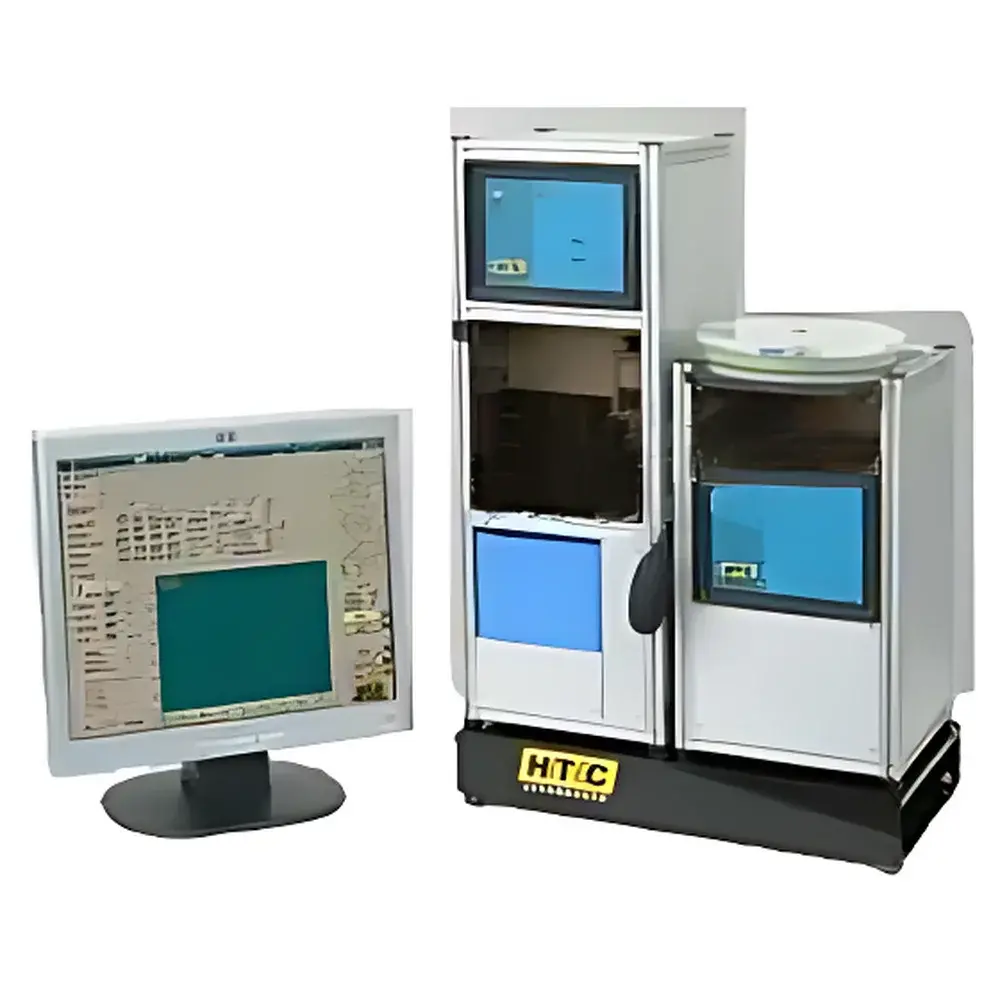
HITEC IPHT Carbon Black Particle Strength Analyzer
| Origin | Germany |
|---|---|
| Manufacturer Type | Distributor |
| Origin Category | Imported |
| Model | IPHT |
| Pricing | Upon Request |
Overview
The HITEC IPHT Carbon Black Particle Strength Analyzer is a precision mechanical testing instrument engineered to quantify the mechanical robustness of individual carbon black agglomerates—specifically, their resistance to compressive fracture under controlled loading. It operates on the principle of single-particle micro-compression, applying calibrated axial force to discrete granules while measuring displacement and failure load in real time. Designed explicitly for carbon black used in rubber compounding, battery electrode formulations, and pigment applications, the IPHT delivers quantitative metrics essential for correlating raw material morphology with downstream processing behavior (e.g., dispersion efficiency in mixers) and final product performance (e.g., tensile strength in vulcanized rubber). Its compliance with ASTM D5230 (“Standard Test Method for Determination of Carbon Black Pellet Strength”) and ASTM D3313 (“Standard Test Method for Determination of Carbon Black Aggregate Strength”) ensures traceable, inter-laboratory comparable results required for QC release, supplier qualification, and R&D benchmarking.
Key Features
- Two standardized test modes: constant-rate compression (ASTM D5230) and constant-force ramp (ASTM D3313), both fully programmable via software interface
- Compact benchtop footprint (W × D × H ≈ 420 × 380 × 360 mm), enabling integration into analytical labs without dedicated floor space
- Dedicated vibration-isolation base (IPHT-DTBL), engineered with tuned mass damping to suppress ambient floor vibrations below 5 Hz—critical for sub-mN force resolution stability
- Modular design supports optional high-throughput sampling: IPHT-RASB random-access sampling station with 14-position pneumatic indexing, compatible with 6 bar compressed air supply
- Real-time force–displacement curve acquisition at ≥1 kHz sampling rate, with hardware-triggered failure detection and auto-zero compensation
- Manual single-particle mode for method development or outlier investigation; automated batch mode for statistical population analysis (n ≥ 100 particles per run)
Sample Compatibility & Compliance
The IPHT accepts dry, free-flowing carbon black pellets and granules ranging from 0.5 mm to 3.0 mm in nominal diameter. Samples must be non-hygroscopic and free of surface oils or binders that could alter contact mechanics. The system is validated for use in ISO Class 8 (100,000) cleanroom-adjacent environments; however, the analyzer head itself is rated IP54 for operation in low-level industrial dust conditions (e.g., carbon black blending rooms). All test protocols, data reporting formats, and calibration procedures adhere strictly to ASTM D5230 and D3313. Full audit trail logging—including operator ID, timestamp, environmental temperature/humidity metadata, and raw sensor files—is maintained in accordance with GLP and FDA 21 CFR Part 11 requirements when paired with validated software configuration.
Software & Data Management
The proprietary IPHT Control Suite runs on Windows OS and communicates with the IPHT-BASU controller via RS-232 or TCP/IP Ethernet. A single PC can manage up to four independent IPHT units simultaneously using configurable COM port mapping or static IP assignment. The software implements all ASTM-specified calculations: median crush strength (kN/m²), coefficient of variation (CV%), Weibull modulus, and particle size–strength correlation plots. Raw force–displacement datasets are exported in CSV and HDF5 formats for third-party statistical analysis (e.g., JMP, Python pandas). Calibration certificates—including linearity verification across 0.1–10 N range and hysteresis assessment—are digitally embedded and exportable as PDF. Firmware updates and parameter templates are managed through role-based access control (admin/operator modes).
Applications
- Quality assurance of carbon black batches prior to rubber masterbatch production
- Correlation studies between furnace reactor conditions (e.g., quench rate, oil absorption) and particle mechanical integrity
- Evaluation of surface treatment efficacy (e.g., silica-coated carbon black) on agglomerate cohesion
- Stability assessment of carbon black during pneumatic conveying and storage
- Development of predictive models linking single-particle strength to compound viscosity and scorch time in rubber processing
- Root-cause analysis of extruder die buildup or calendering defects linked to friable agglomerates
FAQ
What environmental conditions are required for reliable operation?
The IPHT analyzer head tolerates ambient temperatures of 15–30 °C and relative humidity ≤70% non-condensing, including dusty industrial settings. However, the host PC must reside in a clean, climate-controlled environment (ISO Class 7 or better) to prevent contamination of internal electronics.
Can the system measure irregularly shaped agglomerates?
Yes—the compression platen geometry and adaptive contact detection algorithm accommodate non-spherical particles; reported strength values are normalized to projected area derived from integrated optical diameter measurement (optional add-on module).
Is calibration traceable to national standards?
All force transducers are calibrated annually against NIST-traceable deadweight standards, with full uncertainty budgets documented per ISO/IEC 17025 requirements.
How is data integrity ensured during networked operation?
TCP/IP communication uses TLS 1.2 encryption; local database writes employ ACID-compliant SQLite with write-ahead logging and automatic checksum validation on every data commit.
Does the system support GMP-regulated workflows?
When deployed with electronic signature-enabled user accounts, 21 CFR Part 11-compliant audit trails, and change-controlled software versions, the IPHT meets baseline GMP documentation requirements for pharmaceutical-grade conductive carbon black used in medical device electrodes.





