
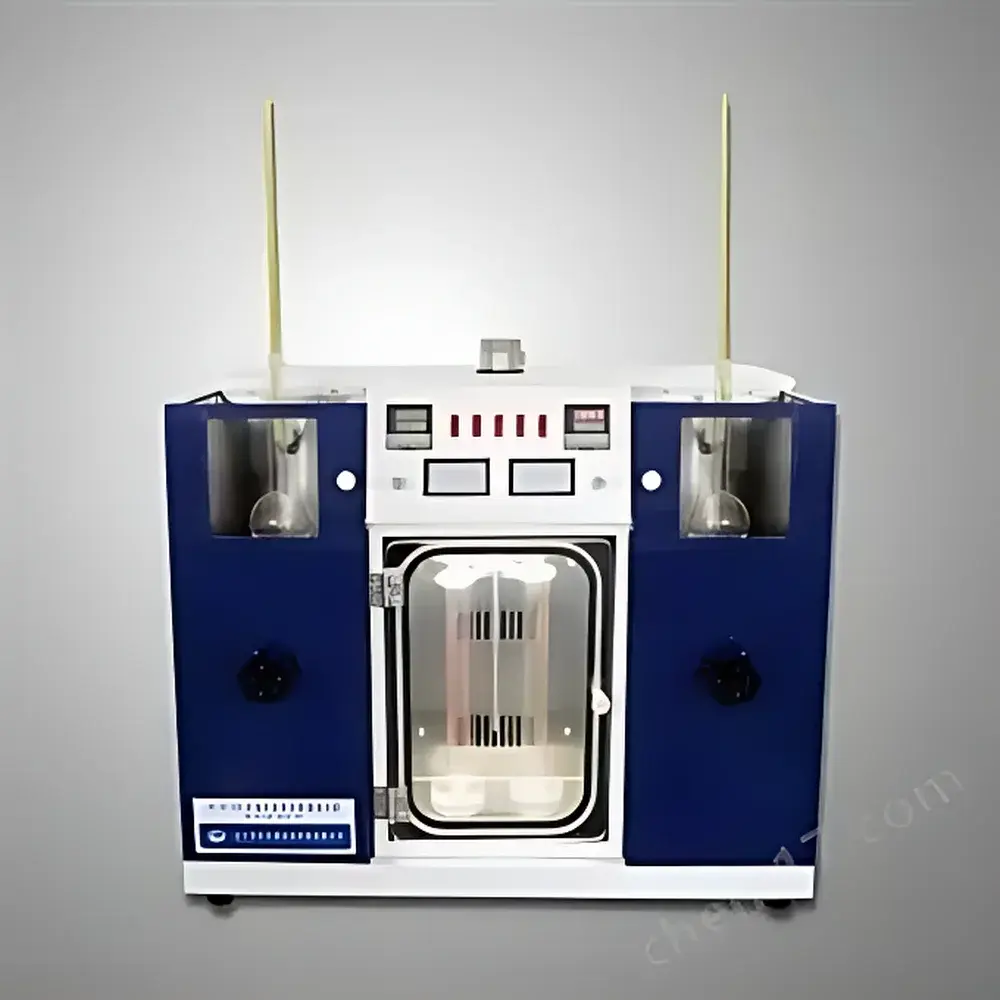
HK-6536C Dual-Channel Atmospheric Distillation Apparatus for Petroleum Products
| Brand | Other Brands |
|---|---|
| Origin | Imported |
| Manufacturer Type | Authorized Distributor |
| Model | HK-6536C |
| Power Supply | AC 220 V ±10%, 50 Hz |
| Rated Power | 3800 W |
| Temperature Control | Digital PID Controller |
| Temperature Accuracy | ±0.5 °C |
| Condensate Bath Range | 0–60 °C |
| Air Bath Range | 1 °C to Ambient |
| Cooling Method | Forced-Air with Dual Electric Coolers |
| Stirring | Pump-Circulated Coolant |
| Heating Element | Quartz Tube Heaters |
| Thermometer Fixation | Silicone Rubber Stopper |
| Air Chamber | Auto-Temperature Regulation & Digital Display |
| Illumination | Dual LED Auxiliary Lighting |
| Operating Environment | 5–40 °C, RH ≤85% |
Overview
The HK-6536C Dual-Channel Atmospheric Distillation Apparatus is a precision-engineered instrument designed for the standardized determination of distillation characteristics of petroleum products under atmospheric pressure. It operates in strict accordance with GB/T 6536—2023 “Petroleum Products—Determination of Atmospheric Distillation Characteristics” and ASTM D86—22 “Standard Test Method for Distillation of Petroleum Products at Atmospheric Pressure.” The apparatus enables simultaneous, independent distillation analysis of two samples—enhancing laboratory throughput without compromising measurement integrity. Its core methodology follows the classical batch distillation principle: controlled heating of a defined sample volume (typically 100 mL) in a calibrated ASTM distillation flask, followed by real-time monitoring of vapor temperature (via ASTM-certified mercury-in-glass or platinum resistance thermometers), recovered volume, and condensate temperature. Critical endpoints—including initial boiling point (IBP), 10%, 50%, 90% recovery temperatures, and final boiling point (FBP)—are recorded manually or via integrated data acquisition interfaces compliant with GLP documentation requirements.
Key Features
- Dual-channel configuration allows concurrent execution of two ASTM D86 or GB/T 6536 test runs—reducing per-sample turnaround time by up to 45% compared to single-channel systems.
- Quartz tube heating elements provide uniform thermal distribution across both distillation flasks, minimizing localized superheating and ensuring reproducible vaporization kinetics.
- Integrated air bath chamber with PID-controlled auto-regulation maintains stable ambient-equivalent conditions around the vapor path; digital display enables real-time verification of air temperature stability within ±0.5 °C.
- Cooling system employs dual forced-air electric coolers with adjustable airflow velocity, supporting condensate bath temperature control from 0 °C to 60 °C—fully covering the operational range required for light naphthas through heavy diesel fractions.
- Silicone rubber stoppers ensure secure, leak-tight fixation of ASTM E1 specification thermometers and distillation flasks—preventing mechanical drift during prolonged heating cycles.
- LED auxiliary lighting enhances operator visibility of meniscus levels in graduated receivers and thermometer scales under variable ambient lab lighting conditions.
- Pump-circulated coolant loop ensures consistent thermal transfer efficiency across repeated test sequences, reducing thermal hysteresis between consecutive runs.
Sample Compatibility & Compliance
The HK-6536C is validated for use with a broad spectrum of volatile hydrocarbon streams, including but not limited to: unstabilized natural gasoline (light hydrocarbons), motor gasoline (including ethanol-blended variants up to E15), aviation gasoline (Avgas), jet fuels (Jet A, Jet A-1), diesel fuel (EN 590, ASTM D975), kerosene, naphthas, and petroleum solvents (e.g., VM&P naphtha). All mechanical design elements—including ASTM E29-compliant receiver graduation markings, standardized flask geometry (125 mL capacity), and vapor temperature sensor positioning—conform to dimensional tolerances specified in ASTM D86 Annex A1 and GB/T 6536 Clause 6. The apparatus supports full traceability workflows aligned with ISO/IEC 17025:2017 accreditation requirements for testing laboratories and meets hardware-level prerequisites for FDA 21 CFR Part 11–compliant electronic record systems when paired with validated third-party data capture software.
Software & Data Management
While the HK-6536C operates as a standalone benchtop instrument with analog/digital hybrid controls, its architecture includes RS-232 and optional USB interfaces for integration with external LIMS or ELN platforms. When connected to compliant software (e.g., LabWare LIMS, Thermo Fisher SampleManager), it supports automated timestamped logging of temperature/volume pairs, user authentication, electronic signature capture, and audit trail generation meeting GLP and GMP documentation standards. All temperature readings are referenced to NIST-traceable calibration certificates (available upon request), and the digital controller retains calibration history with version-stamped entries for regulatory review.
Applications
This apparatus serves critical roles in refinery quality assurance labs, independent petroleum testing facilities, and R&D centers engaged in fuel formulation. Typical use cases include: verification of refinery cut-point consistency across crude distillation units; compliance screening of finished gasoline against regional specifications (e.g., EPA Tier 3, Euro 5); volatility assessment of biofuel blends per ASTM D7467; evaluation of solvent purity in petrochemical feedstock certification; and method validation studies supporting ISO 4259-based repeatability/reproducibility assessments. Its dual-channel capability is especially advantageous for inter-laboratory comparison trials and proficiency testing programs administered by ASTM Committee D02 on Petroleum Products, Liquid Fuels, and Lubricants.
FAQ
Does the HK-6536C comply with both ASTM D86 and GB/T 6536?
Yes—the mechanical configuration, flask dimensions, receiver calibration, and temperature measurement protocols satisfy all mandatory clauses in both standards.
Can it be used for ethanol-blended gasoline (E10/E15)?
Yes, provided the test is conducted using ASTM D86 Annex A4 procedures for oxygenated fuels, including pre-test sample stabilization and modified receiver handling.
Is external calibration verification required before each test series?
Per ASTM D86 Section 7.2, thermometer calibration must be verified daily using reference standards traceable to NIST or equivalent national metrology institutes.
What maintenance intervals are recommended for the quartz heating tubes?
Quartz elements should be inspected visually before each shift for microfractures or discoloration; typical service life exceeds 12 months under standard operating conditions with proper thermal cycling protocols.
Is the air bath temperature actively cooled below ambient?
No—the air bath provides regulated ambient-equivalent conditions only; sub-ambient cooling requires optional chiller integration via the condensate bath port.



