
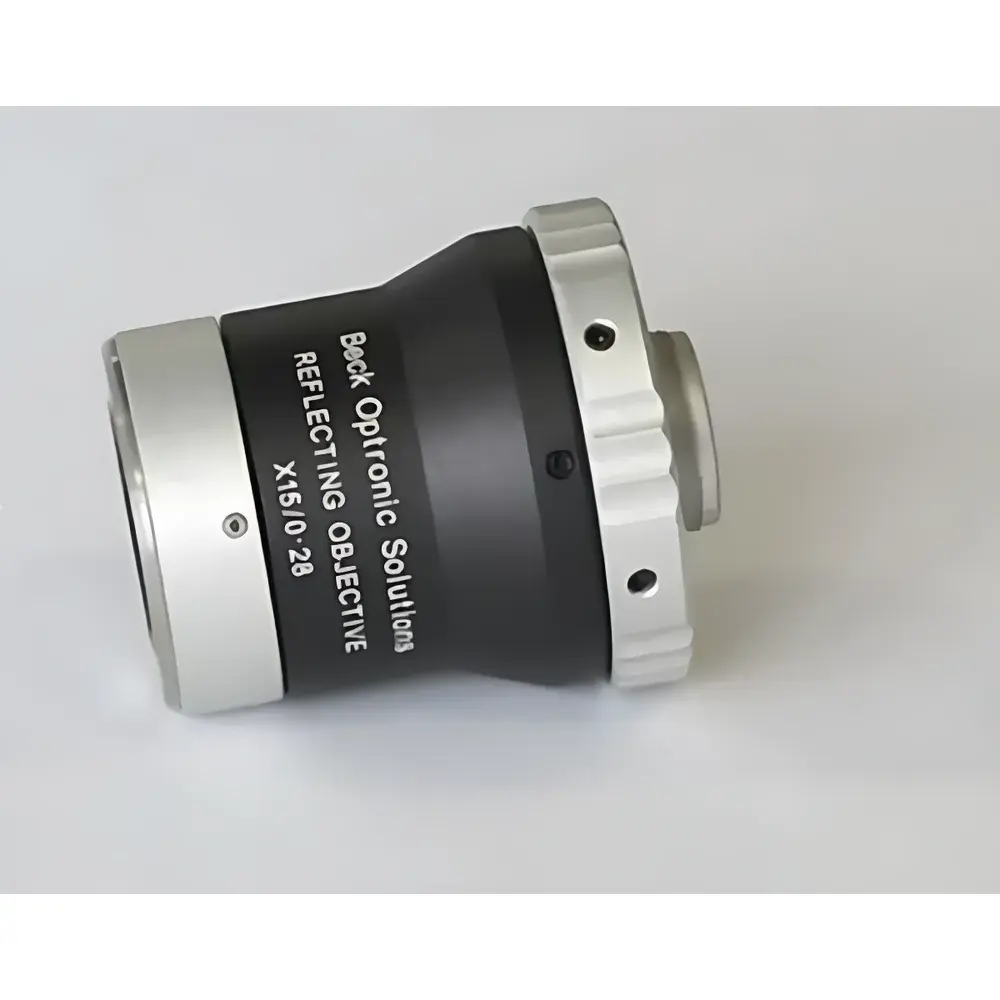
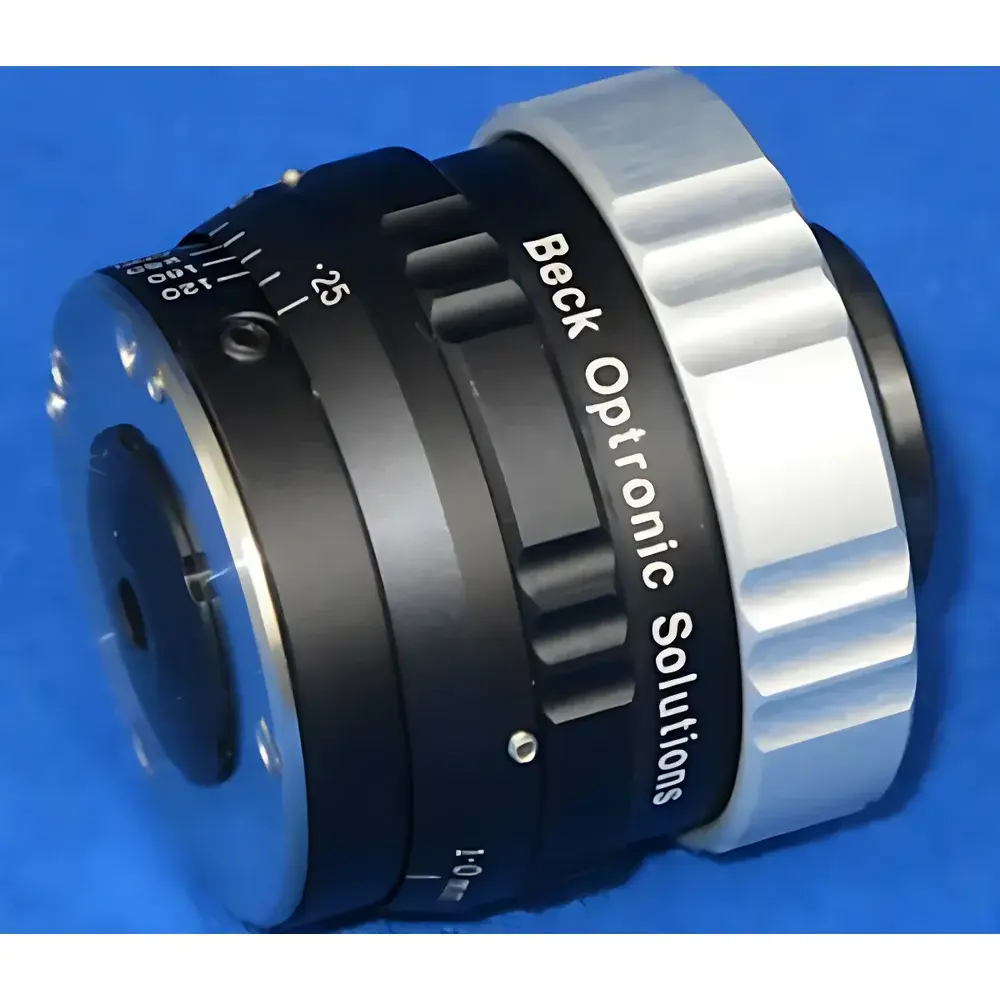
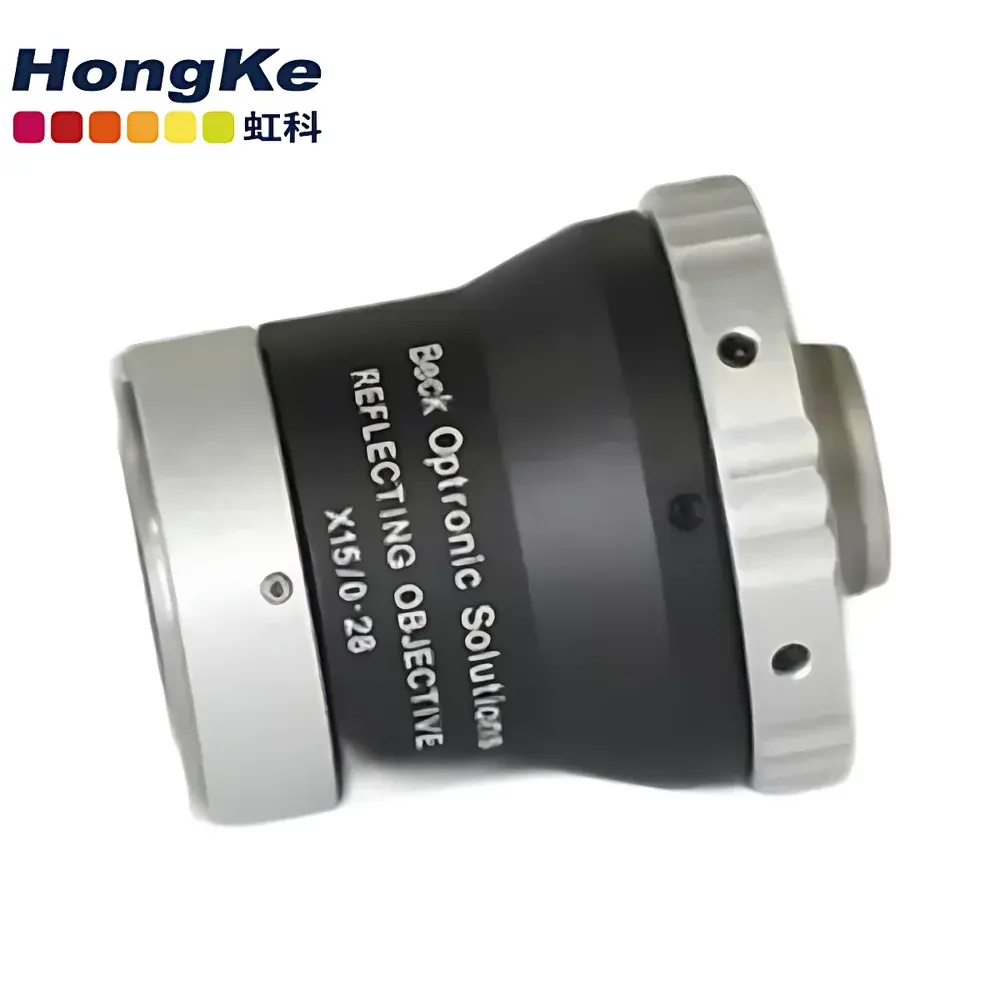
HK-Beck Reflecting Objective X15/0.28 (Model HK-BOS 5001/7-000/190/120)
| Brand | HongKe |
|---|---|
| Origin | United Kingdom |
| Manufacturer Type | Authorized Distributor |
| Product Origin | Imported |
| Model | HK-BOS Reflecting Objective |
| Magnification | 15× |
| Numerical Aperture | 0.28 |
| Working Distance | 190 mm |
| Clear Aperture | 120 mm |
| Optical Design | All-Reflective, Achromatic |
| Coating Options | Customizable Broadband Metallic (e.g., Al+MgF₂, Protected Au, or Enhanced Ag) |
Overview
The HK-Beck Reflecting Objective X15/0.28 (Model HK-BOS 5001/7-000/190/120) is a precision all-reflective microscope objective engineered for demanding optical measurement applications requiring broadband spectral fidelity and chromatic aberration elimination. Unlike conventional refractive objectives, this objective employs a purely reflective optical architecture—based on a modified Schwarzschild or Cassegrain configuration—ensuring diffraction-limited performance across an exceptionally wide spectral range, from deep ultraviolet (190 nm) through visible and into the far-infrared (>12 µm), without wavelength-dependent focus shift or dispersion. Its design is optimized for high-throughput reflectance metrology, ellipsometry, synchrotron beamline instrumentation, and vacuum-compatible UV/VUV imaging systems where transmissive optics introduce absorption, thermal drift, or birefringence. With a fixed magnification of 15× and numerical aperture of 0.28, it delivers consistent spatial resolution and light-gathering efficiency while maintaining a long working distance of 190 mm—enabling non-contact inspection of delicate, heated, or environmentally isolated samples.
Key Features
- All-reflective optical path eliminates chromatic aberration across 190 nm – 12 µm, enabling quantitative reflectance measurements without spectral recalibration.
- Long working distance (190 mm) facilitates integration into custom optical benches, vacuum chambers, and in-situ process monitoring setups.
- Large clear aperture (120 mm) supports high étendue collection and compatibility with collimated or moderately convergent input beams.
- Modular mounting interface (standard SM2-threaded or kinematic flange options) ensures mechanical stability and repeatable alignment in metrology-grade assemblies.
- Customizable front-surface coatings—including protected aluminum (Al+MgF₂), enhanced silver (Ag), or gold (Au)—optimized for specific spectral bands and environmental durability (e.g., humidity resistance or UHV compatibility).
- Zero transmission loss and negligible thermal lensing make it suitable for high-power laser diagnostics and pulsed UV applications.
Sample Compatibility & Compliance
This reflecting objective is routinely deployed in ISO/IEC 17025-accredited laboratories for reference-grade reflectance calibration against NIST-traceable standards (e.g., SRM 2036, SRM 1921b). It complies with optical safety requirements per IEC 60825-1 for Class 1 operation when integrated into enclosed systems. The all-metal construction and absence of cemented elements ensure compatibility with cleanroom Class 100 environments, ultra-high vacuum (UHV ≤10⁻⁹ mbar), and cryogenic stages down to 4 K. No outgassing or hydrocarbon contamination occurs under bake-out conditions—critical for space-qualified instrumentation and semiconductor metrology tools. The objective meets mechanical shock and vibration specifications per MIL-STD-810H for laboratory transport and field-deployable spectrophotometer integration.
Software & Data Management
While the HK-Beck reflecting objective is a passive optical component, its performance is fully characterizable via standard metrology software suites including Zemax OpticStudio (non-sequential mode), FRED, and ASAP for stray-light analysis and system-level throughput modeling. When paired with calibrated spectroradiometers (e.g., Ocean Insight QE Pro, Avantes AvaSpec-HS) or FTIR systems, it enables traceable bidirectional reflectance distribution function (BRDF) mapping per ASTM E259–22 and ISO 13655:2017. Full audit trails—including coating batch records, interferometric surface map data (λ/20 RMS wavefront error verified), and collimation test reports—are provided with each unit to support GLP/GMP documentation and FDA 21 CFR Part 11-compliant data integrity workflows.
Applications
- Primary and secondary reflectance standard calibration in national metrology institutes (NMIs) and commercial calibration labs.
- In-line reflectance monitoring of thin-film deposition processes (e.g., sputtering, ALD) using real-time UV-VIS-NIR spectroscopy.
- Vacuum-ultraviolet (VUV) imaging of plasma diagnostics and fusion research diagnostics (e.g., ITER diagnostic port plugs).
- Non-destructive evaluation (NDE) of heritage artwork pigments and conservation materials using multispectral reflectance imaging (400–2500 nm).
- Beam conditioning and focusing in femtosecond laser micromachining systems operating at 266 nm or 800 nm.
- Reference optics in hyperspectral Earth observation sensor ground verification facilities (e.g., ESA ESTEC calibration labs).
FAQ
What spectral range is supported by the standard Al+MgF₂ coating?
The standard protected aluminum coating provides >85% average reflectance from 250 nm to 2000 nm. Optional coatings extend coverage to 190 nm (with MgF₂ overcoat optimization) or beyond 10 µm (enhanced gold).
Can this objective be used in ultra-high vacuum (UHV) environments?
Yes. The monolithic metal housing, no organic adhesives, and vacuum-compatible surface finishes meet UHV outgassing requirements per ASTM E595 and are routinely qualified for use in synchrotron beamlines.
Is focal plane flatness specified?
Yes. Measured field curvature is <±15 µm over a 10 mm image field diameter at 546 nm, verified via interferometric null testing with a Zygo Verifire MST.
Does HongKe provide NIST-traceable calibration data with shipment?
Each unit ships with a certificate of conformance including measured wavefront error (RMS), effective focal length (EFL) tolerance (±0.3%), and coating reflectance curves measured on a PerkinElmer Lambda 1050+ spectrophotometer.
What mounting interfaces are available?
Standard configurations include SM2 (2.032″-40) external threads with kinematic dowel pin registration; custom flanges (CF-63, ISO-KF40) and motorized focus actuators are available upon request.





