
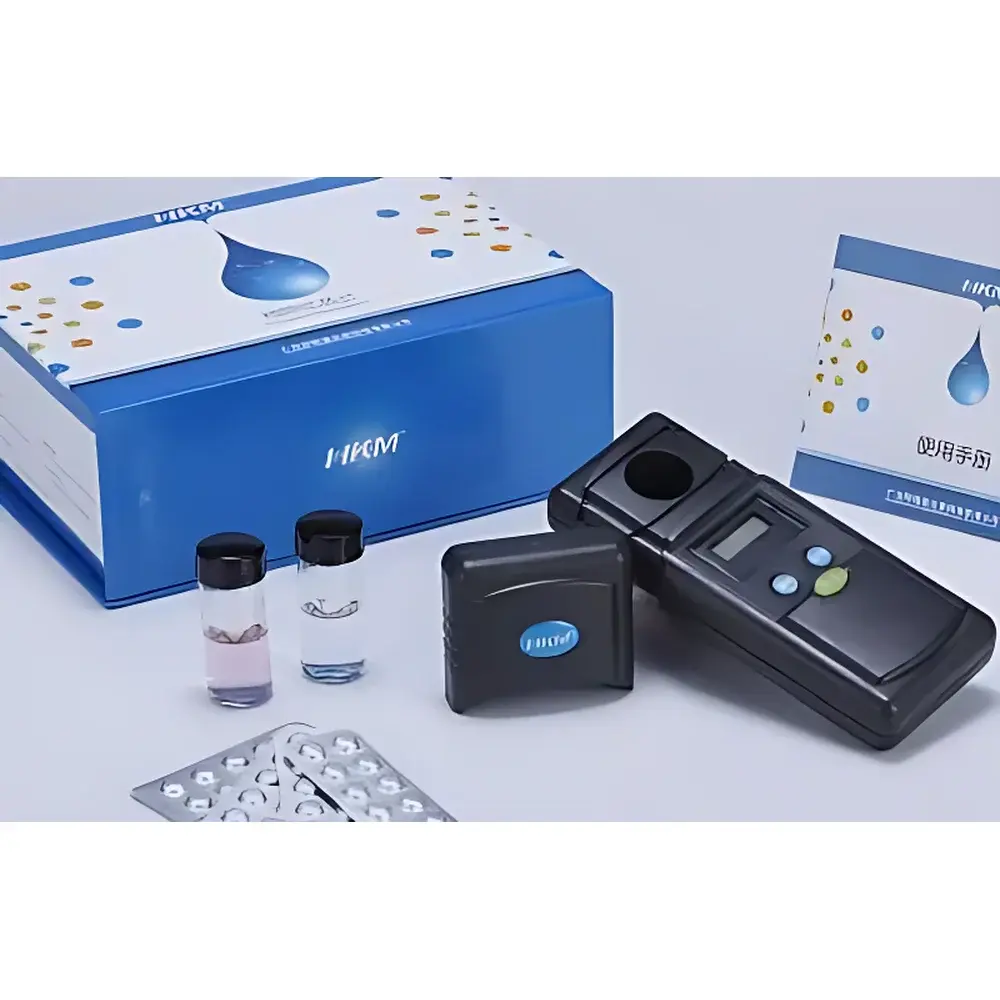
HKM S-101 Portable Ozone Analyzer for Water Quality Monitoring
| Brand | HKM |
|---|---|
| Model | S-101 |
| Measurement Range | 0.00–2.50 mg/L |
| Wavelength | 510 nm |
| Light Source | Silicon Photodiode |
| Accuracy | ±0.05 mg/L (0.05–0.99 mg/L), ±0.10 mg/L (1.00–2.50 mg/L) |
| Method | DPD Colorimetric Method per GB 11898–1989 |
| Operating Temperature | 0–40 °C |
| Relative Humidity | 0–90 % RH (non-condensing) |
| Power Supply | 1 × 9 V alkaline battery (≥40 h continuous operation) |
| Dimensions | 170 × 70 × 30 mm |
| Weight | 200 g (including battery) |
| Compliance | Designed to support compliance with ISO 7027, APHA Standard Methods 4500-O₃, and Chinese National Standard GB 11898–1989 |
Overview
The HKM S-101 Portable Ozone Analyzer is a compact, field-deployable photometric instrument engineered for rapid, on-site quantification of dissolved ozone concentration in water treatment systems, disinfection validation protocols, and municipal or industrial water quality monitoring workflows. It operates on the well-established DPD (N,N-diethyl-p-phenylenediamine) colorimetric principle: ozone selectively oxidizes DPD reagent in buffered acidic solution, generating a stable pink-to-red chromophore proportional to ozone concentration. Absorbance is measured at 510 nm using a calibrated silicon photodiode detector, enabling direct concentration readout in mg/L without manual calibration curve interpolation. Its design adheres to the methodological framework of GB 11898–1989 — China’s national standard for ozone determination in water — and aligns with internationally recognized procedures including APHA Standard Methods 4500-O₃ and ISO 7027 for turbidity-corrected absorbance measurement. The device is not intended for gas-phase ozone analysis or continuous online monitoring; it serves as a dedicated, handheld verification tool for batch-wise ozone residual assessment.
Key Features
- Compact, lightweight form factor (170 × 70 × 30 mm, 200 g with battery) optimized for field use, mobile labs, and routine plant walkarounds.
- Dedicated 510 nm optical path with temperature-stabilized silicon photodiode ensures consistent spectral selectivity and minimizes drift across ambient operating conditions (0–40 °C).
- Pre-programmed calibration algorithm supports two accuracy tiers: ±0.05 mg/L for low-range measurements (0.05–0.99 mg/L) and ±0.10 mg/L for mid-range (1.00–2.50 mg/L), reflecting the inherent nonlinearity of DPD response at higher concentrations.
- Single 9 V alkaline battery provides ≥40 hours of continuous operation — sufficient for multi-shift field deployment without frequent replacement or charging infrastructure.
- Simple ON/OFF toggle switch and intuitive single-button operation reduce operator training burden and minimize procedural error in time-sensitive disinfection audits.
- No internal memory or data logging capability — intentionally designed to prioritize mechanical robustness, low power consumption, and method transparency over digital feature bloat.
Sample Compatibility & Compliance
The S-101 is validated for use with clear, low-turbidity aqueous samples typical of ozonated drinking water, swimming pool recirculation lines, bottled water production effluents, and tertiary wastewater effluents. Samples must be free of interfering oxidants (e.g., chlorine >0.5 mg/L, chlorine dioxide, permanganate) unless quenched with standardized sodium arsenite or glycine prior to DPD addition. High turbidity (>5 NTU) or suspended solids may scatter incident light and require pre-filtration through 0.45 µm membrane filters. While not certified to ISO/IEC 17025, the instrument supports laboratory quality assurance when used within a documented method validation protocol per ISO/IEC 17025 Clause 7.2. Its adherence to GB 11898–1989 enables traceability to national metrological references and facilitates regulatory reporting in jurisdictions recognizing this standard.
Software & Data Management
The HKM S-101 operates as a standalone photometer with no embedded firmware, wireless interface, or proprietary software dependency. All measurement logic resides in hardwired analog-to-digital conversion circuitry and fixed-range linearization firmware. Results are displayed numerically on a monochrome LCD and must be manually recorded. This architecture eliminates cybersecurity vulnerabilities, firmware update cycles, and compatibility dependencies — critical considerations in regulated environments where audit trails rely on operator-recorded paper logs or LIMS-integrated manual entry. For laboratories operating under GLP or GMP frameworks, the absence of electronic records simplifies 21 CFR Part 11 compliance planning, as no electronic signature, audit trail, or system validation is required for the device itself.
Applications
- Verification of ozone residual in municipal drinking water distribution points post-contact tank.
- Routine monitoring of ozone dosage in bottled water sterilization tunnels and filler line rinse water.
- Validation of ozone generator output stability during commissioning and preventive maintenance checks.
- Swimming pool and spa water management to ensure disinfectant efficacy while remaining below health-based exposure thresholds (e.g., WHO guideline value of 0.05 mg/L for residual ozone).
- Educational use in environmental engineering and water chemistry laboratories for teaching standardized colorimetric assay principles.
FAQ
Does the S-101 require periodic factory calibration?
No — it is factory-calibrated against NIST-traceable ozone standards and does not include user-accessible calibration adjustment. Users should verify performance quarterly using certified DPD standard solutions (e.g., 0.50 mg/L and 2.00 mg/L ozone reference standards).
Can the instrument measure ozone in seawater or high-salinity brines?
Not without modification — chloride interference may suppress DPD color development. Sample dilution with deionized water and matrix-matched standard preparation are required for semi-quantitative estimation.
Is the DPD reagent supplied with the instrument?
No — DPD powder tablets or liquid reagent kits (compatible with GB 11898–1989 formulation) must be procured separately from authorized chemical suppliers.
What is the shelf life of prepared DPD reagent solution?
Freshly prepared DPD solution remains stable for ≤2 hours at room temperature; refrigerated storage extends usability to 6 hours. Discard if discoloration or precipitation occurs.
Does the device meet IP rating requirements for wet environments?
It carries no formal IP rating — avoid direct water immersion or prolonged exposure to condensation. Wipe clean with dry lint-free cloth after use in humid locations.
Related Products







