
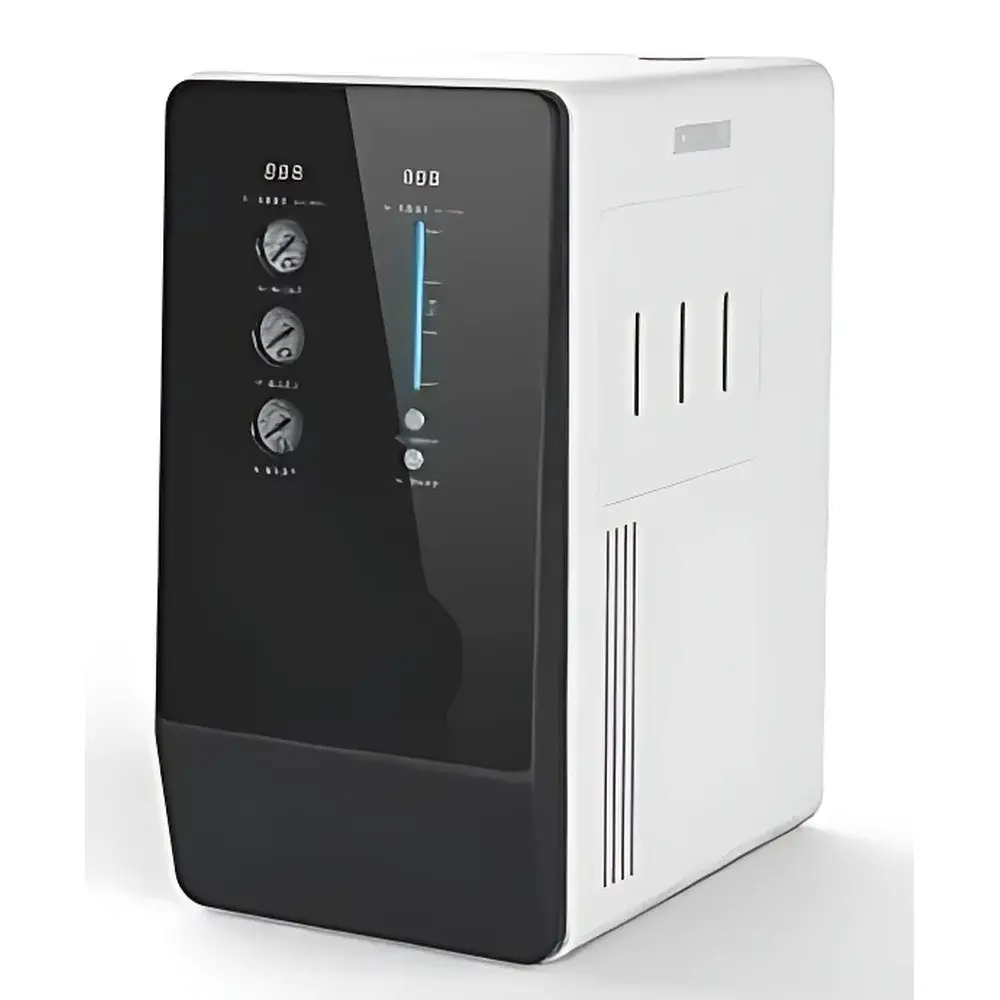
HLT HLT-300II & HLT-500II Nitrogen-Hydrogen-Air Integrated Gas Generator
| Brand | HLT |
|---|---|
| Origin | Shanghai, China |
| Model | HLT-300II, HLT-500II |
| Gas Purity | N₂ > 99.997%, H₂ > 99.999%, Air: oil-free, dried, triple-purified |
| Output Flow | N₂/H₂: 0–300 mL/min (HLT-300II) / 0–500 mL/min (HLT-500II) |
| Air | 0–2000 mL/min (HLT-300II) / 0–5000 mL/min (HLT-500II) |
| Output Pressure | H₂/N₂/Air: 0–0.5 MPa (factory-set at 0.4 MPa) |
| Power Supply | 220 V ±10%, 50 Hz ±5% |
| Max. Power | 450 W |
| Dimensions (W×D×H) | 460 × 310 × 670 mm |
| Weight | 39 kg |
| Operating Environment | 10–40 °C, RH ≤85%, non-corrosive, low-dust ambient |
Overview
The HLT HLT-300II and HLT-500II Nitrogen-Hydrogen-Air Integrated Gas Generator is an engineered solution for laboratories requiring simultaneous, on-demand supply of high-purity nitrogen, hydrogen, and zero-air—primarily for gas chromatography (GC), GC–MS, and related analytical instrumentation. Unlike conventional cylinder-based gas delivery systems, this integrated generator employs membrane-based nitrogen separation (PSA or hollow-fiber membrane), PEM electrolysis for hydrogen production, and a multi-stage compression/filtration system for clean, dry, oil-free air. All three gas streams are generated, purified, pressure-regulated, and monitored within a single compact chassis—eliminating cross-contamination risks, reducing infrastructure footprint, and supporting continuous, unattended operation under GLP-compliant workflows.
Key Features
- Monolithic cabinet design with integrated stainless-steel storage tanks for hydrogen and air—engineered to meet ISO 8573-1 Class 1 compressed air quality requirements and eliminate reliance on high-pressure cylinders.
- Hydrogen generation via proton exchange membrane (PEM) electrolysis: features automatic anti-alkaline backflow protection, real-time flow tracking, and triple-stage filtration (particulate, moisture, hydrocarbon) to ensure ≥99.999% purity.
- Nitrogen generation via selective permeation or pressure swing adsorption (PSA), incorporating identical anti-backflow safeguards and triple-stage purification—delivering ≥99.997% N₂ with residual O₂ <30 ppm and H₂O <1 ppm (dew point ≤ –40 °C).
- Air subsystem includes stainless-steel receiver tank, auto-condensate drainage, and sequential coalescing, activated carbon, and desiccant filtration—yielding oil-free, dry, particle-free zero-air suitable for FID, NPD, and ECD detectors.
- Unified pressure regulation across all three gas lines: 0–0.5 MPa adjustable output (factory preset at 0.4 MPa), with mechanical overpressure relief and electronic fault detection for H₂ line integrity.
- Minimalist control interface: front-panel power switch with LED status indicators per gas stream; no software dependency for basic operation—designed for reliability in routine QC labs where uptime and simplicity are prioritized.
Sample Compatibility & Compliance
The HLT-300II/500II is compatible with all major GC and GC–MS platforms requiring dedicated N₂ (make-up or carrier), H₂ (fuel for FID/NPD), and zero-air (oxidant for FID, makeup for ECD). Its output specifications align with ASTM D6299 (precision and bias of GC methods), ISO/IEC 17025 clause 6.4.3 (equipment verification), and USP <1058> guidelines for analytical instrument qualification. While not inherently 21 CFR Part 11 compliant due to lack of audit trail functionality, the unit supports IQ/OQ protocols through documented calibration of pressure regulators, flow meters, and purity verification via external GC-TCD analysis. Stainless-steel wetted parts comply with FDA-recommended materials for contact with analytical gases.
Software & Data Management
This generator operates in standalone mode without embedded firmware or network connectivity. All operational parameters—including on/off state, pressure setpoints, and visual fault alerts—are managed locally via tactile switch and LED indicators. For laboratories implementing computerized system validation (CSV), integration with LabVantage, Empower, or Chromeleon is achievable via optional analog 4–20 mA or digital RS-485 outputs (available upon request). Raw gas purity and flow stability data must be verified externally using calibrated analyzers (e.g., trace O₂/H₂O analyzers, flow calibrators) as part of periodic performance qualification (PQ).
Applications
- Carrier and make-up gas supply for capillary GC systems utilizing FID, TCD, ECD, and NPD detectors.
- Fuel gas source for flame ionization detectors requiring consistent 99.999% H₂ with negligible CO/CH₄ impurities.
- Zero-air generation for combustion-based detectors and environmental air monitoring calibration standards.
- Replacement for bulk nitrogen and hydrogen cylinders in pharmaceutical QC labs, reducing logistics overhead and safety audits associated with compressed gas storage.
- Support for automated GC systems in food safety, petrochemical, and environmental testing where uninterrupted gas supply is critical to method robustness.
FAQ
What is the recommended maintenance schedule for the HLT-300II/500II?
Filter cartridges (coalescing, activated carbon, desiccant) require replacement every 6–12 months depending on ambient humidity and usage intensity. Electrolyte levels in the PEM cell are sealed-for-life; no user-serviceable consumables exist within the H₂ module.
Can the generator be used with GC–MS systems requiring ultra-high-purity nitrogen?
Yes—provided supplemental inline purification (e.g., oxygen/moisture traps) is added downstream, as the standard N₂ output meets typical GC carrier-grade specifications (≤30 ppm O₂, ≤1 ppm H₂O), but not UHP (<1 ppm total impurities) required for some high-resolution MS applications.
Is remote monitoring or alarm notification supported?
Not natively. Integration with building management systems (BMS) or SCADA requires third-party analog signal conversion or optional RS-485 interface modules.
Does the unit comply with CE or UL safety standards?
The generator conforms to IEC 61010-1:2010 for laboratory electrical equipment; CE marking is applied per EU Directive 2014/30/EU (EMC) and 2014/35/EU (LVD). UL certification is not held; users requiring UL listing should consult local regulatory advisors for equivalency pathways.
How does ambient temperature affect nitrogen purity and flow stability?
Operation outside 10–40 °C may reduce membrane separation efficiency and increase dew point in the air stream. Continuous use above 35 °C is discouraged without active lab HVAC; relative humidity >85% may accelerate desiccant saturation and necessitate more frequent filter changes.



