
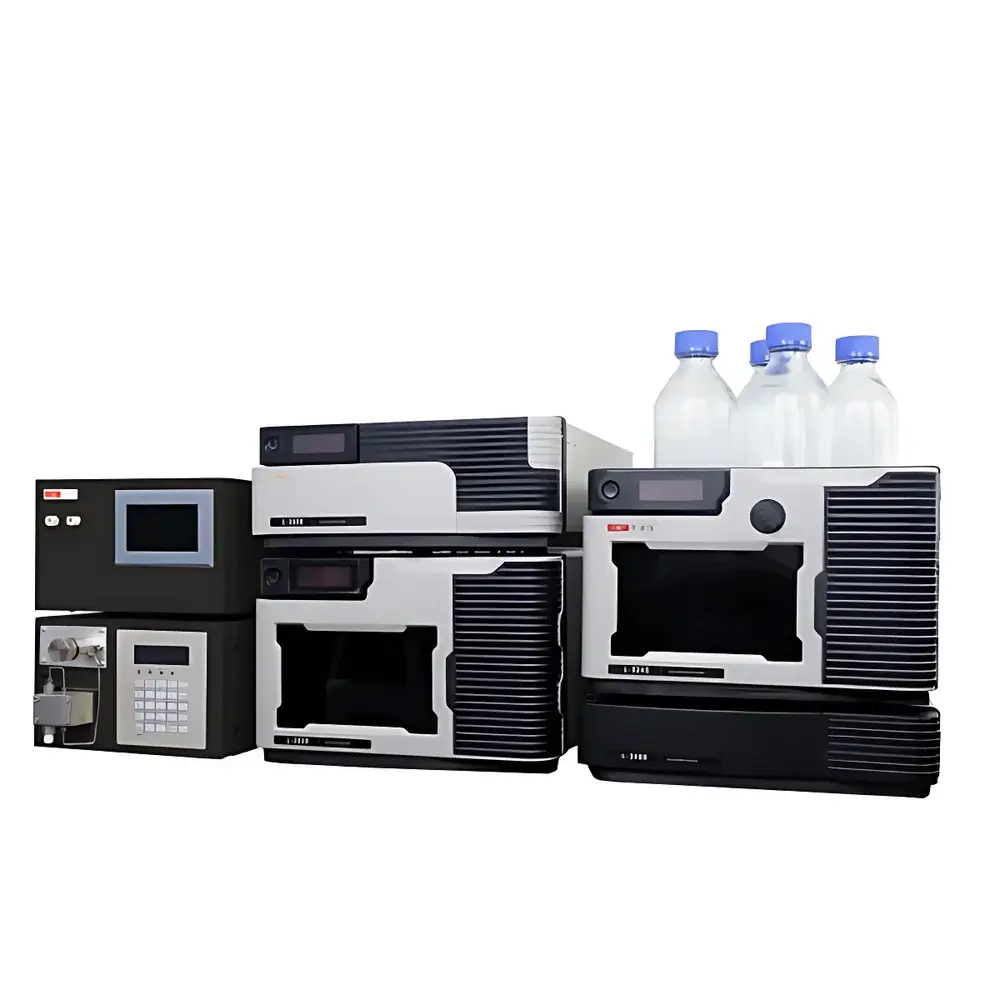
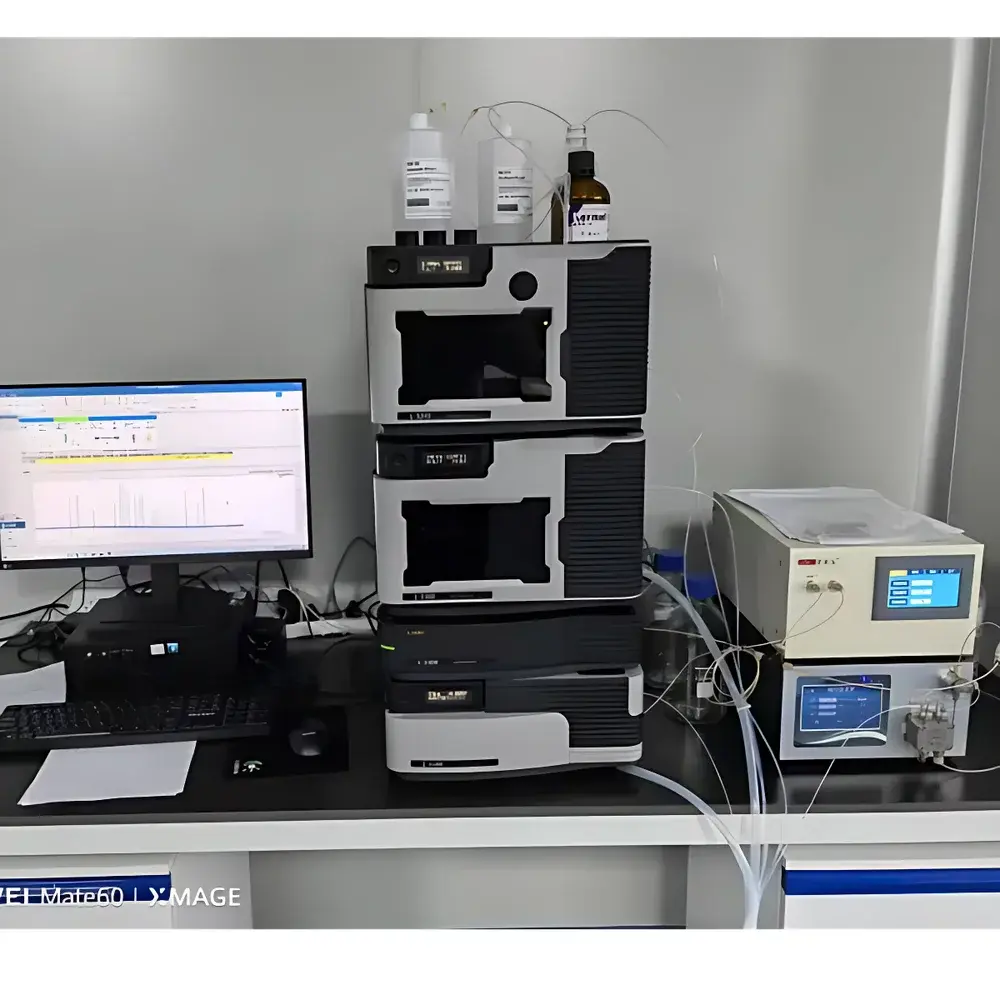
HMC L-3000plus Fully Automated Amino Acid Analyzer
| Brand | HMC |
|---|---|
| Origin | Jiangsu, China |
| Manufacturer Type | Authorized Distributor |
| Origin Category | Domestic (China) |
| Model | L-3000plus |
| Instrument Type | Post-Column Derivatization System |
| Pump Flow Rate | 0.01–9.99 mL/min |
| Maximum Pump Pressure | 6000 psi (41.4 MPa) |
| Autosampler Injection Volume | 1–500 µL |
| Autosampler Temperature Control | +5 °C (±1 °C) to 70 °C |
| Post-Column Reactor Temperature Range | Ambient to 150 °C |
| Detection Wavelength Range | 190–800 nm |
| Flow Cell Volume | 8 µL |
Overview
The HMC L-3000plus Fully Automated Amino Acid Analyzer is a high-performance, post-column derivatization-based chromatographic system engineered for precise, reproducible quantification of protein hydrolysates and physiological amino acids in complex matrices. It operates on the well-established ninhydrin-based post-column reaction principle—where amino acids eluting from a cation-exchange column undergo thermal derivatization with ninhydrin reagent, generating chromophores detectable by UV-Vis absorption. This methodology conforms to internationally recognized protocols including ISO 13903, AOAC 994.12, and USP <467>, and is fully aligned with Chinese national standards GB 5009.124–2016 (Determination of Amino Acids in Foods), GB/T 18246–2019 (Amino Acids in Feed), and NY/T 1975–2010 (Free Amino Acid Content in Water-Soluble Fertilizers). The L-3000plus represents a generational upgrade over its predecessor, reducing analysis time for the standard 22 proteinogenic amino acids from 45 to ≤30 minutes without compromising resolution or sensitivity—enabled by optimized gradient programming, enhanced reactor efficiency, and integration of a high-fidelity diode array detector (DAD).
Key Features
- Modular architecture supporting dual operational modes: dedicated amino acid analysis or standalone quaternary gradient HPLC system—maximizing instrument utilization and laboratory flexibility.
- Quaternary low-pressure gradient pump with dual-piston design, delivering flow rates from 0.01 to 10.00 mL/min and pressure capability up to 9000 psi (62 MPa); incorporates real-time pressure feedback control and <1% gradient accuracy for robust method transferability.
- Autosampler with dual 48-position vial trays (expandable to 2 × 96 or 2 × 384), temperature-controlled sample compartment (+5 °C ±1 °C to 70 °C), and dual-wash mechanism (external needle surface + internal needle flush) to ensure <0.005% carryover across injections.
- Post-column derivatization reactor with inert, uniformly packed silicon carbide microbeads—optimized for thermal stability at 130 °C, providing high surface area and laminar flow to minimize band broadening and peak overlap during rapid derivatization.
- 1024-element diode array detector (DAD) covering 190–800 nm with 0.6 nm pixel resolution, equipped with deuterium lamp source, precision grating monochromator, and 8 µL flow cell—enabling spectral confirmation, peak purity assessment, and multi-wavelength quantitation.
- Integrated safety systems including over-pressure shutdown, leak detection, and front-accessible maintenance panels for all critical components—ensuring operational continuity and compliance with ISO/IEC 17025 laboratory infrastructure requirements.
Sample Compatibility & Compliance
The L-3000plus supports both sodium-cation exchange (for hydrolyzed protein samples) and lithium-cation exchange (for physiological fluids such as plasma, urine, or cerebrospinal fluid) separation chemistries. Its validated workflows meet regulatory expectations for food safety (GB 5009.124–2016), animal nutrition (GB/T 18246–2019), agrochemical testing (NY/T 1975–2010), and clinical research applications. All hardware and software components are designed to support GLP and GMP environments: autosampler sequence logs, detector calibration records, and pump pressure traces are timestamped and stored with audit trail integrity. The system complies with FDA 21 CFR Part 11 requirements for electronic records and signatures when deployed with Ultrachrom’s role-based user authentication, electronic signature capture, and immutable data archiving.
Software & Data Management
Ultrachrom is a validated, dual-language (English/Chinese) chromatography data system (CDS) developed specifically for the L-3000 series. It provides full instrument control—including gradient method setup, temperature ramping, derivatization timing, and DAD spectral acquisition—as well as integrated peak integration, calibration curve generation (linear/non-linear), and report export in PDF, CSV, and XML formats. Data security features include encrypted database storage, automatic backup scheduling, and configurable retention policies aligned with ISO 17025 clause 7.5.2. Raw data files (.ucd) retain complete spectral and temporal metadata, enabling retrospective reprocessing and spectral library matching. Audit trails record all user actions—including method edits, result approvals, and data deletions—with operator ID, timestamp, and reason-for-change fields.
Applications
- Quantitative profiling of 22 standard amino acids in hydrolyzed food proteins (e.g., dairy, soy, meat, and plant-based alternatives) per GB 5009.124–2016.
- Monitoring essential amino acid ratios in animal feed formulations to optimize nutritional balance and compliance with GB/T 18246–2019.
- Clinical determination of free amino acid concentrations in human biological fluids for metabolic disorder screening (e.g., phenylketonuria, maple syrup urine disease).
- Quality control of amino acid-containing pharmaceutical excipients, parenteral nutrition solutions, and fermentation-derived biologics.
- Research-grade characterization of non-proteinogenic amino acids, modified residues (e.g., hydroxyproline, γ-aminobutyric acid), and chiral separations using specialized columns.
FAQ
What derivatization chemistry does the L-3000plus use?
It employs ninhydrin-based post-column derivatization at elevated temperatures (up to 150 °C), optimized for sensitivity and selectivity toward primary and secondary amines.
Can the system analyze both hydrolyzed proteins and physiological fluids?
Yes—via interchangeable cation-exchange columns: sodium-form for hydrolysates and lithium-form for biological fluids.
Is the DAD capable of spectral deconvolution for co-eluting peaks?
Yes—the 1024-channel detector enables full-spectrum acquisition at up to 100 Hz, supporting peak purity analysis and library-based identification.
Does Ultrachrom support 21 CFR Part 11 compliance out-of-the-box?
Yes—when configured with enabled electronic signatures, audit trail logging, and secure user roles, it satisfies predicate rule requirements for regulated laboratories.
What is the minimum injection volume for trace-level analysis?
The autosampler supports precise 1 µL injections with volumetric accuracy ±0.5%, validated per ISO 8655-6 for low-volume precision.
Related Products





