
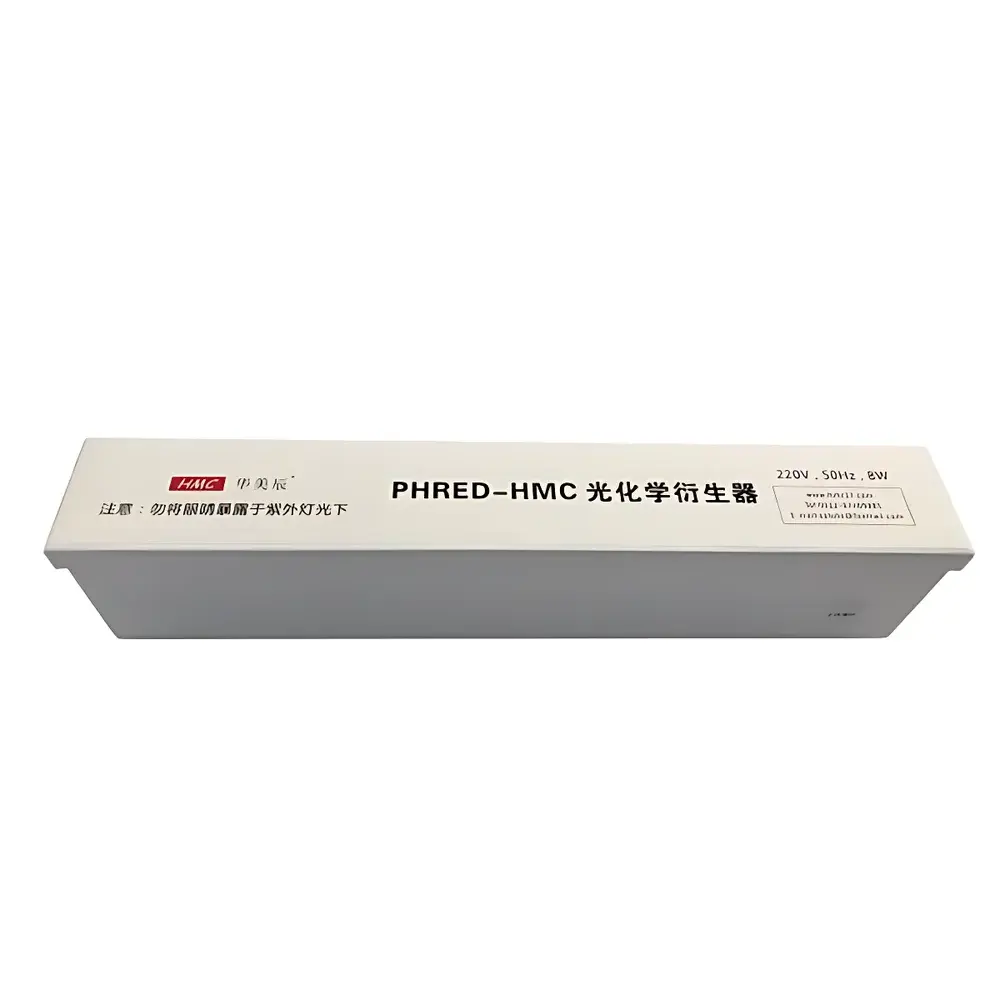
HMC PHRED Photolytic Post-Column Derivatization System
| Brand | HMC |
|---|---|
| Origin | Jiangsu, China |
| Manufacturer Type | Authorized Distributor |
| Product Category | Domestic |
| Model | PHRED |
| Price Range | USD 1,400–2,800 (FOB) |
| Operating Temperature | Ambient |
| Derivatization Flow Rate | 0.3 mL/min |
| Reaction Capillary ID | 0.25 mm |
| Dimensions (L×W×H) | 330 × 50 × 70 mm |
| Power Supply | 220 V / 50 Hz |
| Power Consumption | 8 W |
| Capillary Material | PTFE |
| Maximum Pressure Rating | 500 psi (35 bar) |
| Weight | ~4 kg |
| Regulatory Compliance | AOAC 2005.08, AOAC 2008.02, AOAC Aa 11-05, Taiwan Food Agency Notice No. 0981800370, Ph. Eur. 2.8.18, GB/T 18979–2003, SN/T 1109–2002 |
Overview
The HMC PHRED Photolytic Post-Column Derivatization System is a compact, reagent-free analytical accessory engineered for high-sensitivity fluorescence detection of mycotoxins—particularly aflatoxin B₁, B₂, G₁, and G₂—in liquid chromatography (LC) workflows. Unlike conventional chemical derivatization methods that rely on hazardous reagents such as trifluoroacetic acid or iodine solutions, the PHRED system employs controlled ultraviolet (UV) photolysis to induce structural modification of analytes post-separation but prior to fluorescence detection. This photochemical activation restores and enhances native fluorescence quenching caused by aqueous mobile phases, enabling robust quantification at sub-part-per-trillion (ppt) levels without introducing reactive chemistry into the LC flow path. Designed for seamless integration between the LC column outlet and fluorometric detector, the PHRED operates at ambient temperature with minimal system footprint and zero solvent consumption—making it ideal for regulated food safety, pharmaceutical quality control, and environmental residue laboratories seeking GLP-compliant, low-maintenance derivatization.
Key Features
- Reagent-free photolytic derivatization: Eliminates need for toxic chemical reagents (e.g., TFA or I₂), reducing operator exposure, waste disposal burden, and method variability.
- Optimized UV irradiation module: Incorporates imported high-stability UV lamp and precision-aligned PTFE reaction capillary (0.25 mm ID) to ensure consistent photon flux and residence time for reproducible derivatization efficiency.
- Robust pressure tolerance: Rated for continuous operation up to 500 psi (35 bar), compatible with standard HPLC and UHPLC systems without backpressure compromise.
- Low-power, air-cooled architecture: 8 W power draw enables stable long-term operation without active cooling or thermal management hardware.
- Regulatory alignment: Validated performance per AOAC Official Methods 2005.08 and 2008.02 for aflatoxin analysis in grains, nuts, and feedstuffs; also compliant with Ph. Eur. 2.8.18, Taiwan FDA Notice No. 0981800370, and Chinese national standards GB/T 18979–2003 and SN/T 1109–2002.
Sample Compatibility & Compliance
The PHRED system is optimized for post-column derivatization of aflatoxins under reversed-phase HPLC conditions using common C18 columns and acetonitrile/water or methanol/water mobile phases. It maintains compatibility with gradient elution and does not interfere with column lifetime or detector baseline stability. All wetted components—including the reaction capillary—are constructed from chemically inert PTFE, ensuring resistance to oxidation, hydrolysis, and adsorption artifacts across diverse sample matrices (e.g., corn, peanut butter, milk powder, herbal extracts). The system supports full audit trail documentation when integrated with LIMS or chromatography data systems compliant with FDA 21 CFR Part 11 requirements. Its design facilitates routine verification via system suitability testing per AOAC protocols, including signal-to-noise ratio (S/N ≥ 10), peak symmetry (0.8–1.5), and derivatization efficiency consistency (RSD ≤ 3.5% over 6 injections).
Software & Data Management
As a hardware-only derivatization module, the PHRED requires no embedded firmware or proprietary software. It functions transparently within existing LC instrument control environments (e.g., Waters Empower, Thermo Chromeleon, Agilent OpenLab CDS). Derivatization status is monitored indirectly through fluorescence response enhancement—no real-time parameter logging is performed onboard. For traceability, users are advised to record lamp operating hours manually or via external timer logs; lamp replacement intervals are typically specified at ≥2,000 hours under continuous use. When deployed in GMP-regulated settings, integration with electronic lab notebooks (ELNs) or validated CDS platforms ensures complete chain-of-custody for method development reports, calibration records, and instrument qualification documents (IQ/OQ/PQ).
Applications
- Quantitative determination of aflatoxin B₁, B₂, G₁, and G₂ in cereals, oilseeds, spices, dairy products, and infant formula per ISO 16050, AOAC 2005.08, and EU Commission Regulation (EC) No. 401/2006.
- Residue analysis in herbal medicines and traditional botanicals subject to Chinese Pharmacopoeia monographs requiring aflatoxin screening.
- Supporting regulatory submissions to CFDA (now NMPA), EFSA, FDA, and MOH Taiwan where photolytic derivatization is accepted as an alternative to bromination or iodination.
- Method transfer between QC labs and contract testing facilities due to its plug-and-play installation and absence of reagent preparation steps.
FAQ
Does the PHRED system require calibration or periodic performance verification?
Yes. Users must perform initial system suitability testing using certified aflatoxin reference standards and verify derivatization efficiency (fluorescence enhancement factor ≥ 3.0) before each analytical batch.
Can the PHRED be used with UHPLC systems operating above 600 bar?
No. Its maximum rated pressure is 500 psi (35 bar); it is intended for conventional HPLC systems only. For UHPLC applications, a pressure-reducing tee or back-pressure regulator is required upstream.
Is lamp intensity monitoring available?
No. The system lacks built-in radiometric sensors. Lamp output stability is verified empirically via consistent peak area response during routine standard injections.
What maintenance is required beyond lamp replacement?
Only periodic inspection of PTFE capillary integrity and connection fittings for signs of UV-induced embrittlement or leakage—typically every 6 months under daily use.
Does PHRED support multi-analyte derivatization beyond aflatoxins?
Limited applicability has been reported for ochratoxin A and certain hydrazide-containing compounds; however, validation data for non-aflatoxin analytes are not included in AOAC or pharmacopoeial methods and require user-specific method development and verification.






