
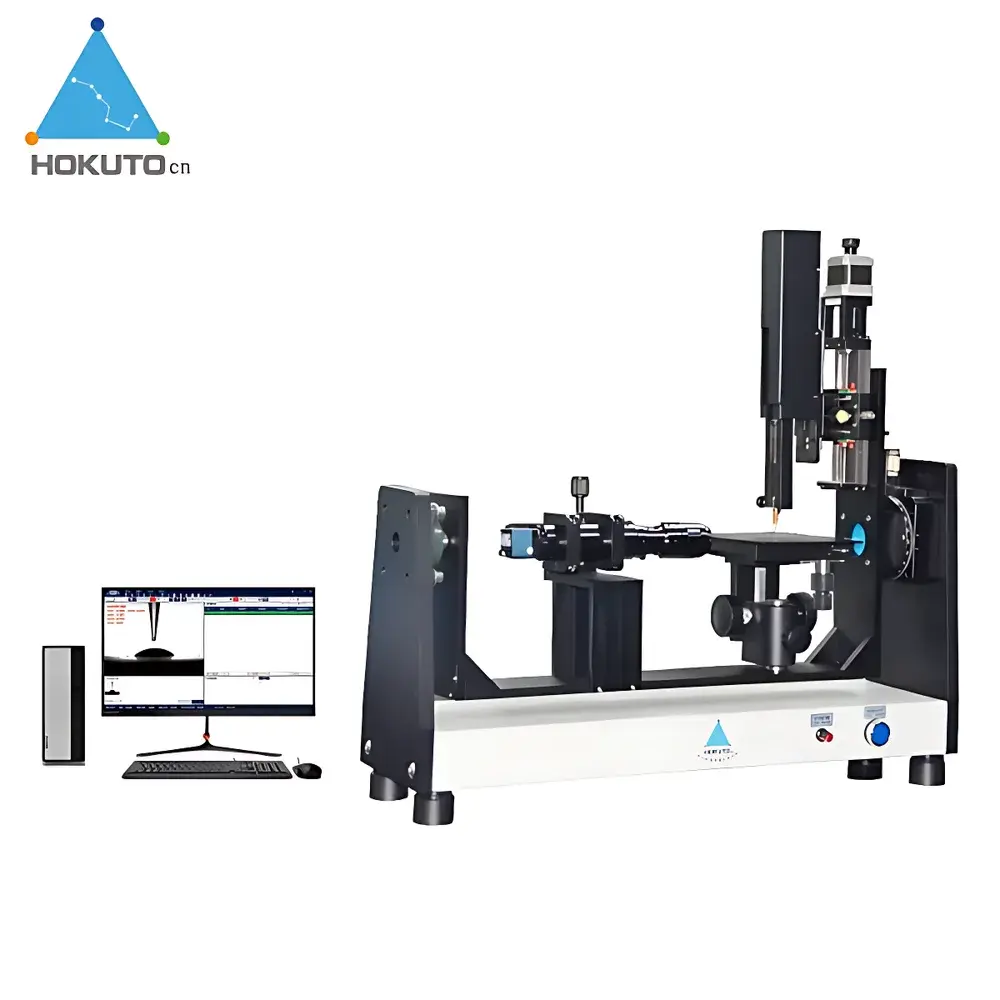
Hokuto CA-500S Automated Tilting Optical Contact Angle Analyzer with Surface & Interfacial Tension Measurement
| Brand | Hokuto Instruments (HOKUTOcn) |
|---|---|
| Origin | Dongguan, Guangdong, China |
| Manufacturer Type | OEM/ODM Producer |
| Instrument Class | Video-Based Optical Contact Angle Analyzer |
| Form Factor | Benchtop Laboratory System |
| Contact Angle Range | 0° < θ < 180° |
| Contact Angle Accuracy | ±0.1° |
| Contact Angle Resolution | 0.001° |
| Sample Stage Dimensions | 130 × 150 mm (customizable) |
| Max Sample Size | 200 (W) × ∞ (L) × 30 (H) mm |
| Surface/Interfacial Tension Range | 0.1–2000 mN/m |
| Surface/Interfacial Tension Accuracy | ±0.01 mN/m |
| Tilt Mechanism | Motorized whole-stage tilting for advancing/receding angle and roll-off angle measurement |
| Imaging | Sony 1/1.8″ progressive-scan CMOS sensor (1280 × 1024), 80 fps, rolling shutter |
| Illumination | Imported industrial-grade cold white LED backlight (400–760 nm), PWM-dimmable, >50,000 h lifetime |
| Software | CA V2.0 Static/Dynamic Contact Angle & Surface Energy Analysis Suite (Windows 10 64-bit) |
| Calibration | Traceable certified angle standards (5°, 8°, 30°, 60°, 90°, 120° optional) |
| Data Management | Audit-trail-enabled reporting (PDF/Excel/Word), GLP-compliant history database, role-based user access (operator/admin) |
Overview
The Hokuto CA-500S Automated Tilting Optical Contact Angle Analyzer is a precision-engineered benchtop instrument designed for quantitative characterization of solid-liquid interfacial phenomena using optical drop shape analysis. It operates on the principle of sessile drop, pendant drop, and dynamic tilting methodologies—enabling high-reproducibility measurement of static and dynamic contact angles, surface energy components, surface tension (γLV), interfacial tension (γLV), work of adhesion, spreading coefficient, and contact line hysteresis. The system integrates a motorized whole-stage tilting mechanism to precisely control substrate inclination (0–90°, resolution 0.001°), facilitating automated acquisition of advancing (θA) and receding (θR) angles under controlled gravitational displacement. Its core architecture supports rigorous compliance with international test standards including ASTM D5725 (wettability of sheet materials), ASTM D971 (oil-water interfacial tension via ring method), ISO 1409 (polymer dispersion surface tension), ISO 6295 (oil-water IFT), and OECD 115 (aqueous solution surface tension)—making it suitable for regulated R&D, QC, and method validation environments.
Key Features
- Motorized whole-stage tilting system with programmable angular velocity (0.1–6°/s) and positional repeatability ±0.1°, enabling fully automated dynamic contact angle and roll-off angle measurement.
- High-fidelity imaging subsystem: Sony 1/1.8″ progressive-scan CMOS sensor (1280 × 1024, 80 fps), paired with a telecentric zoom lens (0.7×–4.5×) and precision focus adjustment (±2.5 mm) for distortion-free, sub-pixel liquid contour capture.
- Uniform cold-white LED backlight (400–760 nm) with dual-mode PWM + software brightness control and imported quartz diffusion optics—eliminating thermal evaporation artifacts and ensuring consistent edge contrast across diverse liquids (including low-volatility inks and solvents).
- Automated dispensing module with 0.01 µL resolution, programmable dispensing speed (0.01–25 µL/s), and real-time meniscus-level monitoring—compatible with Hamilton, Boli, and custom syringes (50–1000 µL), stainless steel, PTFE, and hydrophobic needles (0.25–0.5 mm ID).
- CA V2.0 analytical software suite featuring 7 validated surface energy models (OWRK, Fowkes, Wu harmonic mean, Acid-Base Theory, Zisman, EOS, Extended Fowkes), pre-loaded database of 37 reference liquids, and customizable liquid property library.
- Sub-pixel contact line detection, automatic baseline tilt compensation, bilateral symmetric fitting (circle, ellipse, oblique circle/ellipse, B-Snake), and video-based sequential frame analysis for time-resolved wetting kinetics.
- GLP-ready data management: Role-based user authentication (operator/admin), electronic audit trail, encrypted raw image + metadata storage, and exportable reports in PDF, Excel, and Word formats compliant with 21 CFR Part 11 requirements.
Sample Compatibility & Compliance
The CA-500S accommodates flat or moderately curved substrates up to 200 mm wide and 30 mm thick—including glass, silicon wafers, polymer films, metal foils, textiles, coated papers, and functionalized biomaterials. Its modular stage design (X/Y/Z manual translation with 0.1 mm resolution) and adjustable clamping fixtures support heterogeneous sample geometries without requiring vacuum or adhesive mounting. The system conforms to multiple regulatory and industry-standard test protocols: ASTM D5725 (wettability of sheet materials), ASTM D724 (paper surface wettability), ASTM C813 (hydrophobic contaminant detection on glass), ISO 4311 (CMC determination), ISO 6889 (IFT by Wilhelmy plate), DIN EN 14210 (surfactant IFT), and OECD 115. All measurements are traceably calibrated using NIST-traceable angle reference standards (5°–120°), with documented uncertainty budgets available upon request.
Software & Data Management
CA V2.0 is a proprietary Windows 10 (64-bit) application developed in-house and registered with China’s National Copyright Administration (Registration No.: 2021SRXXXXXX). It implements real-time feedback algorithms for adaptive illumination balancing, sub-pixel droplet boundary localization, and iterative contour fitting convergence. The software supports batch processing of multi-image sequences and full-video contact angle evolution analysis—automatically extracting θA, θR, hysteresis (Δθ), and roll-off dynamics. Surface energy calculations integrate dispersive, polar, Lewis acid/base, and hydrogen bonding contributions, outputting results in mJ/m² with component breakdowns. All raw images, metadata (timestamp, operator ID, environmental conditions), and intermediate calculation parameters are archived in an encrypted SQLite database with immutable audit logs—ensuring full data integrity for GMP/GLP audits and FDA submissions.
Applications
The CA-500S serves as a primary metrology tool across advanced manufacturing and materials science domains. In inkjet printing R&D, it quantifies ink-substrate affinity, predicts dot spreading behavior, and validates plasma or corona pretreatment efficacy. In semiconductor packaging, it assesses underfill resin wettability on Cu/low-k dielectrics and solder mask surfaces. For pharmaceutical film coatings, it evaluates excipient-solvent interactions and tablet coating uniformity. In battery electrode development, it characterizes slurry rheology–wettability coupling on current collectors. Additional use cases include: hydrophobic/hydrophilic surface modification verification (e.g., anti-fog, self-cleaning), textile fiber finish optimization, medical device polymer biocompatibility screening, and surfactant formulation benchmarking against ASTM D1331 and DIN 53914.
FAQ
What standards does the CA-500S support for surface and interfacial tension measurement?
It complies with ASTM D971, ASTM D1331, ISO 6295, ISO 1409, DIN EN 14370, and OECD 115—covering both pendant drop and Wilhelmy plate-derived methods.
Can the system measure contact angles on non-planar or flexible substrates?
Yes—the motorized tilt platform and adjustable stage allow stable positioning of curved, rolled, or thin-film samples; optional vacuum chucks and custom fixtures are available for enhanced fixation.
Is the software validated for 21 CFR Part 11 compliance?
CA V2.0 includes electronic signatures, audit trails, role-based access control, and data immutability features required for regulated environments—though formal validation documentation must be performed per site-specific SOPs.
How is calibration maintained over time?
The system ships with certified angle reference standards (5°–120°); routine verification is performed using these physical artifacts, and software-based auto-calibration routines correct for optical drift and mechanical hysteresis.
Does the instrument support third-party syringe pumps or external environmental chambers?
Yes—via TTL/RS-232 interfaces and open API protocols, the CA-500S integrates with humidity-controlled stages, temperature-controlled sample holders, and programmable syringe pumps for advanced environmental testing scenarios.



