
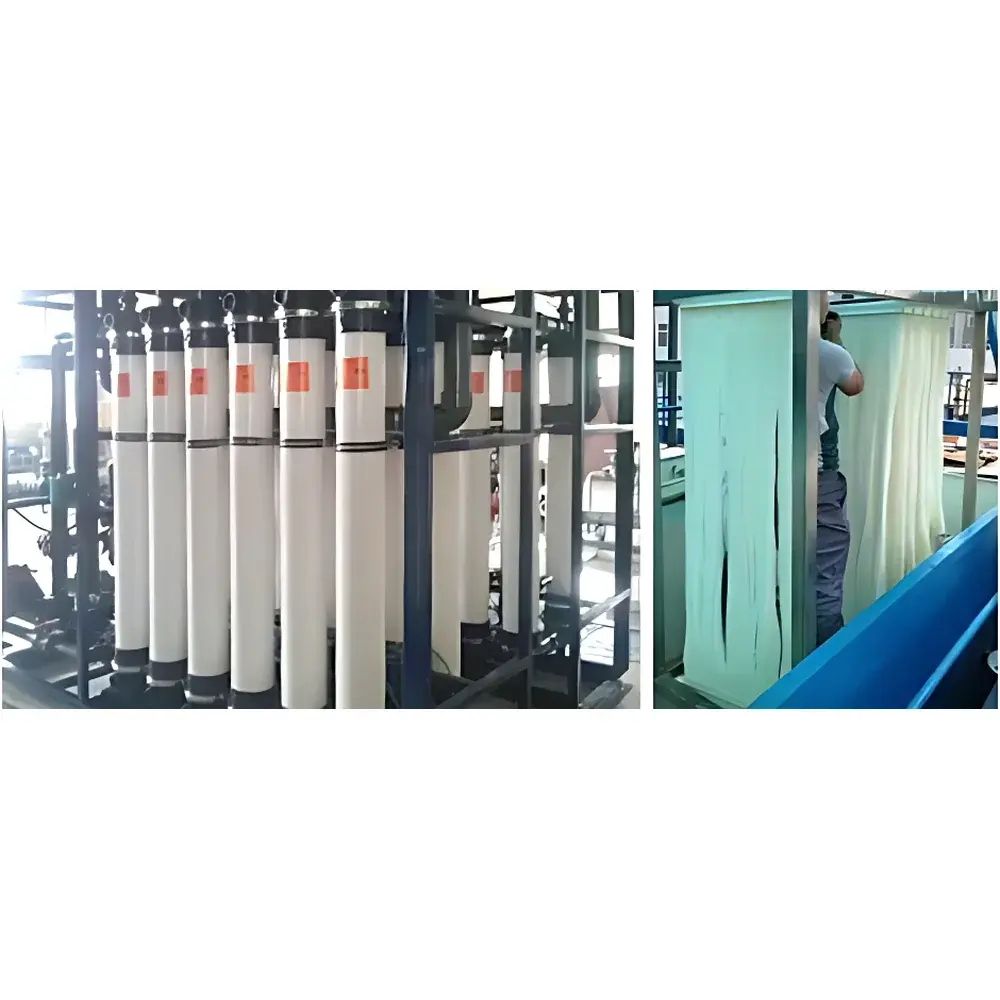
Hollow Fiber Membrane Module (PVDF, TIPS-Processed)
| Brand | New Biolink |
|---|---|
| Origin | Beijing, China |
| Model | Hollow Fiber Membrane |
| Membrane Material | Polyvinylidene Fluoride (PVDF) |
| Manufacturing Process | Thermally Induced Phase Separation (TIPS) |
| Configuration Options | Pressure-Driven, Submerged, and MBR Curtain-Type Modules |
| Chemical Resistance | pH 2–12, Oxidant-Tolerant (up to 50 ppm NaOCl) |
| Mechanical Strength | >1.2 MPa Burst Pressure |
| Typical Pure Water Flux | 250–450 L/m²·h @ 0.1 MPa, 25°C |
| Compatibility | Interchangeable with Dow/Omexell UF Modules (e.g., 2660, 2860) |
| Application Scope | Municipal Wastewater Reuse, RO Pretreatment, Industrial Feedwater, Bottled Water Production, Seawater Desalination Pretreatment, Oilfield Injection Water, High-Strength Industrial Effluent (Coal/Petrochemical), Pharmaceutical Biomolecule Recovery, Dairy Protein Fractionation, Fruit Juice Clarification & Concentration |
Overview
The New Biolink Hollow Fiber Membrane Module is a polyvinylidene fluoride (PVDF)-based ultrafiltration (UF) membrane system engineered for high-reliability liquid separation in demanding industrial and municipal applications. Fabricated via thermally induced phase separation (TIPS), this asymmetric membrane exhibits a well-defined porous structure with narrow pore size distribution (nominal MWCO: 100–500 kDa), enabling precise molecular weight cutoff control and high rejection of colloids, bacteria, viruses, and macromolecules. Unlike solvent-cast alternatives, the TIPS process yields enhanced mechanical integrity and thermal stability—critical for long-term operation under variable hydraulic and chemical conditions. The module operates on a dead-end or cross-flow filtration principle, depending on configuration (pressure-driven or submerged), and integrates seamlessly into both standalone treatment skids and integrated membrane bioreactor (MBR) systems.
Key Features
- PVDF polymer matrix offering exceptional resistance to chlorine, sodium hypochlorite (≤50 ppm), acids (pH ≥2), and alkalis (pH ≤12), ensuring extended service life in aggressive feed streams
- High tensile strength (>1.2 MPa burst pressure) and fatigue resistance—validated per ASTM D882—enabling stable performance under cyclic backwashing and air-scouring protocols
- Optimized fiber geometry (inner diameter: 0.6–0.8 mm; wall thickness: 120–180 µm) delivering high surface-area-to-volume ratio and uniform flux distribution
- Pressure-driven modules designed for direct compatibility with industry-standard 6-inch and 8-inch pressure vessels, including interchangeability with Dow/Omexell UF elements (e.g., 2660, 2860 series)
- Submerged and MBR curtain configurations pre-assembled on stainless-steel frames with integrated air-diffusion manifolds for efficient biofouling mitigation
- Low fouling propensity validated by normalized TMP rise <0.02 bar/day under continuous municipal wastewater operation (ISO 27427-compliant test protocol)
Sample Compatibility & Compliance
This membrane system is validated for use with complex aqueous matrices including activated sludge supernatant, refinery produced water, coal gasification effluent, dairy whey, fruit juice pulp suspensions, and pharmaceutical fermentation broths. It complies with ISO 9001:2015 manufacturing controls and meets material safety requirements under FDA 21 CFR §177.2420 for indirect food contact applications (e.g., bottled water, juice processing). For regulated pharmaceutical environments, the PVDF grade is extractables-tested per USP , and full documentation supports GLP/GMP audit readiness. All modules undergo 100% integrity testing (pressure hold or bubble point) prior to shipment, aligned with ASTM E2952 and ISO 10359-1 standards.
Software & Data Management
While the membrane itself is a passive separation component, New Biolink provides standardized interface specifications for integration with third-party SCADA and PLC platforms (Modbus RTU/TCP, Profibus DP). Recommended monitoring parameters include transmembrane pressure (TMP), permeate flow rate, feed turbidity, and online SDI15—all configurable within common industrial data historians (e.g., Siemens Desigo CC, Emerson DeltaV). For MBR deployments, the system supports automated backpulse scheduling and air-scour duty cycle logging, with timestamped event records traceable for regulatory review under FDA 21 CFR Part 11 when paired with compliant supervisory software.
Applications
- Municipal wastewater tertiary treatment and non-potable reuse (irrigation, toilet flushing, industrial cooling)
- RO pretreatment for seawater desalination and brackish water plants—reducing SDI to 95%
- Industrial feedwater polishing for power generation, semiconductor rinse water, and pharmaceutical purified water (PW) loops
- Mineral water and spring water clarification without carbon dosing or diatomaceous earth filtration
- Oily wastewater treatment in upstream oil & gas—meeting API RP 42 and ISO 16930 discharge thresholds
- Coal chemical wastewater recovery: removal of phenolics, cyanides, and suspended solids prior to zero-liquid-discharge (ZLD) evaporation
- Biopharmaceutical downstream processing: harvest and concentration of monoclonal antibodies, vaccines, and plasmid DNA
- Dairy processing: microfiltration of skim milk for casein/whey protein fractionation (NF/UF hybrid trains)
- Fruit juice stabilization: pectinase-resistant clarification and cold concentration of apple, orange, and grape must
FAQ
What is the maximum operating temperature for these PVDF hollow fiber membranes?
Continuous operation is rated up to 45°C; short-term exposure (≤2 h) is permissible to 55°C under low-fouling conditions.
Can these modules be chemically cleaned in situ?
Yes—standard CIP protocols using citric acid (pH 2–3), sodium hydroxide (pH 11–12), and low-concentration sodium hypochlorite (≤50 ppm available chlorine) are fully compatible.
Is integrity testing required before commissioning?
Yes—bubble point or pressure decay testing per ASTM E2952 is mandatory prior to first use and after each chemical cleaning cycle.
Do you provide flux decline modeling support for system design?
New Biolink supplies empirical fouling coefficient datasets (kf) and normalized flux-time curves for representative feedwaters, compatible with commercial simulation tools such as AFT Fathom and Hydrosim.
Are custom module lengths or fiber densities available?
Yes—OEM configurations (including 1.0 m, 1.5 m, and 2.0 m effective length; 3,000–12,000 fibers per bundle) are offered under NDA for engineered system integrators.



