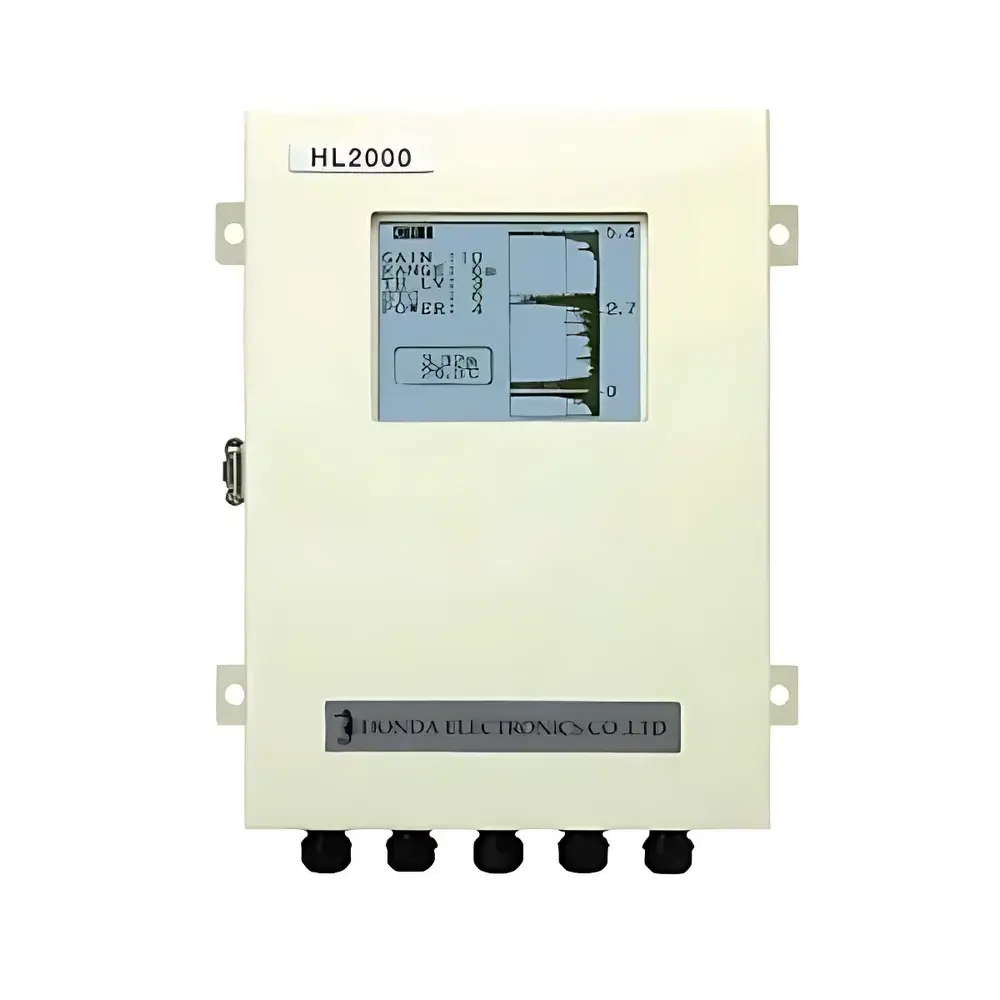
HONDA HL2000 Ultrasonic Sludge Interface Level Meter (Single-Channel Configuration)
| Brand | SANWA |
|---|---|
| Origin | Japan |
| Manufacturer Type | Authorized Distributor |
| Origin Category | Imported |
| Model | HL2000 |
| Price | Upon Request |
| Channel Count | 1 (2nd channel optional) |
| Frequency | 400 kHz |
| Measurement Range | 0.4–10 m |
| Resolution (Measurement & Display) | 1 cm |
| Data Update Interval | 1 s |
| Beam Angle (Half-Power Full Width) | 6° |
| Power Supply | AC 100–240 V ±15% |
| Power Consumption | 10 VA |
| Display | Backlit LCD |
| Alarm Outputs | 2 upper + 2 lower per channel, relay contacts (AC 250 V / DC 30 V, 5 A) |
| Analog Output | 4–20 mA (16-bit resolution), 1 output per channel (max. load resistance: 450 Ω) |
| Communication Interface | RS-232C (≤10 m transmission distance) |
| Operating Temperature | Transmitter: −10 to +60 °C |
| Sensor | −5 to +60 °C |
| Enclosure Rating | Transmitter IP54 |
| Housing Material | Painted steel (transmitter), PVC (sensor housing & cable) |
| Dimensions (Transmitter) | 280 W × 92.5 D × 322 H mm |
| (Sensor) | Ø80 × 95 mm |
| Cable Length | 20 m |
| Weight | Transmitter 3.6 kg |
| Packaging | 530 × 410 × 360 mm, 11 kg |
Overview
The HONDA HL2000 Ultrasonic Sludge Interface Level Meter is an industrial-grade, non-contact interface detection system engineered for continuous, high-reliability monitoring of the sludge/water boundary in primary and secondary clarifiers, thickeners, and lamella settlers. Unlike conventional float or submersible probe systems, the HL2000 employs pulsed ultrasonic time-of-flight measurement at 400 kHz to detect acoustic impedance discontinuities—primarily the transition between low-density supernatant and high-solids sludge layers. Its fixed-mount transducer operates without mechanical contact with the process medium, eliminating risks of entanglement with scraper mechanisms, fouling-induced drift, or mechanical wear. Designed for long-term unattended operation in wastewater treatment plants, the HL2000 delivers stable interface tracking over a 0.4–10 m range with 1 cm resolution, supported by proprietary signal processing algorithms that suppress false echoes from surface turbulence, foam, or suspended solids stratification.
Key Features
- Non-invasive, top-mounted ultrasonic measurement—no submerged components, zero risk of mechanical interference with sludge rakes or scrapers
- High-frequency 400 kHz transducer with narrow 6° beam angle (half-power full width), enabling precise spatial discrimination of the sludge interface even in turbulent or multi-layered settling basins
- Robust dual-housing design: transmitter unit rated IP54 (dust-protected, splash-resistant); sensor head rated IP68 (fully submersible up to 10 m depth, continuous immersion)
- Integrated cleaning nozzle and standardized mounting tube supplied as standard—enables automated or manual air/water purge to maintain acoustic window integrity under high-fouling conditions
- Modular architecture supports single-channel (standard) or dual-channel configuration (second sensor optional)—enabling simultaneous interface profiling at two spatially distinct locations within the same basin
- Low-power, wide-input AC power supply (100–240 V ±15%, 10 VA) ensures compatibility with global plant electrical infrastructure without external transformers
Sample Compatibility & Compliance
The HL2000 is validated for use in municipal and industrial wastewater applications where interface stability, repeatability, and corrosion resistance are critical. It reliably measures interfaces in activated sludge, anaerobic digestate, and primary sedimentation tanks containing suspended solids concentrations ranging from 0.5% to 12% w/w. The PVC sensor housing and cable meet ISO 15837 and EN 61000-6-2/6-4 electromagnetic compatibility requirements for industrial environments. While not certified for SIL-rated safety functions, its deterministic response time (<1 s update interval), relay alarm redundancy (2 upper + 2 lower per channel), and fail-safe analog output align with IEC 61511 functional safety principles for level monitoring in non-critical control loops. The device supports basic audit trail logging via RS-232C for GLP-aligned maintenance records.
Software & Data Management
The HL2000 operates as a standalone instrument with embedded firmware—no PC software is required for basic operation. All configuration (e.g., damping factor, alarm thresholds, zero/span calibration) is performed locally via the backlit LCD interface with tactile keypad navigation. RS-232C serial communication enables integration into SCADA or DCS platforms using ASCII protocol (baud rate: 9600, 8N1). Raw interface distance values, status flags (e.g., “signal weak”, “no echo”, “cleaning active”), and relay state logs can be polled on demand or streamed at user-defined intervals. The 16-bit 4–20 mA output provides traceable analog backup for PLCs compliant with ISA-50.00.01 analog signal standards. Data persistence is maintained across power cycles; no volatile memory or battery-backed clock is used.
Applications
- Real-time optimization of sludge blanket depth in circular and rectangular clarifiers to prevent effluent turbidity excursions
- Feedback control input for automatic sludge withdrawal pumps and return activated sludge (RAS) flow regulation
- Interface trending for predictive maintenance of scraper mechanisms and torque monitoring
- Dual-point profiling to assess sludge compaction uniformity across basin width—critical for diagnosing short-circuiting or hydraulic maldistribution
- Commissioning support for new clarifier installations, including baseline interface mapping during startup and ramp-up phases
- Regulatory compliance reporting (e.g., EPA NPDES permit requirements for sludge blanket monitoring)
FAQ
Can the HL2000 measure interface in aerated basins or tanks with heavy surface foam?
Yes—the 400 kHz frequency and adaptive echo discrimination algorithm suppress false returns from foam layers; however, sustained thick biological foam (>5 cm) may require periodic manual cleaning or compressed-air purging.
Is the 20 m sensor cable length field-extensible?
No—cable extension beyond 20 m is not recommended due to signal attenuation and noise susceptibility; for longer runs, a local junction box with shielded twisted-pair cable and proper grounding must be installed per IEC 61000-4-5 surge protection guidelines.
Does the device support Modbus RTU or other industrial protocols?
No—only ASCII-based RS-232C communication is provided; Modbus integration requires an external protocol converter.
What calibration procedures are required for long-term accuracy?
Factory calibration is traceable to NIST-equivalent ultrasonic reference standards; field verification uses known geometry (e.g., calibrated water level in test tank) every 6–12 months per ISO/IEC 17025 metrological practice.
Can the HL2000 be used in potable water storage tanks?
Not recommended—the sensor’s PVC housing and signal processing are optimized for high-turbidity, high-solids wastewater; for clear-water applications, a dedicated drinking-water-certified ultrasonic level sensor (e.g., meeting NSF/ANSI 61) should be selected instead.