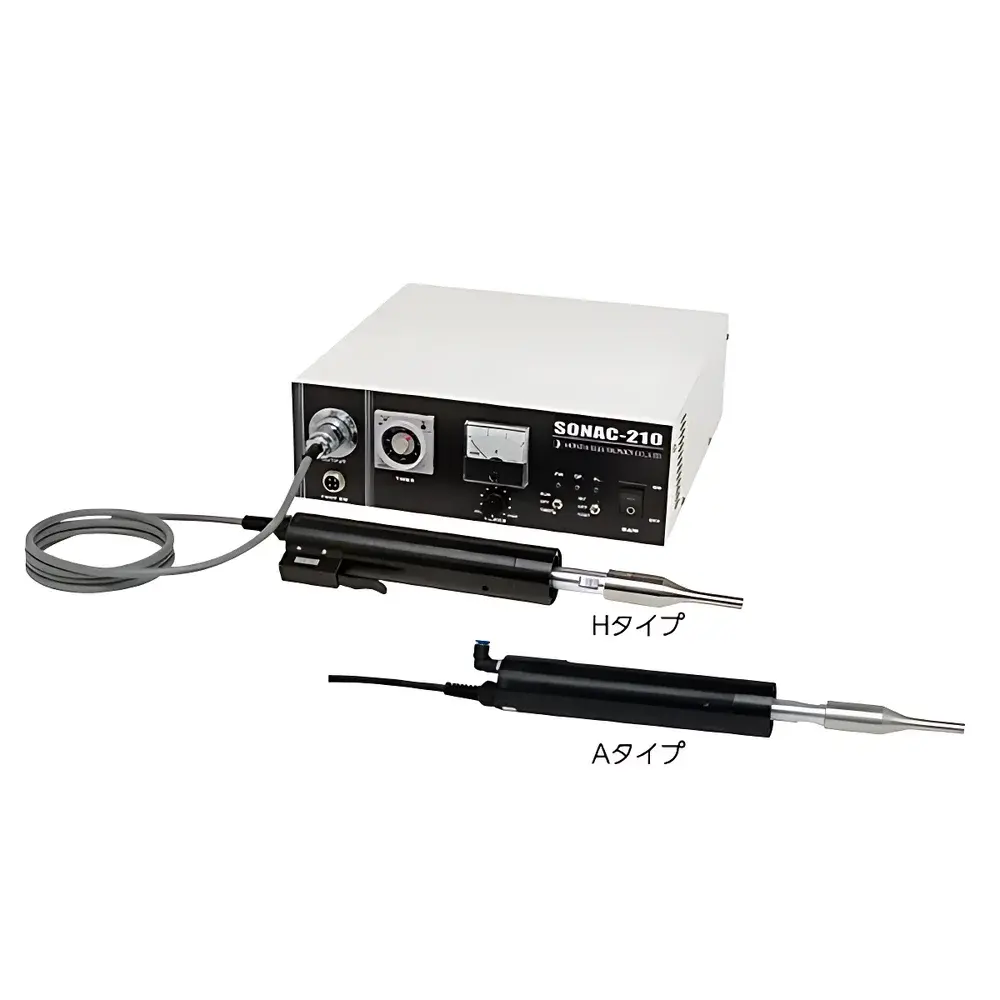
Honda HONDA SONAC-210 Handheld Ultrasonic Plastic Welding System
| Brand | SANWA |
|---|---|
| Origin | Japan |
| Manufacturer Type | Authorized Distributor |
| Origin Category | Imported |
| Model | SONAC-210 (H-Type) |
| Output Power | 200 W |
| Operating Frequency | 28 kHz |
| Oscillation Method | PLL Auto-Tracking |
| Power Supply | AC 100 V ±10%, 50/60 Hz |
| Dimensions (Oscillator) | 300 × 308 × 107 mm |
| Dimensions (Handheld Horn Assembly, incl. φ9 mm Standard Horn) | Ø42 × 338 mm |
| Weight (incl. Standard Horn) | 4.9 kg |
| Output Cable Length | 1.5 m |
| Power Cord Length | 2.0 m |
| Timer Range | 0.1–9.9 s |
| Packaging Dimensions | 410 × 410 × 250 mm |
| Net Weight | 8.0 kg |
Overview
The Honda HONDA SONAC-210 is a compact, handheld ultrasonic plastic welding system engineered for precision joining of thermoplastic components in R&D labs, quality control environments, and low-to-medium volume production settings. Unlike conventional thermal or adhesive bonding methods, this system employs high-frequency mechanical vibration—generated via piezoelectric transduction—at a nominal frequency of 28 kHz to induce localized molecular friction at the interface of two plastic parts. This process melts the polymer surface layers under controlled pressure, enabling solid-state coalescence upon cooling. The system utilizes a bolted Langevin-type resonator, specifically designed and validated for sustained high-output operation (200 W nominal), ensuring consistent energy delivery and long-term reliability. Its integrated PLL (Phase-Locked Loop) auto-tracking circuit continuously monitors and adjusts the drive frequency to match the mechanical resonance of the horn assembly in real time—compensating for thermal drift, load variation, and material-dependent impedance shifts. As a certified Type-Approved device under Japan’s Radio Law (Ministry of Internal Affairs and Communications), the SONAC-210 operates without requiring individual high-frequency equipment licensing—a critical advantage for laboratories operating under strict regulatory or facility compliance protocols.
Key Features
- Handheld ergonomic design with balanced weight distribution (4.9 kg inclusive of standard φ9 mm horn) for extended operator usability and precise manual positioning.
- Bolted Langevin resonator architecture—developed in-house for SONAC-210—optimized for high electromechanical coupling efficiency and resistance to fatigue under repetitive 200 W duty cycles.
- PLL-based automatic frequency tracking ensures stable amplitude output across varying joint geometries, material thicknesses, and ambient temperature conditions.
- Dedicated constant-amplitude control circuitry maintains consistent vibrational energy delivery, minimizing weld inconsistency due to input voltage fluctuations (AC 100 V ±10%).
- Digitally adjustable weld timer (0.1–9.9 s resolution) enables reproducible energy input for process validation and documentation traceability.
- Standard configuration includes a φ9 mm titanium alloy horn; additional horn profiles (e.g., flat, tapered, custom geometries) are available as optional accessories for application-specific joint designs.
Sample Compatibility & Compliance
The SONAC-210 is compatible with a broad range of amorphous and semi-crystalline thermoplastics—including ABS, PC, PS, PMMA, PP, PE, and certain grades of PBT and PET—provided they exhibit sufficient melt viscosity and interfacial compatibility. It is not suitable for thermosets, filled composites with >30% glass fiber, or highly conductive or heat-dissipative polymers lacking adequate viscoelastic damping at 28 kHz. The system complies with JIS C 61000-6-3 (EMC emission limits) and JIS C 61000-6-2 (immunity requirements) for industrial environments. Its Type Approval certification (Japan MIC Notification No. applicable to ultrasonic welders under Article 31) eliminates the need for site-specific radio frequency licensing. While not inherently 21 CFR Part 11 compliant, audit-ready operation is supported through external logging of timer settings, cycle counts, and operator IDs when integrated into validated laboratory workflows.
Software & Data Management
The SONAC-210 operates as a standalone analog-controlled system with no embedded microprocessor or digital interface. All operational parameters—including timer setting and power-on activation—are managed locally via front-panel controls. For GxP-aligned environments, integration with external data acquisition systems is achievable using its TTL-compatible trigger output (optional accessory) and analog amplitude monitoring port. Users may record weld duration, cycle count, and pass/fail status manually or via PLC-linked SCADA systems. Calibration verification follows manufacturer-recommended procedures using calibrated force gauges and oscilloscope-based waveform analysis (per ISO 17025-accredited methods where applicable). Maintenance logs—including resonator torque verification, horn wear inspection, and amplitude calibration checks—should be retained per internal GLP/GMP documentation standards.
Applications
- Rapid prototyping of plastic enclosures, fluidic manifolds, and medical device housings requiring hermetic, particulate-free seams.
- QC testing of weld integrity in automotive interior components (e.g., sensor bezels, HVAC ducts) using destructive pull tests or non-destructive ultrasonic C-scan evaluation.
- Assembly of microfluidic cartridges and diagnostic consumables where solvent-free, low-heat-input bonding preserves reagent stability.
- Educational demonstration of polymer rheology and interfacial energy dissipation mechanisms in materials science laboratories.
- Field-service repair of consumer electronics casings where portability and immediate readiness (no warm-up required) are essential.
FAQ
Is the SONAC-210 compatible with 230 V power supplies?
No—the unit is rated exclusively for AC 100 V ±10% operation. Use with step-down transformers is not recommended due to potential waveform distortion affecting PLL stability.
Can I replace the standard φ9 mm horn with a custom-designed horn?
Yes—SANWA offers OEM horn design and tuning services; third-party horns must undergo resonant frequency verification (28.0 ±0.3 kHz) and amplitude calibration prior to deployment.
Does the system include built-in weld quality monitoring?
No—it provides no real-time amplitude, force, or energy feedback. Process consistency relies on fixed parameter settings and periodic verification per ASTM F2102 (Standard Guide for Ultrasonic Welding of Plastics).
What maintenance intervals are recommended for the resonator assembly?
Torque verification of the Langevin stack bolts every 200 operating hours; visual inspection of horn tip erosion before each shift; full resonator recalibration annually or after 1,000 weld cycles.
Is technical support available outside Japan?
Yes—authorized SANWA distributors provide multilingual documentation, application engineering consultation, and spare parts logistics under global service agreements.