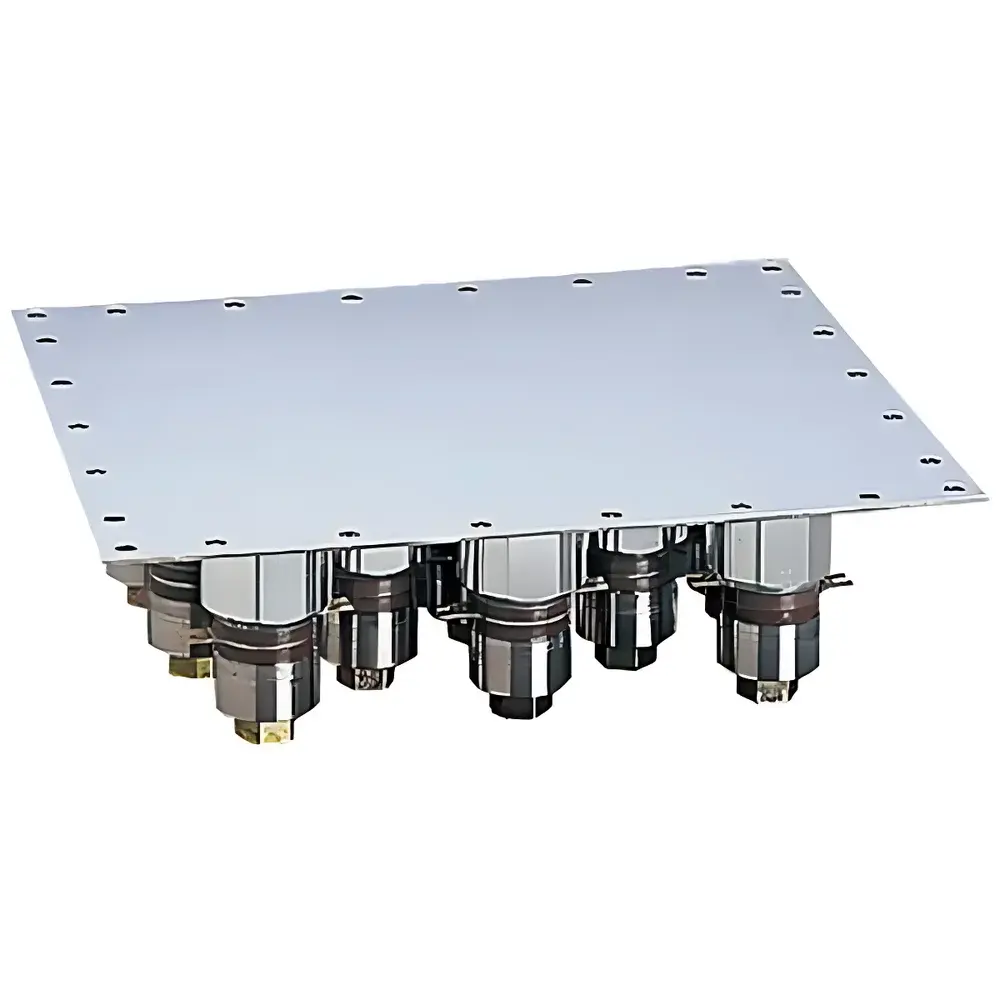
Honda WDX-600N-I Piezoelectric Diaphragm Ultrasonic Transducer
| Brand | Honda |
|---|---|
| Origin | Japan |
| Model | WDX-600N-I |
| Max Input Power | 600 W |
| Resonant Frequencies | 28 kHz & 75 kHz |
| Effective Radiating Area | 350 mm (W) × 200 mm (D) |
| Dimensions (Transducer) | 390 × 240 × 83 mm |
| Housing Material | SUS304 stainless steel (t = 2.5 mm) |
| Diaphragm Sealing Material | EPDM rubber (t = 3 mm) |
| Weight | 10 kg |
| Packaging Dimensions | 540 × 470 × 250 mm |
| Net Weight | 10 kg |
| Gross Weight | 15 kg |
| System Requirement | Must be operated with a compatible ultrasonic generator/amplifier — not functional as a standalone unit |
Overview
The Honda WDX-600N-I is a high-power piezoelectric diaphragm-type ultrasonic transducer engineered for industrial and laboratory-scale ultrasonic processing applications. Unlike conventional bolted Langevin transducers, this device employs a monolithic diaphragm architecture where piezoceramic elements are integrated into a tensioned SUS304 stainless steel membrane. This design enables efficient acoustic energy transfer across large surface areas while maintaining mechanical stability under high-intensity vibrational loads. The transducer operates at two discrete resonant frequencies—28 kHz and 75 kHz—allowing users to select the optimal frequency based on process requirements: lower frequency (28 kHz) delivers higher cavitation intensity suitable for cleaning, emulsification, and cell disruption; higher frequency (75 kHz) provides finer cavitation distribution and reduced erosion risk, appropriate for delicate dispersion, nanoparticle deagglomeration, and precision sonochemical synthesis. As a non-self-contained component, the WDX-600N-I requires integration with a matched ultrasonic generator capable of impedance matching, frequency tracking, and real-time power regulation. It is not rated for direct connection to mains power or unregulated signal sources.
Key Features
- High-power capability: Rated for continuous operation at up to 600 W input power, enabling scalable process intensification in batch and flow-through systems.
- Dual-frequency resonance: Factory-tuned mechanical resonance at both 28 kHz and 75 kHz—verified via impedance spectroscopy—ensuring stable output without external tuning adjustments.
- Large radiating surface: 350 mm × 200 mm effective emission area supports uniform energy distribution across wide-area reactors, sonoreactors, or immersion tanks.
- Corrosion-resistant construction: Housing fabricated from AISI 304 stainless steel (2.5 mm thickness) with EPDM elastomer sealing (3 mm) ensures compatibility with aqueous, mildly acidic, and organic solvent environments.
- Thermally robust design: Optimized heat dissipation path from piezoceramic stack to baseplate minimizes thermal drift during extended duty cycles.
- Standardized mechanical interface: Modular flange-mount configuration facilitates integration into OEM equipment, custom-built sonication chambers, or ISO-standard reactor vessels.
Sample Compatibility & Compliance
The WDX-600N-I is designed for use with liquid-phase samples in controlled environments, including water-based suspensions, polymer solutions, colloidal dispersions, and low-viscosity organic media. It is unsuitable for dry-powder excitation or gaseous transmission. When installed in validated systems, the transducer supports compliance with key industry frameworks: its stainless-steel wetted parts meet FDA 21 CFR §177.2600 for indirect food contact surfaces; EPDM sealing conforms to USP Class VI biocompatibility standards; and mechanical construction aligns with ISO 13849-1 (PL d) for safety-related control systems when paired with appropriate interlocks. While the transducer itself does not carry CE or UL certification, it is intended for incorporation into final equipment that undergoes full EMC and LVD assessment per IEC 61000-6-3/6-4 and IEC 61010-1.
Software & Data Management
As a passive electromechanical transduction element, the WDX-600N-I does not incorporate embedded firmware, onboard memory, or digital communication interfaces. All operational parameters—including drive frequency selection, amplitude modulation, power ramping, and duty cycle control—are managed externally by the connected ultrasonic generator. Compatible generators typically support analog 0–10 V or 4–20 mA setpoint inputs, RS-485 Modbus RTU, or Ethernet/IP protocols for integration into SCADA or MES platforms. Audit-trail-capable generators compliant with FDA 21 CFR Part 11 may log timestamped power, frequency, and temperature data—provided the transducer is coupled with external PT100 or thermistor sensors mounted on the housing. No proprietary software is required or distributed with this component.
Applications
- Industrial ultrasonic cleaning of precision components (e.g., semiconductor wafers, optical lenses, medical devices)
- Continuous-flow nanoparticle dispersion in pharmaceutical nanosuspension development
- Scale-up of sonochemical reactions including Fenton oxidation, hydrolysis catalysis, and polymer grafting
- Enhanced mass transfer in extraction processes (e.g., botanical active compound recovery)
- Acoustic levitation and particle manipulation research setups requiring planar wavefront generation
- Integration into automated QC testing stations for material fatigue evaluation under cyclic stress
FAQ
Can the WDX-600N-I operate without an ultrasonic generator?
No. It is a passive transducer and must be driven by a matched ultrasonic amplifier/generator providing precise frequency control, impedance compensation, and current-limited output.
What is the recommended coupling method for immersion applications?
Direct immersion is permitted only if the EPDM seal remains fully submerged and undamaged; for tank-mounted configurations, use ISO-standard flange gaskets and torque-controlled fastening to prevent acoustic leakage and mechanical fatigue.
Is the transducer suitable for explosive atmospheres?
Not inherently. Integration into ATEX/IECEx-certified systems requires additional explosion-proof enclosures, intrinsically safe drivers, and third-party hazardous-area validation.
Does Honda provide calibration certificates for this model?
No. Calibration is performed at the system level (transducer + generator + load) by end-users or accredited metrology labs using laser vibrometry or hydrophone-based acoustic field mapping per IEC 61545-2.
What maintenance intervals are recommended?
Visual inspection of EPDM integrity and stainless-steel surface corrosion every 500 operational hours; no scheduled internal servicing is specified due to hermetically sealed piezoceramic assembly.