
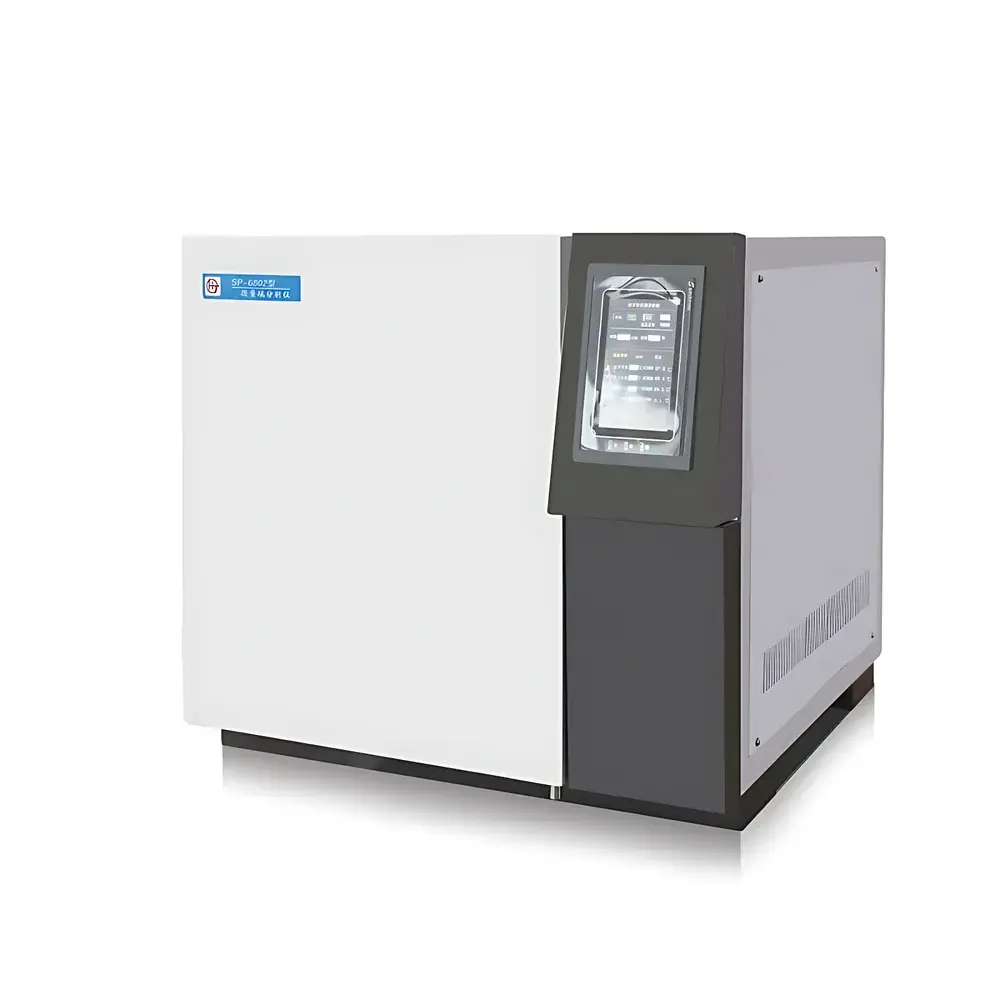
Hongtu SP-6802 Micro-Sulfur Analyzer
| Brand | Hongtu |
|---|---|
| Origin | Shandong, China |
| Model | SP-6802 |
| Detection Limit (as S in H₂S) | 0.01 mg/m³ (Type A, non-conversion) |
| Measurement Range (as S in H₂S, undiluted) | 0.01–50 mg/m³ (extendable to 0.1–500 mg/m³) |
| Repeatability (RMS error) | <5% (n ≥10, certified H₂S standard gas or CS₂ permeation source) |
| Column Temperature Control | Ambient to 100°C ±0.2°C |
| Permeation Source Temperature Control | Ambient to 50°C ±0.1°C |
| Detector Temperature Control | Ambient to 110°C ±1°C |
| Converter Furnace Temperature | Ambient to 900°C ±5°C |
| High-Voltage Power Supply | –400 V to –800 V adjustable |
| Compliance | GB/T 19001–2016 (ISO 9001), GB/T 14001–2016 (ISO 14001) |
Overview
The Hongtu SP-6802 Micro-Sulfur Analyzer is a dedicated trace sulfur detection system engineered for high-sensitivity, quantitative analysis of sulfur compounds—including hydrogen sulfide (H₂S), carbonyl sulfide (COS), mercaptans, and thiophenes—in gaseous samples. It operates on the principle of microcoulometric detection following gas chromatographic separation, where sulfur-containing species are thermally converted to SO₂ in a high-temperature catalytic furnace (up to 900°C), followed by electrochemical titration in a microcoulometric cell. This method ensures selective, stoichiometric response to total sulfur—regardless of molecular structure—with minimal interference from nitrogen, hydrocarbons, or halogens. Designed for continuous or discrete monitoring in refinery off-gas, natural gas transmission lines, syngas purification loops, and petrochemical process streams, the SP-6802 delivers laboratory-grade accuracy in field-deployable instrumentation architecture.
Key Features
- Three configurable detection modes: Type A (direct H₂S analysis, LOD 0.01 mg/m³), Type B (broad-range direct analysis, LOD 0.1 mg/m³), and Type C (full sulfur conversion via high-efficiency furnace, LOD 0.2 mg/m³)
- Precision temperature control across critical subsystems: chromatographic column (±0.2°C), permeation source (±0.1°C), detector cell (±1°C), and catalytic converter furnace (±5°C up to 900°C)
- Adjustable high-voltage bias (–400 V to –800 V) for optimized coulometric cell response and baseline stability
- Robust thermal management architecture minimizing drift during extended unattended operation (e.g., 72-hr continuous monitoring)
- Integrated hardware diagnostics and real-time signal validation—supporting GLP-compliant data integrity protocols
- Modular design enabling field replacement of consumables (conversion catalyst, electrolyte, silver cathode) without recalibration
Sample Compatibility & Compliance
The SP-6802 accepts pressurized or ambient-pressure gas samples via standardized 1/8″ Swagelok fittings. Compatible matrices include natural gas, liquefied petroleum gas (LPG), hydrogen, nitrogen, air, and synthesis gas—with no requirement for pre-drying or particulate filtration when used with optional inline coalescing filters. The analyzer meets Chinese national standards GB/T 11060.4 (natural gas sulfur determination) and GB/T 17820 (specifications for pipeline-quality natural gas). Its quality management system is certified to GB/T 19001–2016 (equivalent to ISO 9001:2015) and environmental management to GB/T 14001–2016 (ISO 14001:2015). While not FDA 21 CFR Part 11–certified out-of-the-box, audit trails, user access logs, and electronic signature support can be enabled via firmware update for regulated QC/QA environments.
Software & Data Management
Bundled PC-based acquisition software provides real-time chromatogram visualization, peak integration (with manual baseline correction), calibration curve generation (linear, quadratic, or multi-point weighted), and automated report export in CSV, PDF, and XML formats. All raw analog signals (detector current, temperature setpoints, voltage bias) are timestamped at 10 Hz and stored locally with cyclic overwrite protection. Audit trail functionality records operator ID, method changes, calibration events, and instrument fault codes—retained for ≥36 months per internal flash memory log. Data export supports ASTM E1382-compliant metadata tagging, facilitating LIMS integration via OPC UA or Modbus TCP interfaces.
Applications
- Refinery sour water stripper overhead monitoring for H₂S breakthrough detection
- Quality control of ultra-low-sulfur diesel (ULSD) and jet fuel blending streams
- Verification of Claus unit tail gas treatment efficiency (SO₂/SxOy speciation)
- Trace sulfur screening in hydrogen feedstocks for ammonia synthesis and hydrotreating units
- Environmental compliance testing of flare gas and vent emissions per EPA Method 16
- Research-grade quantification of sulfur speciation in Fischer–Tropsch synthesis effluents
FAQ
What sulfur species does the SP-6802 detect?
It quantifies total sulfur content via catalytic oxidation to SO₂; individual speciation requires GC retention time correlation with certified standards.
Is carrier gas purity critical for low-level detection?
Yes—helium or argon with ≤0.1 ppm total hydrocarbon and ≤0.05 ppm O₂/H₂O is recommended for sub-0.1 mg/m³ measurements.
Can the instrument operate unattended for extended periods?
Yes—configured with external gas standards and auto-calibration routines, it supports 168-hour continuous operation with remote alarm notification via dry-contact relay output.
What maintenance intervals are recommended?
Electrolyte replacement every 6 months; silver cathode polishing every 12 months; furnace catalyst regeneration annually or after exposure to >50 ppm H₂S spikes.
Does the system support ASTM D5453 or ISO 20846 compliance?
The measurement principle aligns with ASTM D5453 (UV fluorescence) in terms of total sulfur equivalence, though method validation per ISO 20846 requires lab-specific correlation studies due to differing detection chemistries.



