
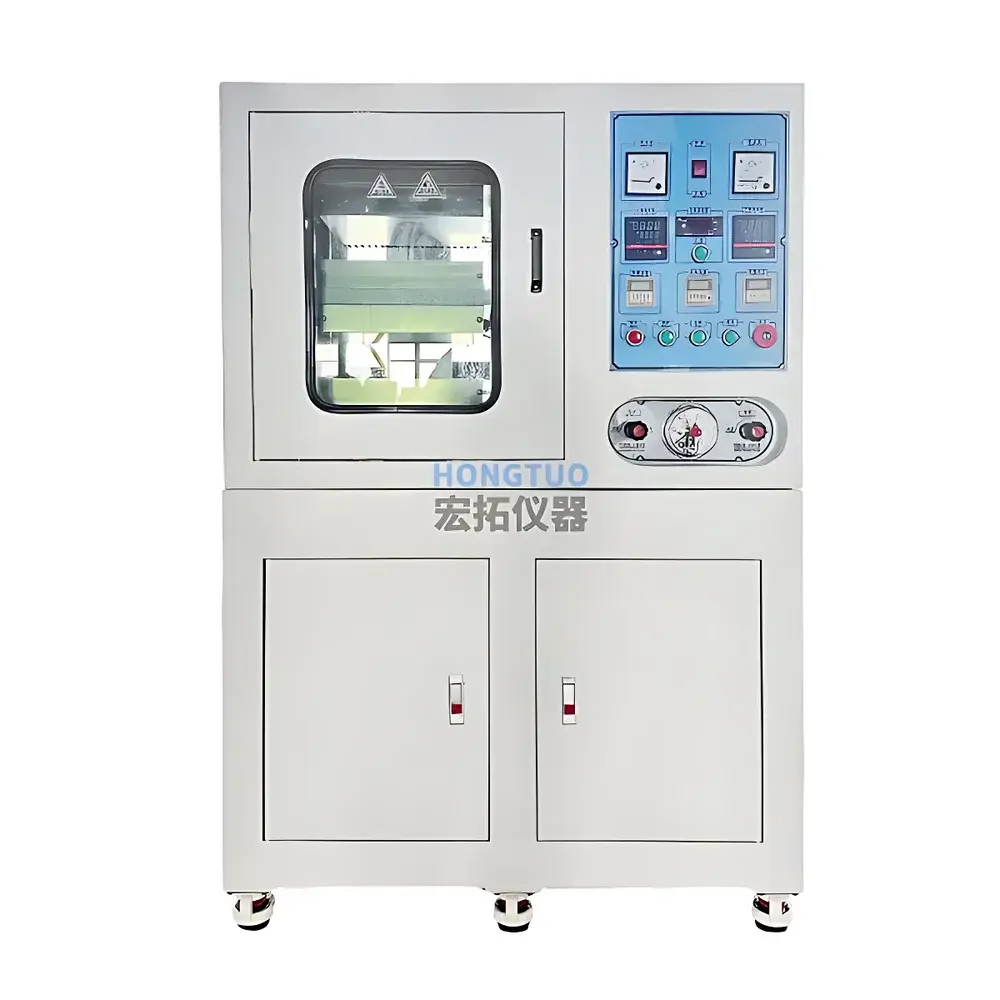
Hongtuo HT-LH30平板硫化仪
| Brand | Hongtuo |
|---|---|
| Origin | Guangdong, China |
| Model | HT-LH30 |
| Type | Plate Vulcanizer |
| Heating Method | Cartridge Heater |
| Pressure Range | 0–30 Ton (adjustable) |
| Weight | ~780 kg |
| Temperature Range | Ambient to 300 °C |
| Temperature Accuracy | ±3 °C |
| Power Supply | 3-phase 5-wire AC 380 V |
| Total Power | 8 kW |
| Platen Dimensions | 300 × 300 mm |
| Platen Spacing | 0–80 mm |
| Exhaust Cycles | 0–10 (programmable) |
| Timing Range | 0.1 min – 99 min – 9.9 h (LED digital timer) |
| Cooling | External tap water cooling |
| Platen Configuration | Dual-layer (upper heated, lower cooled) |
| Surface Finish | Mirror-finish hard chromium plating |
| Platen Material | High-strength corrosion- and heat-resistant alloy steel |
| Control Mode | Self-tuning PID with temperature auto-compensation |
| Mobility | Brake-equipped casters |
Overview
The Hongtuo HT-LH30 Plate Vulcanizer is an engineered laboratory-scale vulcanization system designed for precise simulation of industrial rubber curing processes under controlled thermal and mechanical conditions. Based on the fundamental principle of compression vulcanization—where uncured elastomer compounds are subjected to simultaneous elevated temperature and uniaxial compressive force within a closed mold cavity—the HT-LH30 enables reproducible measurement of scorch time (ts₁, ts₂), optimum cure time (t₉₀), torque development, and crosslink density evolution. Its dual-zone platen architecture (heated upper platen and actively cooled lower platen) ensures rapid thermal equilibration and minimizes thermal lag during dynamic cure profiling. The system complies with core ASTM D5289 and ISO 6502 standards for vulcanization testing, supporting both quality control and formulation development in R&D laboratories serving tire, sealant, conveyor belt, and automotive rubber component manufacturers.
Key Features
- Dual-function platen system: Upper platen (300 × 300 mm) equipped with embedded cartridge heaters and high-accuracy Pt100 sensors; lower platen integrated with external water-cooling interface for active thermal management and rapid cycle turnaround.
- Precision hydraulic actuation: Programmable pressure application from 0 to 30 metric tons via servo-controlled hydraulic cylinder, featuring three-phase motion profile—fast approach, slow-lock clamping, and rapid retraction—to ensure consistent mold closure force and eliminate flash formation.
- Self-tuning PID temperature control: Digital controller with auto-tuning algorithm and real-time temperature compensation logic maintains ±3 °C uniformity across the entire platen surface, verified per ASTM E742 thermal mapping protocols.
- Configurable cure sequencing: Independent parameter programming for pre-compression time, exhaust cycles (0–10), exhaust duration, heating ramp rate, dwell temperature, and final cure duration—all stored in non-volatile memory with timestamped execution logs.
- Robust mechanical architecture: Heavy-duty alloy steel platens with mirror-finish hard chromium coating (≥65 HRC) provide exceptional wear resistance, thermal conductivity homogeneity, and corrosion immunity against sulfur-rich compound residues.
- Operational safety & ergonomics: Emergency stop circuit compliant with IEC 60204-1; brake-equipped heavy-duty casters (load-rated ≥1000 kg); full enclosure interlock system; LED digital timer with 0.1-minute resolution and multi-range display (minutes/hours).
Sample Compatibility & Compliance
The HT-LH30 accommodates standard ASTM D5289 test specimens (e.g., 12.7 mm diameter × 1.6 mm thick discs) as well as custom molds up to 300 × 300 mm footprint and 80 mm maximum cavity depth. It supports natural rubber (NR), styrene-butadiene rubber (SBR), ethylene propylene diene monomer (EPDM), nitrile rubber (NBR), silicone (VMQ), and thermoplastic elastomers (TPEs). All thermal, pressure, and timing parameters meet traceability requirements for GLP-compliant labs. Data logging functionality supports audit-ready records aligned with FDA 21 CFR Part 11 principles when paired with validated third-party software (e.g., LabArchives or Empower).
Software & Data Management
While the HT-LH30 operates via embedded standalone controller, its RS485/Modbus RTU interface enables integration with LIMS or SCADA systems for centralized parameter monitoring and batch record generation. Optional PC-based acquisition software (sold separately) provides real-time torque–time and temperature–time curve visualization, automatic t₅/t₉₀/t₉₀ calculation per ASTM D5289 Annex A1, and CSV export compatible with JMP, Minitab, or Python pandas workflows. All setpoints, actual values, alarms, and operator IDs are logged with ISO 8601 timestamps and retained for ≥12 months.
Applications
- Rubber compound screening: Comparative analysis of accelerator systems, sulfur donors, and filler dispersion effects on cure kinetics.
- Process validation: Correlation of lab-scale cure profiles with production press cycle times and energy consumption models.
- Quality assurance: Incoming raw material verification (e.g., polymer Mooney viscosity impact on scorch safety) and batch-to-batch consistency checks.
- Failure root cause analysis: Diagnosis of under-cure (low torque plateau), over-cure (torque reversion), or scorch-related defects in extruded or molded parts.
- Regulatory documentation: Generation of test reports compliant with ISO/TS 16949, IATF 16949, and customer-specific PPAP Level 3 submission requirements.
FAQ
What standards does the HT-LH30 comply with for vulcanization testing?
It conforms to ASTM D5289 (Standard Test Method for Rubber Property—Vulcanization Using Moving Die Rheometer), ISO 6502 (Rubber—Vulcanization—Determination of Cure Characteristics with Moving Die Rheometers), and supports method validation per ISO/IEC 17025 Clause 7.2.2.
Can the HT-LH30 be used for thermoplastic elastomer (TPE) processing simulation?
Yes—its wide temperature range (ambient to 300 °C) and programmable pressure hold profiles enable TPE melt flow and compression molding trials, though torque interpretation differs from chemically cured elastomers.
Is external cooling water required for continuous operation?
Yes—tap water at 0.2–0.4 MPa and ≤30 °C inlet temperature must be supplied to the lower platen’s cooling jacket to maintain thermal stability during repeated 30+ minute cure cycles.
Does the system support automated data export for statistical process control (SPC)?
Via optional Modbus-enabled software, torque and temperature time-series data can be streamed directly into SPC platforms (e.g., InfinityQS ProFicient) for real-time control charting and capability analysis (Cp/Cpk).
What maintenance intervals are recommended for hydraulic and thermal subsystems?
Hydraulic oil replacement every 24 months; cartridge heater calibration verification annually; platen surface inspection and chromium recoating recommended after 5,000 compression cycles or visible wear.





