
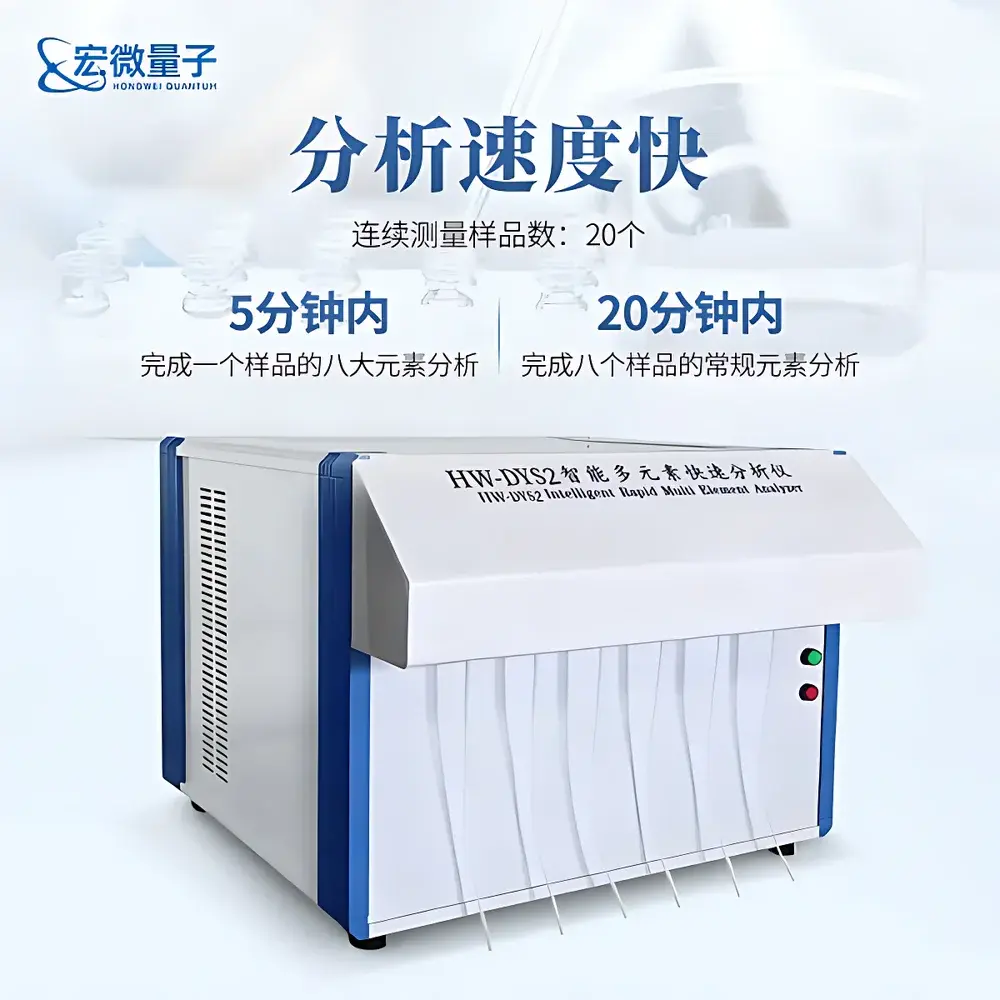
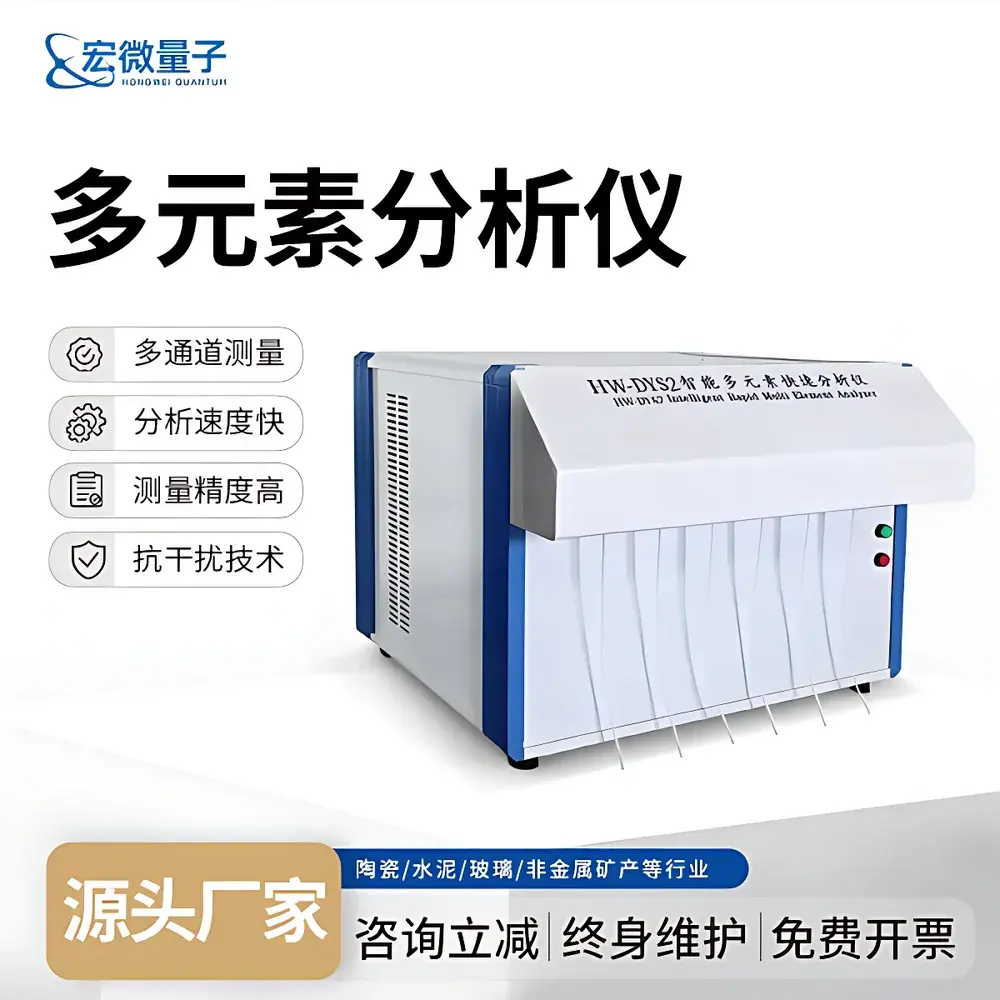
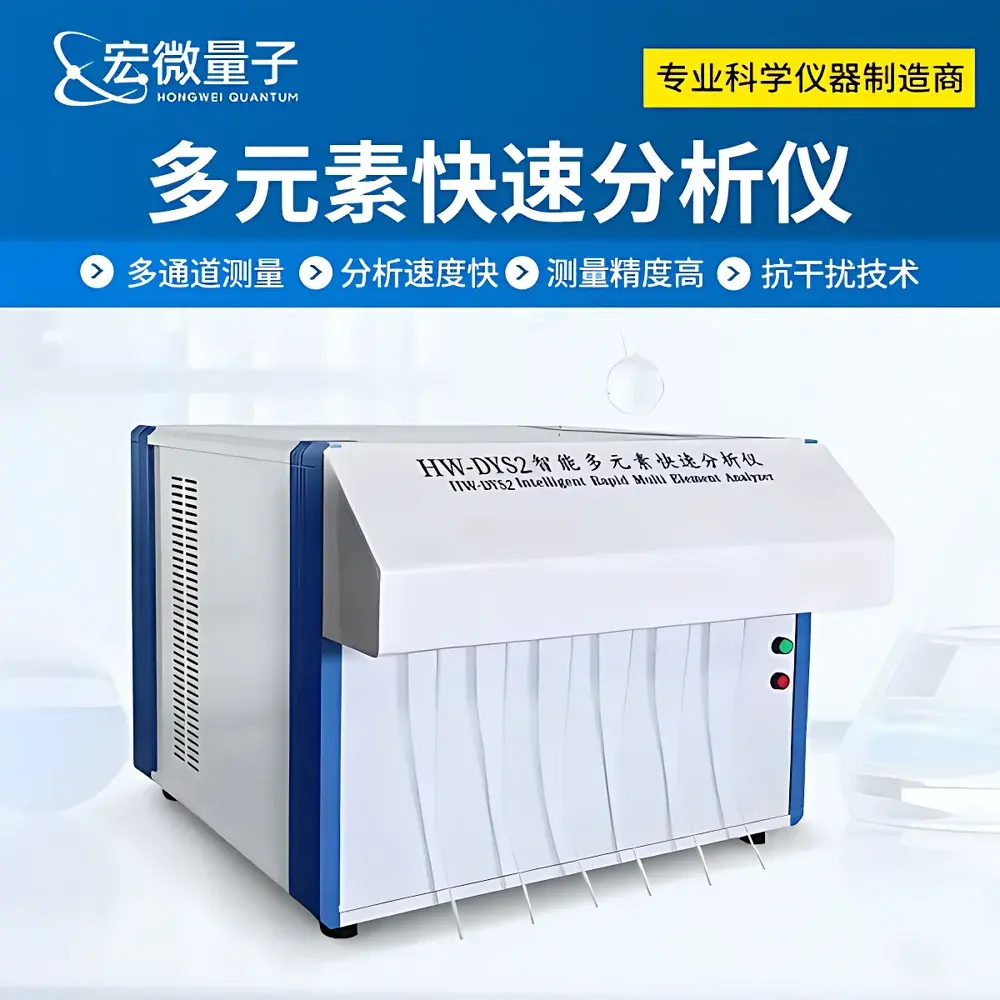
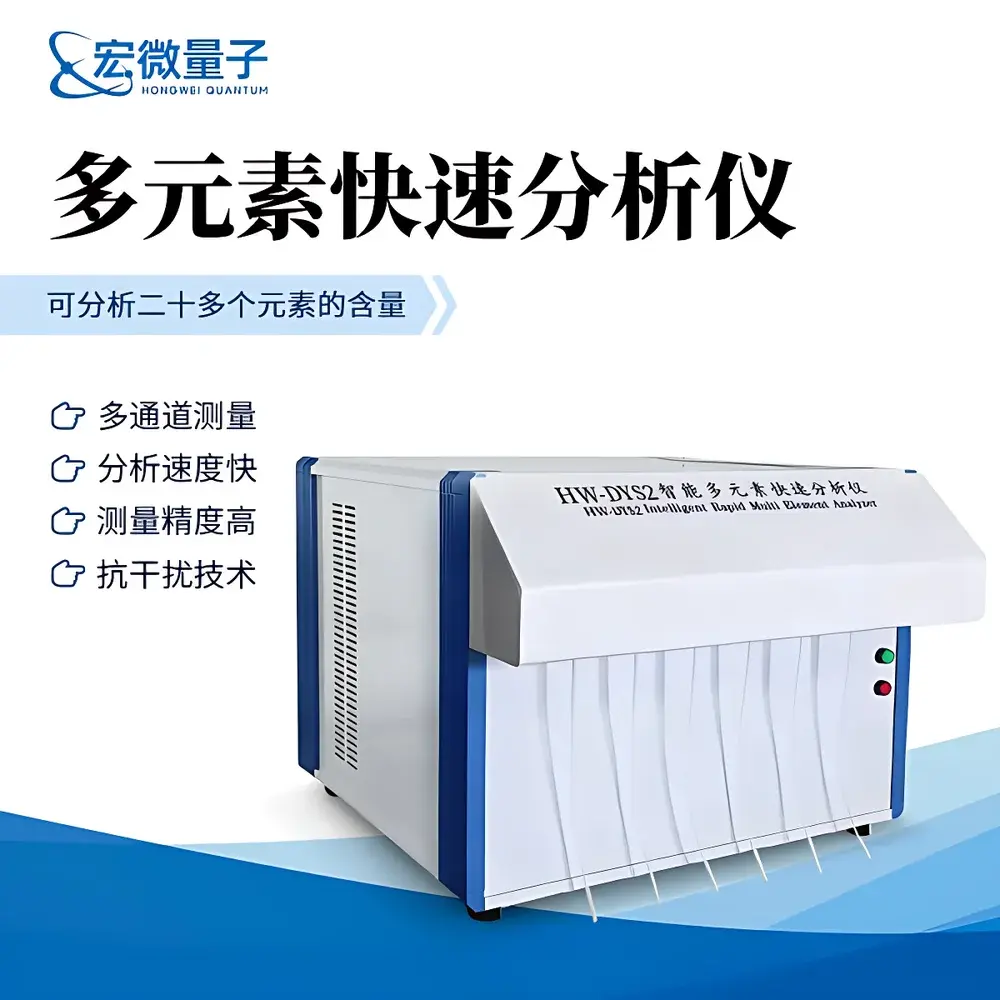
Hongweiliangzi HW-DYS2 Intelligent Multi-Element Rapid Analyzer for Refractory Materials
| Brand | Hongweiliangzi |
|---|---|
| Origin | Shandong, China |
| Model | HW-DYS2 |
| Measurement Channels | 6 |
| Sample Throughput | 20 consecutive samples |
| Analysis Time per Sample (8 elements) | ≤5 min |
| Stability | ±1 digit within 5 min |
| Compliance Standards | GB/T 4734, GB/T 6900, QB/T 2578–2002 |
| Operating Temperature | 10–30 °C |
| Relative Humidity | ≤85% |
| Power Supply | 220 V, 50/60 Hz |
| Power Consumption | 1 kW |
| Dimensions (Instrument) | 500 × 460 × 350 mm |
| Weight (Instrument + Packaging) | 15 kg |
Overview
The Hongweiliangzi HW-DYS2 Intelligent Multi-Element Rapid Analyzer is a dedicated wet-chemical spectrophotometric system engineered for high-throughput quantitative elemental analysis in silicate-based inorganic non-metallic materials. It operates on the principle of colorimetric photometry—where analyte-specific chromogenic reactions generate measurable absorbance signals proportional to elemental concentration—combined with precision liquid handling and digital signal processing. Unlike atomic absorption or ICP-based instruments, the HW-DYS2 leverages optimized classical wet chemistry protocols (e.g., molybdenum blue for phosphorus, thiocyanate for iron, alizarin complexone for aluminum) enhanced by proprietary anti-interference algorithms and real-time linear calibration correction. Its design targets laboratories requiring rapid, cost-effective, and regulatory-aligned analysis of raw materials and finished products in refractories, ceramics, glass, cement, and mineral processing—without reliance on high-purity gases, plasma sources, or vacuum systems. The instrument integrates six independent optical measurement channels, enabling simultaneous or sequential quantification of up to 24 major and trace elements across diverse sample matrices, with detection limits extendable to 0.001% for selected components under validated conditions.
Key Features
- Enhanced fluidic architecture: Tripled sample mass capacity (up to 3× original loading) and proportional reagent dispensing volume, significantly reducing relative analytical error and improving repeatability.
- Six-channel photometric detection system with high-stability LED light sources and precision photodiodes, delivering improved signal-to-noise ratio and extended dynamic range.
- Fully software-controlled operation: Automatic zero-point calibration, real-time linearity correction, and multi-point standard curve fitting—all executed without manual hardware adjustment.
- Dedicated anti-interference technology: Compensates for spectral overlap, matrix-induced color quenching, and ionic strength effects via embedded correction models trained on representative silicate and oxide matrices.
- Integrated workflow automation: Supports batch analysis of up to 20 samples unattended; full sequence—including digestion, dilution, color development, and measurement—is programmable via the HM-Analyze Suite.
- Modular hardware configuration: Includes flame photometer module for alkali metals (K, Na), ultrasonic cleaner for crucible preparation, and pre-qualified silver crucibles for fusion-based sample dissolution.
Sample Compatibility & Compliance
The HW-DYS2 is validated for use with silicate ceramics, refractory bricks and raw materials (e.g., bauxite, magnesia, zirconia, alumina powders), glass batches, cement clinker and additives, and industrial minerals including kaolin, bentonite, talc, wollastonite, andalusite, and fly ash. It accommodates both fused bead (alkali fusion with Li₂B₄O₇/Na₂B₄O₇) and acid digestion (HCl/HNO₃/HF mixtures) sample preparation methods. Analytical performance meets or exceeds tolerance limits defined in national standards GB/T 4734 (ceramics), GB/T 6900 (refractories), and QB/T 2578–2002 (glass), supporting internal quality control, supplier qualification, and process optimization. While not designed for GLP/GMP-regulated final release testing per FDA 21 CFR Part 11, its audit-ready data logs, user-access controls, and electronic signature-capable software allow integration into ISO/IEC 17025-compliant laboratory management systems when deployed with documented SOPs and periodic verification.
Software & Data Management
The HM-Analyze Suite v3.2 provides intuitive method setup, real-time monitoring of reaction kinetics, automated peak integration, and customizable reporting templates compliant with ISO/IEC 17025 documentation requirements. All calibration curves, sample IDs, reagent lot numbers, operator credentials, and timestamped raw absorbance values are stored in an encrypted local SQLite database with optional export to CSV or PDF. The software supports trend analysis across batches, statistical process control (SPC) charting (X-bar/R), and comparison against specification limits. Audit trails record all parameter modifications, result overrides, and user logins—enabling traceability for internal reviews and third-party assessments. No cloud dependency or external telemetry is enabled by default; data sovereignty remains fully under laboratory control.
Applications
- Refractory manufacturing: Quantitative control of Al₂O₃, SiO₂, Fe₂O₃, ZrO₂, MgO, and CaO in shaped/unshaped products and raw bauxite/magnesite blends.
- Ceramic R&D: Rapid profiling of glaze formulations (K₂O, Na₂O, B₂O₃, ZnO, PbO) and body compositions (Li₂O, TiO₂, MnO, Cr₂O₃) during formulation iteration.
- Glass production: Monitoring batch consistency for soda-lime, borosilicate, and specialty optical glasses using SiO₂, Na₂O, K₂O, CaO, MgO, and B₂O₃ assays.
- Cement and clinker analysis: Determination of SiO₂, Al₂O₃, Fe₂O₃, CaO, MgO, SO₃, and alkalis to calculate Lime Saturation Factor (LSF) and Silica Modulus (SM).
- Mineral processing labs: Grade control of industrial minerals such as kaolin (Al₂O₃/SiO₂ ratio), zircon sands (ZrO₂/HfO₂ estimation), and phosphate rock (P₂O₅).
FAQ
What sample preparation methods are supported?
The HW-DYS2 supports both alkaline fusion (using silver crucibles and lithium metaborate/tetraborate fluxes) and acid digestion (with HF–HNO₃–HCl mixtures), with method selection dependent on sample solubility and target elements.
Can the instrument analyze metallic alloys or organic matrices?
No—it is specifically optimized for inorganic, oxide-rich, silicate-based materials. Metallic alloys require dissolution in strong oxidizing acids and may introduce interferences not corrected by the current algorithm set; organic matrices are incompatible with the fusion protocol and photometric chemistry.
Is ASTM or ISO standard compliance documented?
While the HW-DYS2 implements chemistries aligned with ASTM C289 (for pozzolanic materials) and ISO 6872 (dental ceramics), formal method validation reports per ASTM E1447 or ISO 11097 must be performed by the end-user laboratory in accordance with their scope of accreditation.
How often does the system require recalibration?
Daily calibration verification using certified reference materials (CRMs) is recommended; full multi-point calibration is required after reagent lot changes, optical component cleaning, or after any maintenance affecting fluidic or photometric alignment.
What is the expected lifetime of the photometric sensors?
Under normal operating conditions (≤8 h/day, stable ambient temperature), the LED–photodiode assemblies maintain factory-specified linearity for ≥5 years, with annual verification recommended using NIST-traceable neutral density filters.



