
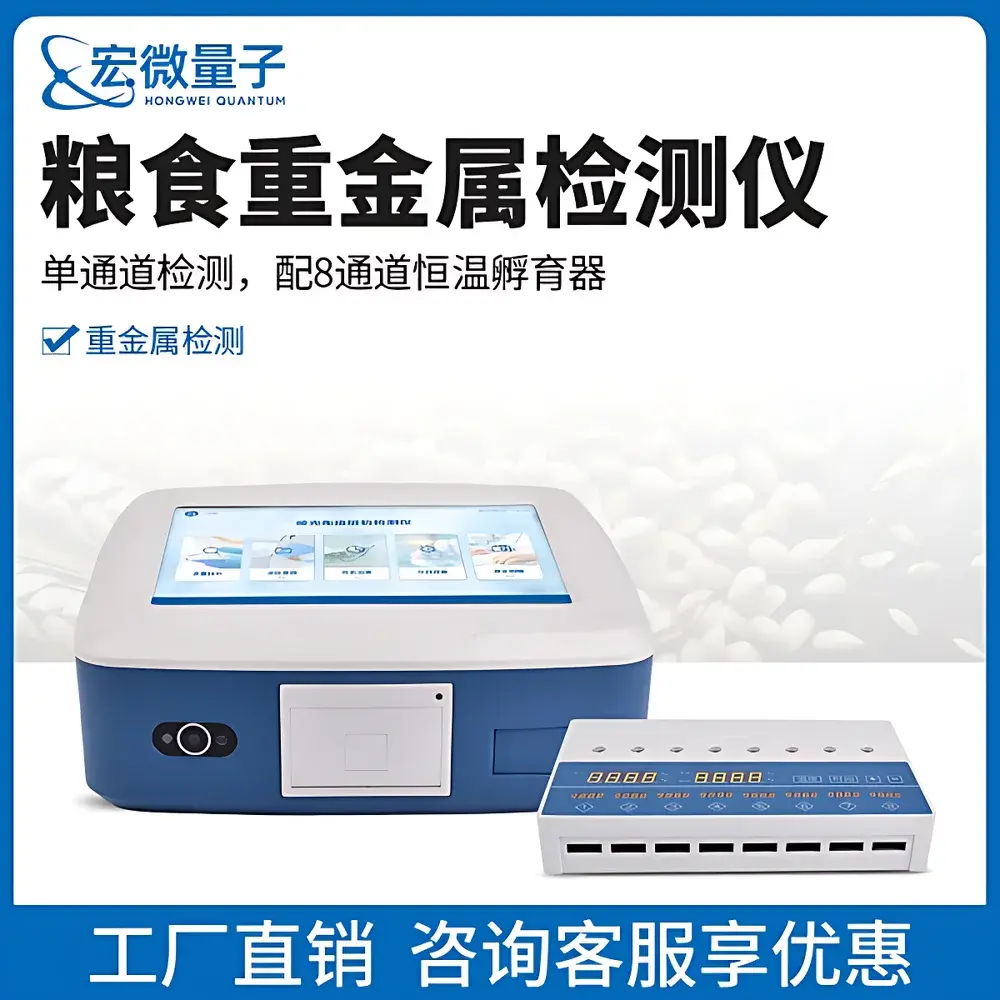
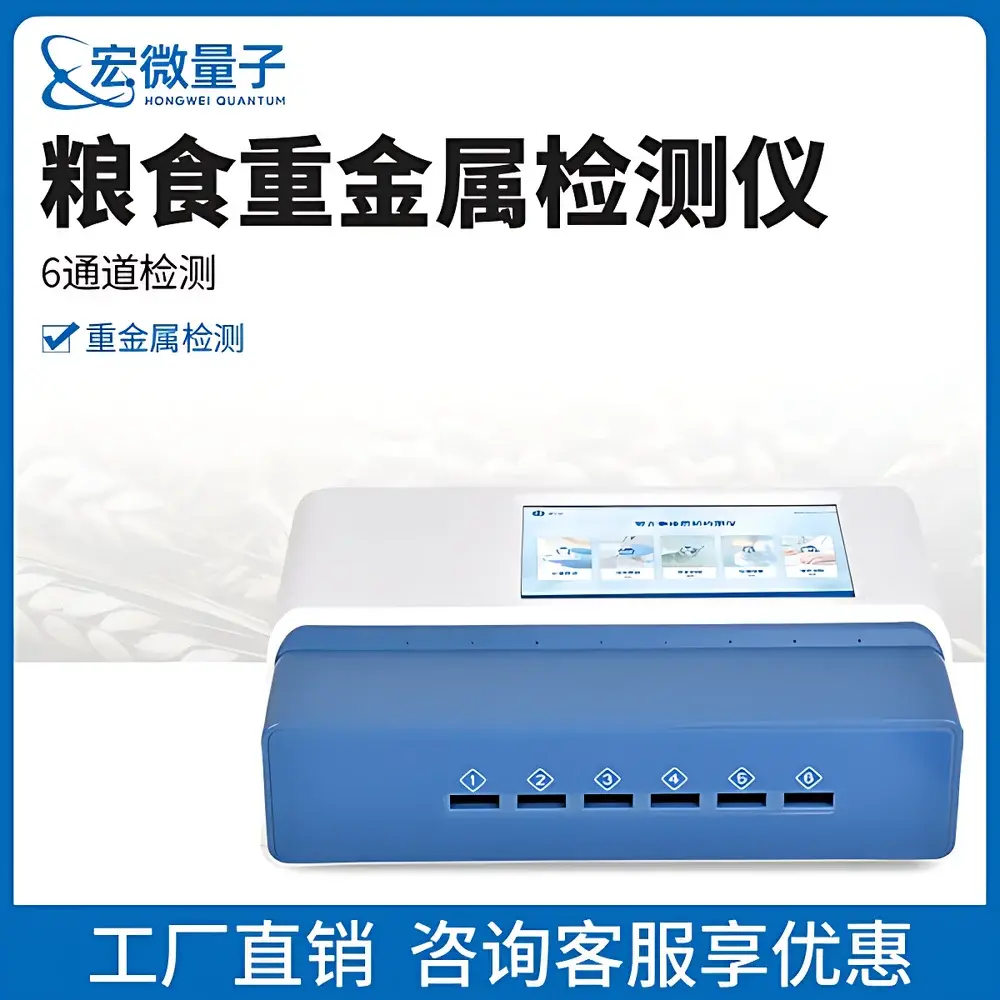
Hongweiliangzi HW-LS2 Multi-Channel Rapid Heavy Metal Analyzer for Grains and Feed
| Brand | Hongweiliangzi |
|---|---|
| Origin | Shandong, China |
| Model | HW-LS2 |
| Detection Principle | Fluorescent Immunoassay (FIA) |
| Detection Targets | Lead (Pb) and Cadmium (Cd) |
| Sample Types | Cereals (rice, corn, wheat, barley, sorghum), cereal products, feed & feed ingredients, edible oils, milk & dairy products |
| Detection Time | ≤12 min per sample (including sample prep) |
| Channels | 6 independent optical detection channels |
| Accuracy | ±5% deviation from reference method |
| Precision (CV) | ≤3% intra-assay, ≤5% inter-assay |
| Temperature Control Range | Ambient +5°C to 60°C |
| Display | 7-inch capacitive touchscreen (1920×1200) |
| OS | Android 7.1 |
| Internal Storage | 1 GB RAM + 8 GB eMMC |
| Data Capacity | >100,000 test records |
| Connectivity | Dual USB-A, USB-B, RJ45 Ethernet, Wi-Fi 802.11 b/g/n, optional Bluetooth & RFID scanner |
| Printer | Built-in thermal printer (57×20 mm paper) |
| Dimensions (H×W×D) | 308×205×91 mm |
| Weight | 2.7 kg |
| Operating Environment | 0–50°C, 0–90% RH non-condensing |
Overview
The Hongweiliangzi HW-LS2 Multi-Channel Rapid Heavy Metal Analyzer is an engineered solution for quantitative detection of lead (Pb) and cadmium (Cd) in grain, feed, and food matrices using fluorescent immunoassay (FIA) technology. Unlike atomic absorption or ICP-MS systems requiring extensive sample digestion and laboratory infrastructure, the HW-LS2 leverages lateral-flow immunochromatography coupled with high-sensitivity photometric fluorescence detection. This enables field-deployable, lab-grade quantification within 12 minutes—covering sample preparation, incubation, and optical readout—while maintaining trace-level sensitivity aligned with national regulatory thresholds (e.g., GB 2762-2022 for Pb/Cd in cereals). Designed for operational continuity across decentralized testing environments, it meets the functional demands of grain storage facilities, feed mills, dairy processors, third-party laboratories, and provincial food safety supervision bureaus under China’s State Administration for Market Regulation (SAMR) framework.
Key Features
- Six independent optical detection channels enable parallel analysis of up to six samples—or multiple analytes per sample—without cross-talk or signal interference.
- Integrated incubation-detection architecture maintains precise temperature control (ambient +5°C to 60°C) during assay development, eliminating manual transfer steps and reducing operator-induced variability.
- Proprietary fluorescent microsphere conjugates—sourced from certified international suppliers—ensure batch-to-batch uniformity, delivering CV ≤3% repeatability and SW ≤5% stability across instrument lifetime.
- Pre-calibrated quantitative standard curves are embedded at factory level; no recalibration with reference standards is required for routine operation, minimizing analyst exposure to hazardous reference materials and lowering consumable costs.
- Android 7.1 operating system supports over-the-air (OTA) firmware updates, multi-language UI (English/Chinese), and seamless integration with LIMS or government food safety platforms via encrypted HTTP/HTTPS protocols.
- Robust mechanical design includes IP54-rated enclosure, shock-absorbing aluminum chassis, silent omnidirectional casters, and a military-grade transit case (800×340×540 mm) compliant with IATA air transport guidelines for sensitive instrumentation.
Sample Compatibility & Compliance
The HW-LS2 accepts homogenized extracts from raw and processed agricultural commodities—including paddy rice, maize kernels, wheat flour, soybean meal, fishmeal, palm oil, whole milk powder, and yogurt—following standardized extraction protocols (e.g., GB/T 5009.12–2017 for Pb, GB/T 5009.15–2014 for Cd). All assay cartridges conform to ISO/IEC 17025:2017 method validation requirements for qualitative/quantitative rapid tests. Instrument software logs full audit trails—including operator ID, timestamp, calibration status, and QC flagging—for alignment with GLP principles and readiness for SAMR or CNAS on-site assessments. Data export formats (CSV, PDF, XML) support interoperability with China’s National Food Safety Risk Monitoring Information System (NFMRIS) and provincial food traceability platforms.
Software & Data Management
Embedded software provides role-based access control, configurable reporting templates, and automated data aggregation across local network or cloud endpoints. Each test record stores analyte concentration (µg/kg), LOD/LOQ values, sample ID, operator credentials, environmental sensor logs (temperature/humidity), and digital signatures. Thermal printouts include QR-coded result verification links for chain-of-custody integrity. USB and Ethernet interfaces allow secure bulk export to external databases; Wi-Fi connectivity enables real-time synchronization with centralized dashboards for trend analysis and early-warning alerts. All stored data adheres to China’s Personal Information Protection Law (PIPL) and Cybersecurity Law requirements for sensitive food safety information handling.
Applications
- Grain procurement screening at state reserve depots and commercial elevators prior to intake.
- In-process quality control in feed formulation plants verifying compliance with GB 13078–2017 limits.
- Routine surveillance testing in dairy cooperatives assessing heavy metal carryover from contaminated forage.
- Emergency response deployment during regional contamination events (e.g., soil leaching incidents).
- Contract testing laboratories serving export-oriented food manufacturers requiring documentation for EU Regulation (EC) No 1881/2006 or FDA Import Alert 99-28.
FAQ
Does the HW-LS2 require daily calibration with certified reference materials?
No. Factory-loaded calibration curves remain valid for ≥12 months under normal use; only periodic verification with control cartridges (included in kit lot) is recommended per GB/T 27404–2008.
Can the instrument detect other heavy metals beyond Pb and Cd?
Currently validated only for Pb and Cd; future expansion depends on availability of CE-IVD or NMPA-approved lateral-flow assay cartridges for As, Hg, or Cu.
Is the thermal printer compatible with continuous-feed label stock?
No—it uses standard 57 mm thermal paper rolls (20 mm core); custom labeling requires external barcode printers interfaced via USB.
What cybersecurity measures protect data during Wi-Fi transmission?
All wireless communications use WPA2-Enterprise encryption with TLS 1.2+ tunneling; local storage employs AES-256 full-disk encryption.
How does the system handle failed QC checks during assay run?
Automated abort logic halts result generation, flags error code on screen, and logs diagnostic parameters—including channel-specific photodiode voltage drift and incubation temperature deviation—for root-cause review.






