
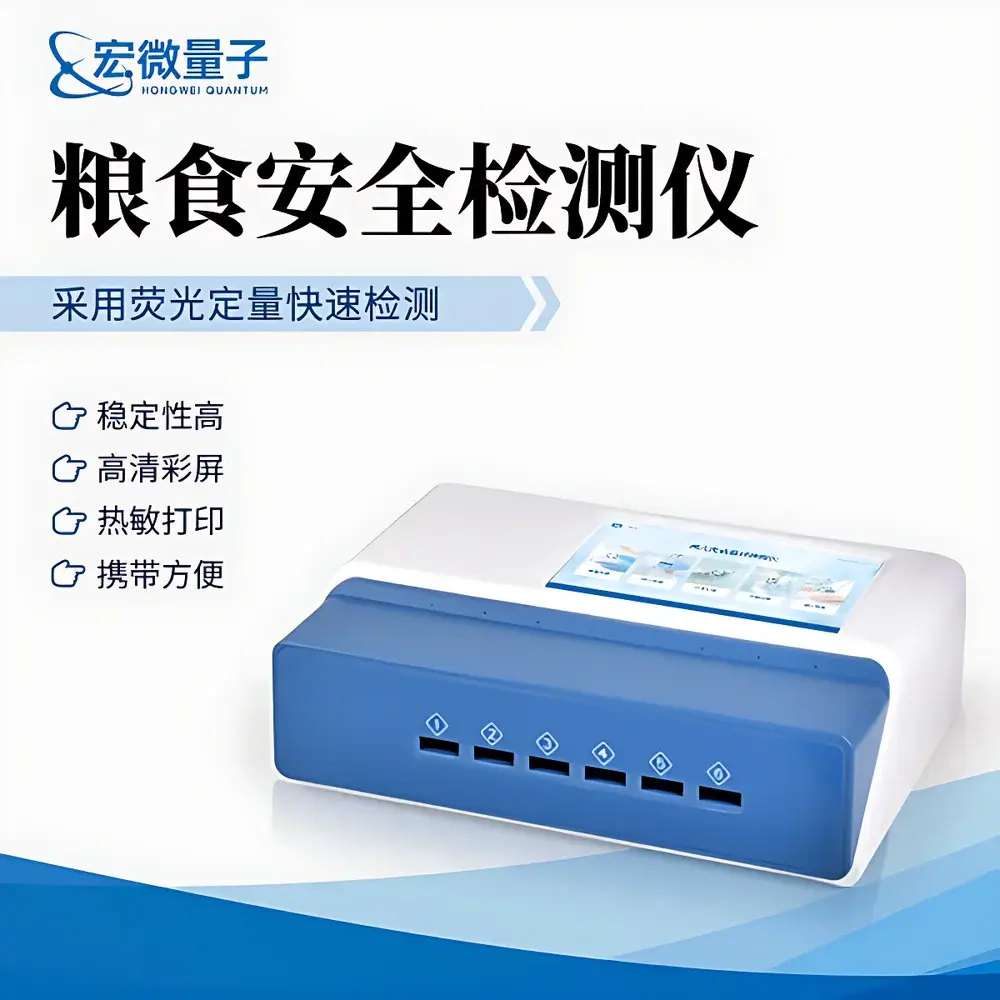
Hongweiliangzi HW-LZ2 Multi-Channel Fluorescent Quantitative Mycotoxin Analyzer
| Brand | Hongweiliangzi |
|---|---|
| Origin | Shandong, China |
| Model | HW-LZ2 |
| Detection Principle | Fluorescent Quantitative Immunochromatography |
| Target Analytes | Aflatoxin B1 (1–100 µg/kg), Deoxynivalenol (50–5000 ppb), Ochratoxin A (2–400 µg/kg), Zearalenone (5–400 µg/kg), Fumonisin (50–6000 ppb), T-2 Toxin (2–2500 ppb) |
| Detection Time | < 5 seconds per test |
| Repeatability | CV ≤ 3% |
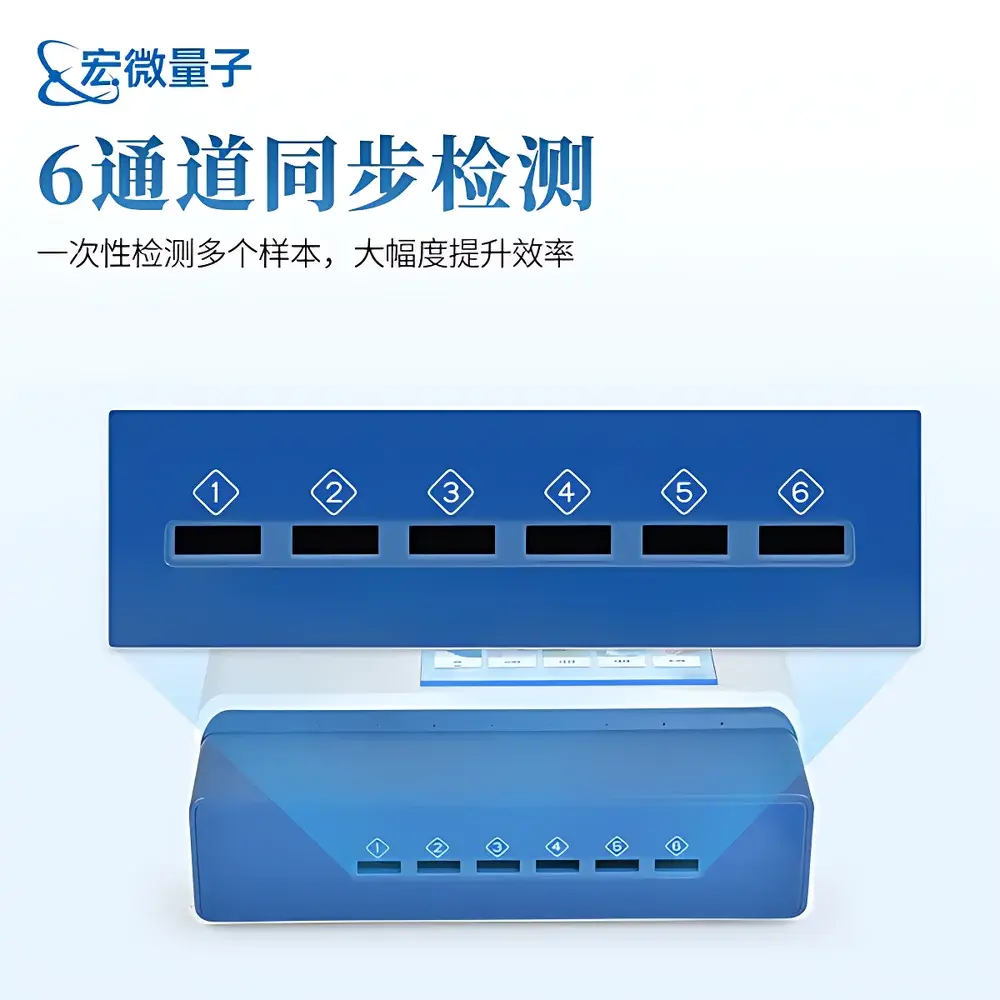
| Channels | 6 independent optical detection channels |
| Operating Temperature Range | Ambient +5°C to 60°C |
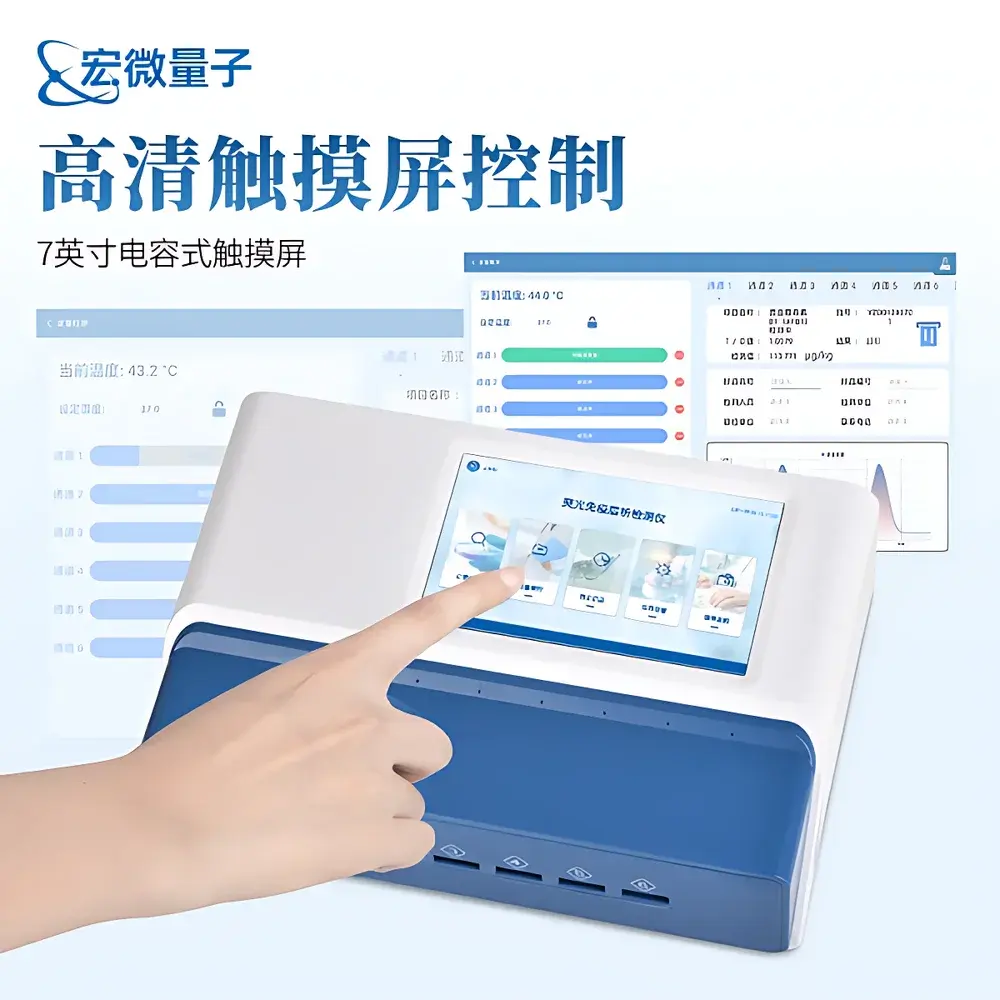
| Display | 7-inch capacitive touchscreen (1920 × 1200) |
| OS | Android 7.1 |
| Onboard Storage | 1 GB RAM + 8 GB eMMC |
| Data Capacity | >100,000 records |
| Connectivity | Dual USB-A, USB-B, Gigabit Ethernet, Wi-Fi 802.11 b/g/n, optional Bluetooth & RFID/QR scanning |
| Thermal Printer | Built-in (57 × 20 mm thermal paper) |
| Power Input | AC 100–240 V, 50 Hz |
| Output | DC 12 V / 5 A |
| Dimensions (H×W×D) | 308 × 205 × 91 mm |
| Net Weight | 2.7 kg |
| IP Rating | IP54 |
| Transport Case | Military-grade shock-absorbing aluminum trolley case (800 × 340 × 540 mm, 18 kg gross) |
Overview
The Hongweiliangzi HW-LZ2 Multi-Channel Fluorescent Quantitative Mycotoxin Analyzer is an engineered solution for rapid, on-site quantification of major mycotoxins in food and feed matrices using time-resolved fluorescent immunochromatographic assay (TRF-ICA). Unlike conventional lateral flow strips read by subjective visual interpretation, the HW-LZ2 employs dual-wavelength excitation and high-sensitivity photodiode detection to quantify fluorescence intensity emitted by europium-doped microspheres conjugated to anti-mycotoxin antibodies. This principle delivers quantitative results traceable to reference standards, with measurement uncertainty aligned with ISO/IEC 17025–compliant validation protocols. Designed for deployment in grain elevators, feed mills, dairy processors, and regulatory field laboratories, the instrument supports full-chain monitoring from raw material intake to finished product release—meeting functional requirements outlined in AOAC Official Method 2019.04 and supporting compliance with EU Commission Regulation (EC) No. 1881/2006 and FDA Guidance for Industry: Action Levels for Aflatoxins in Animal Feed.
Key Features
- Six independent optical detection channels enable parallel analysis of up to six samples—or multiplexed detection of multiple mycotoxins within a single sample—without cross-talk or signal interference.
- Integrated incubation module maintains precise temperature control (±0.5°C) across the full operating range (ambient +5°C to 60°C), eliminating external water baths and reducing operator-dependent variability.
- Pre-calibrated quantitative standard curves are embedded at factory level and updated remotely via over-the-air (OTA) firmware upgrades—removing the need for routine recalibration with certified reference materials and minimizing analyst exposure to hazardous analytes.
- Capacitive 7-inch touchscreen (1920 × 1200 resolution) runs Android 7.1 with intuitive graphical interface, multilingual support (English/Chinese), and configurable report templates compliant with GLP documentation standards.
- Built-in thermal printer outputs auditable hard-copy reports containing analyte name, measured concentration, LOD/LOQ, sample ID, operator ID, timestamp, and instrument serial number—fully traceable per 21 CFR Part 11 data integrity requirements when paired with audit-log-enabled software.
- Robust mechanical architecture includes IP54-rated enclosure, shock-dampened transport case with aviation-grade aluminum frame, and silent omnidirectional casters—validated for continuous operation in ambient conditions ranging from 0°C to 50°C and relative humidity up to 90% non-condensing.
Sample Compatibility & Compliance
The HW-LZ2 is validated for use with extracted supernatants from homogenized samples of cereals (corn, wheat, barley, rice, sorghum), oilseeds, compound feed, feed ingredients (e.g., DDGS, soybean meal), edible oils, and dairy products (milk, whey powder). Sample preparation follows standardized extraction protocols compatible with AOAC 2005.02 (aflatoxins), AOAC 2007.02 (DON), and EN 14123-2:2013 (zearalenone). All reagent test cassettes (70 × 20 mm format) are manufactured under ISO 13485 quality management systems and supplied with lot-specific calibration files. Instrument performance meets repeatability (CV ≤ 3%) and accuracy (bias ≤ ±5%) criteria specified in ISO 5725-2:2019 for intermediate precision assessment. The system supports audit-ready data export in CSV and PDF formats, enabling integration with LIMS and national food safety surveillance platforms.
Software & Data Management
Data handling conforms to international regulatory expectations for analytical instrumentation in food safety testing. Internal storage retains ≥100,000 test records with full metadata—including date/time stamps, operator login credentials, environmental sensor logs (temperature/humidity), and real-time QC flagging. Communication interfaces include dual USB-A ports (for flash drive export), USB-B (for PC synchronization), Gigabit Ethernet (for LAN-based data aggregation), and Wi-Fi (WPA2-secured) for cloud-based reporting. Optional Bluetooth and RFID modules allow automated sample ID capture and chain-of-custody tracking. Firmware enforces role-based access control (RBAC), electronic signatures, and immutable audit trails—supporting alignment with FDA 21 CFR Part 11, EU Annex 11, and China’s JJF 1001–2011 metrological verification guidelines.
Applications
The HW-LZ2 serves as a primary screening tool in preventive control programs aligned with HACCP and FSMA Preventive Controls for Animal Food. Its sub-5-second readout enables high-throughput batch acceptance testing at receiving docks; its portability supports mobile labs deployed during harvest season or outbreak investigations; and its multi-analyte capability reduces reliance on centralized LC-MS/MS confirmation for routine compliance checks. End users include state-level grain reserve centers, commercial feed manufacturers subject to GMP+ B6 certification, third-party contract labs accredited to CNAS-CL01:2018, and municipal food safety supervision bureaus conducting routine market surveillance under China’s GB 2761–2023 limits.
FAQ
Does the HW-LZ2 require daily calibration with reference standards?
No. Quantitative calibration curves are pre-loaded and digitally signed at manufacture. Routine verification is performed using built-in control cassettes; recalibration is only required after firmware updates or hardware service events.
Can test results be exported directly to a national food safety information platform?
Yes. Structured CSV exports and HTTP POST API endpoints support automated upload to provincial and national food safety monitoring systems, including China’s National Food Safety Risk Monitoring Information System (NFSRMIS).
Is the instrument suitable for untrained personnel in field settings?
The interface is designed for minimal training: guided workflows, auto-detection of inserted cassettes, real-time error prompts, and contextual help overlays reduce procedural errors. However, operators must complete documented competency assessments per ISO/IEC 17025 Clause 6.2.5.
What regulatory standards does the HW-LZ2 assist in meeting?
It supports compliance with EU Regulation (EC) No. 1881/2006, US FDA Compliance Policy Guide Sec. 683.100, China GB 2761–2023, Codex Alimentarius GSCTFF standards, and internal quality specifications aligned with FSSC 22000 v5.1 Clause 8.4.2.
How is data integrity ensured during transmission and storage?
All stored records include cryptographic hash signatures; network transfers use TLS 1.2 encryption; audit logs record every user action with timestamp, IP/MAC address, and outcome status—fulfilling ALCOA+ principles (Attributable, Legible, Contemporaneous, Original, Accurate, Complete, Consistent, Enduring, Available).





