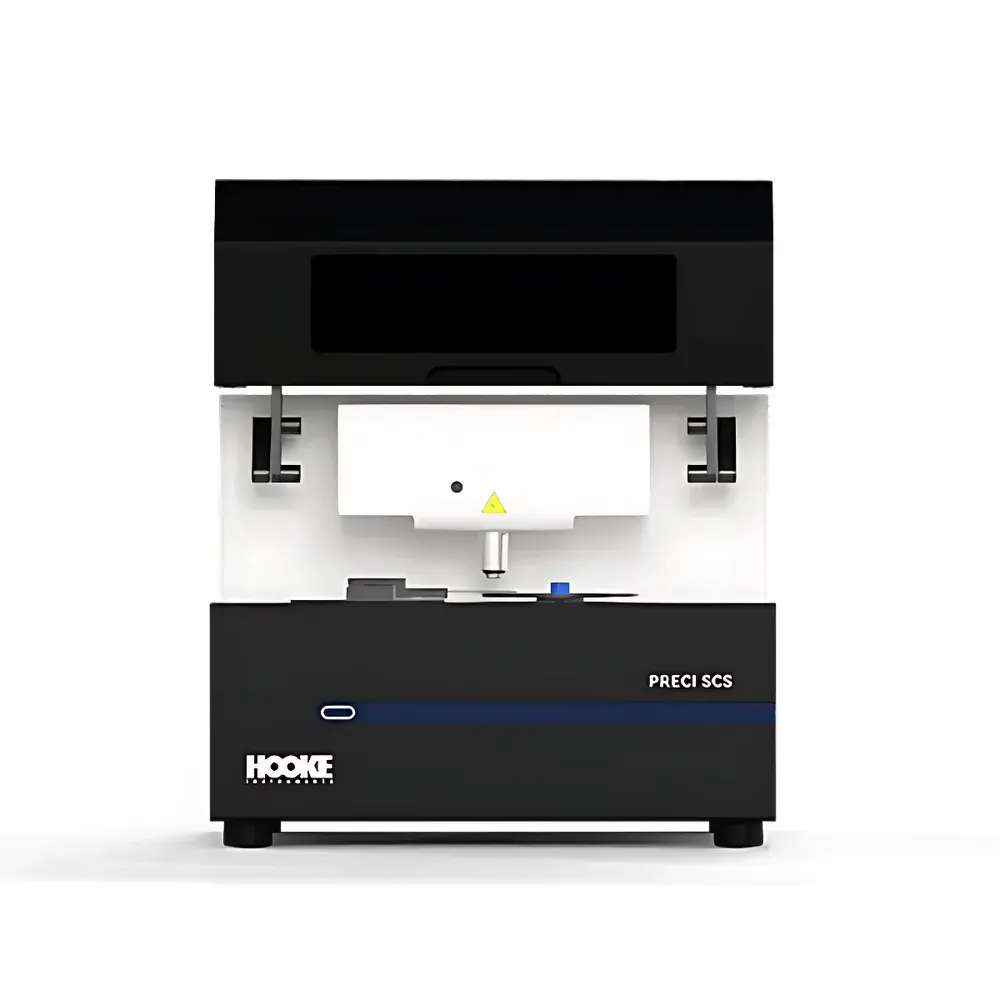
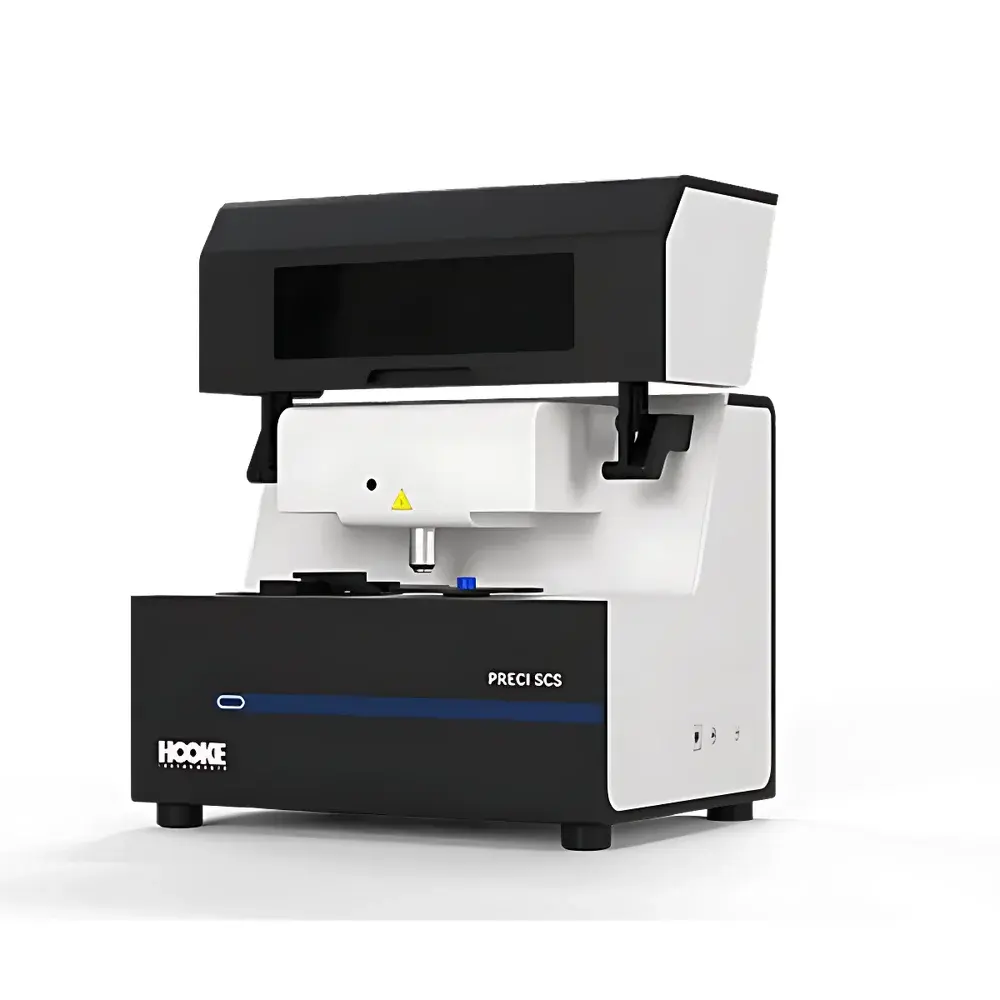
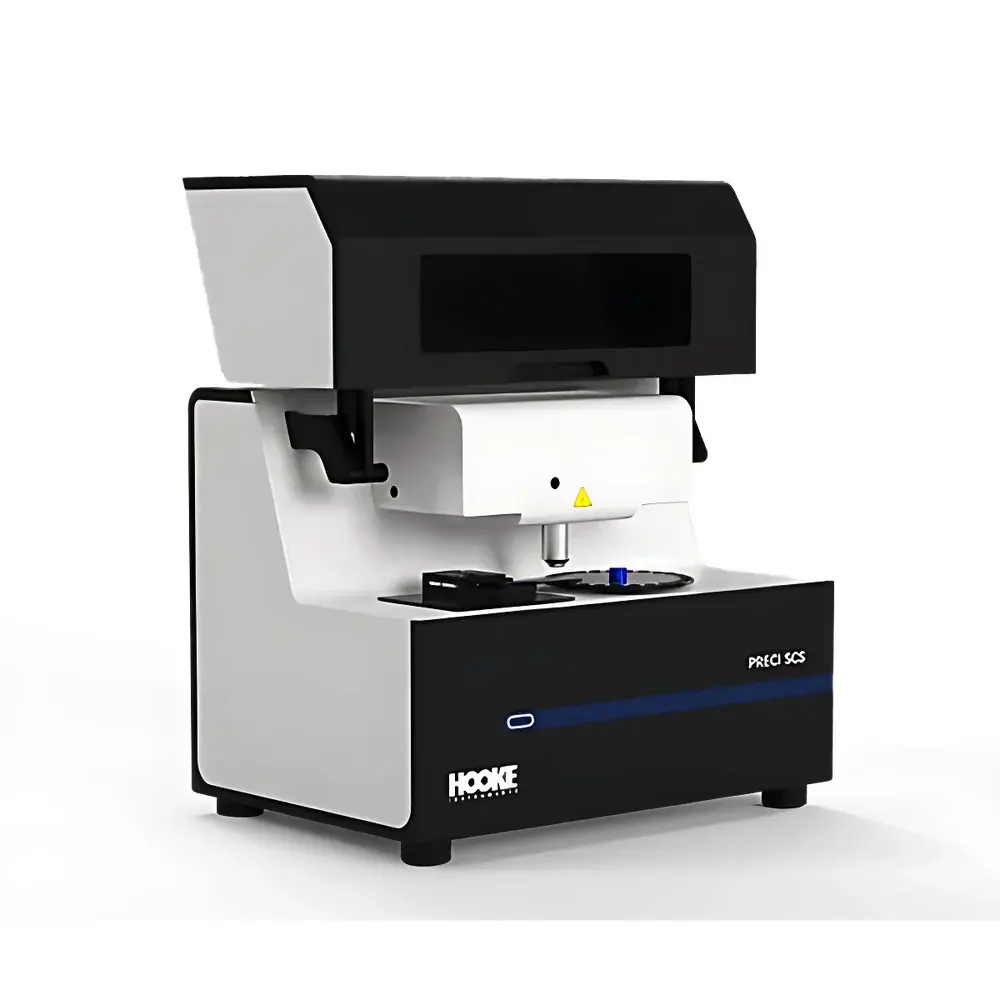
HOOKE INSTRUMENTS PRECI SCS Visual Single-Cell Sorter
| Brand | HOOKE INSTRUMENTS |
|---|---|
| Origin | Jilin, China |
| Manufacturer Type | Original Equipment Manufacturer (OEM) |
| Country of Origin | China |
| Model | PRECI SCS |
| Type | Fully Automated |
| Pricing | Upon Request |
Overview
The HOOKE INSTRUMENTS PRECI SCS Visual Single-Cell Sorter is an engineered platform for label-free, image-guided isolation of individual microbial cells from complex environmental and clinical matrices. It operates on the principle of Laser-Induced Forward Transfer (LIFT), a non-contact, non-destructive micro-dispensing technique wherein a nanosecond-pulsed laser irradiates a donor substrate coated with a thin energy-absorbing layer, generating localized thermoelastic expansion that propels a picoliter-scale liquid microdroplet—containing one or more target cells—onto a predefined collector surface. Unlike conventional flow cytometry or microfluidic sorting, LIFT enables deterministic, positionally resolved deposition without hydrodynamic shear stress, pressure-induced deformation, or antibody labeling, preserving native cell integrity and viability for downstream functional assays, cultivation, and multi-omics analysis.
Key Features
- Visual-driven single-cell isolation: Integrated high-resolution brightfield, phase contrast, and optional fluorescence imaging enables real-time morphological and functional phenotyping at cellular resolution.
- High-fidelity single-cell recovery: Achieves >99% single-cell yield and positional accuracy via calibrated LIFT pulse control and sub-micrometer stage positioning.
- Non-invasive operation: No physical contact between laser beam and biological sample; laser interaction occurs exclusively with the transfer substrate, minimizing phototoxicity and thermal damage to cells.
- Fully automated workflow: HOOKE IntP intelligent software provides end-to-end automation—from image acquisition and AI-assisted cell recognition to auto-focus, region-of-interest selection, laser triggering, and collector plate registration.
- Robust performance in heterogeneous samples: Engineered to tolerate particulate load, organic debris, and variable turbidity typical of soil suspensions, fecal slurries, sediment extracts, sputum, and aquatic microbiomes.
- Modular expandability: Compatible with multimodal detection modules—including epifluorescence, Raman spectroscopy, and morphometric profiling—for correlative single-cell phenotyping.
Sample Compatibility & Compliance
The PRECI SCS accepts liquid suspensions (0.1–50 µm particle size range) prepared from diverse sample types including but not limited to: environmental soils, freshwater/marine sediments, activated sludge, human gut microbiota isolates, clinical sputum, and algal cultures. Sample preparation follows standardized protocols aligned with ISO 17994:2022 (microbiological methods for water quality) and ASTM D5905-21 (standard practice for preparation of environmental samples for microbiological analysis). The system supports GLP-compliant data traceability through audit-log-enabled software, with timestamped image metadata, laser parameter records, and user action logs exportable in CSV and TIFF formats for regulatory submission.
Software & Data Management
HOOKE IntP is a dedicated Windows-based application built on a modular architecture compliant with FDA 21 CFR Part 11 requirements for electronic records and signatures. It incorporates convolutional neural network (CNN)-based object detection models trained on >10⁵ annotated microbial images across Gram-positive/negative bacteria, archaea, yeasts, and microalgae. Image processing pipelines support batch-level morphometric quantification (area, perimeter, aspect ratio, texture entropy), fluorescence intensity thresholding, and spatial clustering analysis. All raw images, processed masks, sorting coordinates, and instrument parameters are stored in a relational SQLite database with SHA-256 checksum validation. Export options include FAIR-compliant JSON-LD metadata bundles compatible with MIAME and MIAPE standards.
Applications
- Single-cell genomics: Direct isolation of uncultured microbes for whole-genome amplification (WGA) and long-read sequencing (e.g., PacBio HiFi, Oxford Nanopore).
- Functional strain discovery: Targeted sorting of Fe²⁺-reducing bacteria using FSFC fluorescent probes, enabling rapid enrichment and cultivation of novel metal-reducing isolates (Appl. Environ. Microbiol. 2020, 86:e02342-19).
- Algal biotechnology: High-throughput screening of lipid-rich or stress-tolerant microalgal variants under RSM-optimized growth conditions (Sci. Total Environ. 2022, 812:152438).
- Clinical microbiology: Pathogen-specific isolation from polymicrobial infections without culture bias, supporting antimicrobial resistance (AMR) gene profiling and host-pathogen interaction studies.
- Cell atlas construction: Spatially registered single-cell deposition facilitates parallel downstream assays—such as single-cell RNA-seq, proteomics, and MALDI-TOF MS—on identically positioned cells.
FAQ
What is the minimum viable cell concentration required for reliable detection and sorting?
For optimal performance, samples should contain ≥10³ cells/mL with minimal clumping; optional pre-enrichment or filtration steps are recommended for low-biomass samples.
Can the system sort multiple cell types simultaneously within one run?
Yes—multi-class classification is supported via user-defined morphological or fluorescence gating criteria, with independent sorting trajectories assigned per class.
Is the LIFT process compatible with fragile or slow-growing microbes?
Yes—the absence of shear forces and short laser pulse duration (<100 ns) preserves membrane integrity and culturability, as validated for anaerobes, acidophiles, and oligotrophs.
Does the system support integration with third-party sequencing or cultivation platforms?
Yes—collector plates conform to ANSI/SLAS standard microplate footprints (96-/384-well), enabling direct transfer to WGA kits, microfluidic culture chips, or robotic liquid handlers.
How is system calibration maintained over time?
Automated daily self-calibration routines verify laser alignment, stage positioning accuracy (±0.5 µm), and image focus stability using NIST-traceable calibration targets.