
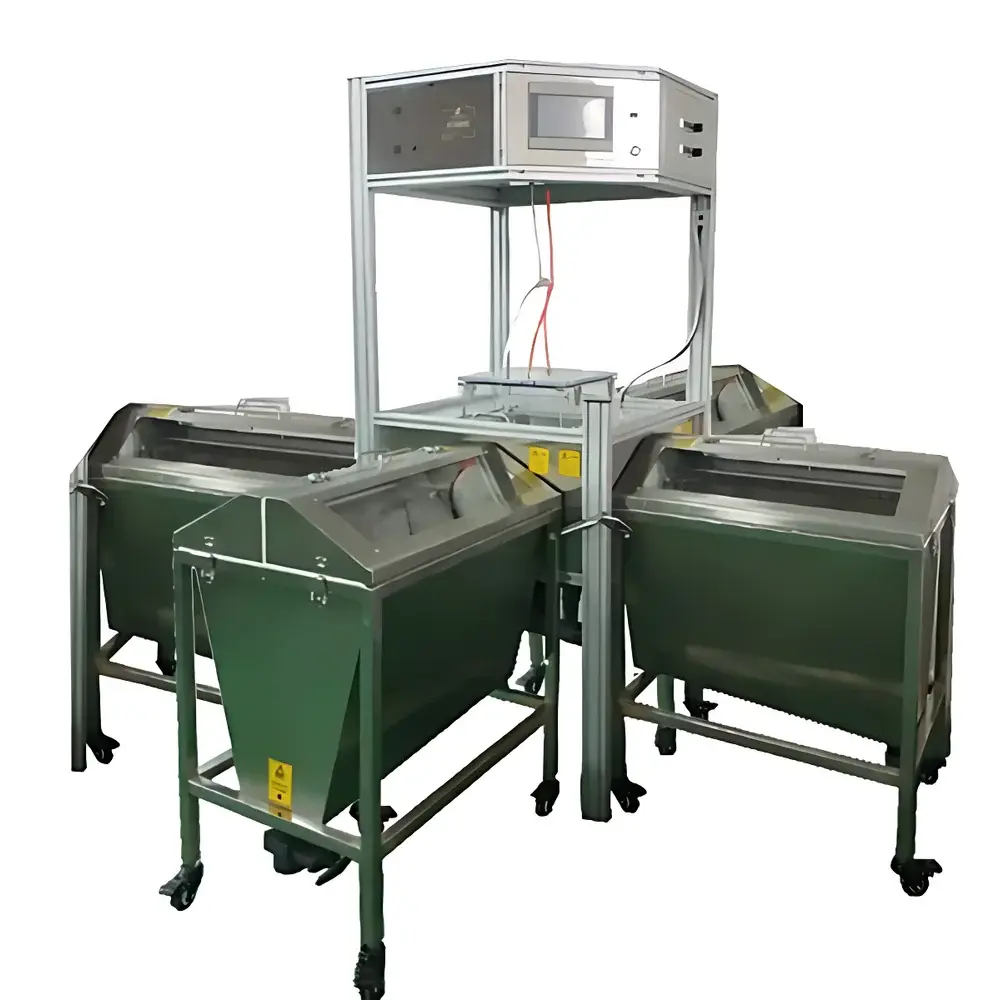
Hope-Med 8052DS Large-Animal Oro-Nasal Inhalation Exposure Chamber
| Brand | Hope-Med |
|---|---|
| Origin | Tianjin, China |
| Model | 8052DS |
| Chamber Operating Pressure Range | −20 Pa to 0 Pa (gauge, negative pressure mode) |
| Animal Capacity | Up to 25 kg (e.g., Beagle dogs) |
| Number of Exposure Ports | ≥4 |
| Aerosol Concentration Capability | ≥10,000 mg/m³ (liquid/solid aerosols) |
| Inter-port Uniformity | ±10% for gas & liquid aerosols |
| Construction | Stainless steel main frame with chemically resistant soft-contact interior surfaces |
| Fault Monitoring | Real-time alerts for condensate accumulation, electrical faults, pressure, temperature, relative humidity, O₂, and CO₂ deviations |
| Compliance | Designed to support OECD 412, ASTM E171, ISO 10993-12, and GLP-aligned inhalation toxicology workflows |
Overview
The Hope-Med 8052DS Large-Animal Oro-Nasal Inhalation Exposure Chamber is an engineered platform for controlled, quantitative respiratory toxicology studies in conscious, unrestrained large animals—primarily Beagle dogs and similarly sized species. It operates on the principle of whole-body or head-only exposure via precisely regulated oronasal delivery, enabling reproducible dosing of gaseous, vapor-phase, liquid aerosol, and dry powder test agents under dynamically monitored negative-pressure conditions. The chamber maintains a stable sub-atmospheric operating range (−20 Pa to 0 Pa gauge), ensuring containment integrity and preventing ambient leakage into operator workspaces—a critical requirement for GLP-compliant inhalation safety assessment per OECD Test Guideline 412 and ISO 10993-12. Its architecture integrates fluid-dynamic compartmentalization to isolate inspiratory supply from expiratory exhaust, minimizing cross-contamination and preserving agent fidelity across exposure cycles.
Key Features
- Negative-pressure operation (−20 Pa to 0 Pa) with continuous leak-tightness verification, validated per ASTM E171 Annex A3 protocols.
- Real-time multi-parameter fault detection system delivering simultaneous visual text alerts and audible indicators for: condensate accumulation in gas lines, electrical anomalies, pressure deviation beyond ±5 Pa, temperature drift >±1.5°C, RH excursion >±5% RH, O₂ <19.5% or >23.5%, and CO₂ >0.5% v/v.
- Modular port configuration with ≥4 independent oronasal interfaces, each equipped with dedicated supply and exhaust manifolds to enforce strict inspiratory–expiratory stream separation—essential for maintaining delivered dose purity and avoiding rebreathing artifacts.
- Structurally reinforced stainless-steel chassis (AISI 316L grade) with replaceable, non-porous soft-contact liners (medical-grade silicone elastomer, USP Class VI compliant) designed for repeated cleaning, chemical resistance to organic solvents and disinfectants, and mechanical stability under dynamic loading up to 25 kg.
- Uniformity-optimized flow distribution: inter-port aerosol concentration variance ≤±10% for liquid/gas systems and ≤±20% for dry powder aerosols, verified using calibrated photometric and gravimetric sampling per ISO 13320 and USP <1207> guidelines.
- High-capacity aerosol generation compatibility: supports sustained delivery of test atmospheres at concentrations ≥10,000 mg/m³ for particulate challenges, compatible with jet mill, vibrating mesh, and Collison nebulizer integration.
Sample Compatibility & Compliance
The 8052DS accommodates conscious, non-restrained Beagle dogs (up to 25 kg) during acute or subchronic exposure regimens. Its modular interface design permits rapid adaptation to species-specific oronasal mask geometries without hardware modification. The system meets foundational engineering requirements for OECD 412 (Inhalation Toxicity), ASTM E171 (Standard Practice for Laboratory Use of Inhalation Exposure Chambers), and ISO 10993-12 (Biological evaluation of medical devices — Part 12: Sample preparation and reference materials). While not certified as a Class II biological safety cabinet, its negative-pressure containment strategy aligns with institutional biosafety office (IBO) risk mitigation frameworks for low-to-moderate hazard aerosols. All wetted materials comply with USP <87> and <88> cytotoxicity and systemic injection testing standards.
Software & Data Management
The embedded control unit logs time-synchronized data streams—including pressure differential, temperature, RH, O₂, CO₂, and fault event timestamps—at 1 Hz resolution. Raw data exports to CSV or .tdms format for post-processing in MATLAB, Python (Pandas), or commercial statistical packages. Audit trails are retained for ≥18 months with immutable timestamps and user-action tagging, satisfying FDA 21 CFR Part 11 electronic record requirements when deployed within validated IT infrastructure. Optional integration with LabArchives ELN or Benchling enables direct metadata linkage between exposure parameters and downstream histopathology or PK/PD datasets.
Applications
- Regulatory inhalation toxicity screening (OECD 412, 413) in large-animal models for pharmaceutical, agrochemical, and nanomaterial development.
- Dose–response characterization of respiratory irritants, pulmonary sensitizers, and nanoparticle deposition kinetics.
- Pharmacokinetic evaluation of inhaled therapeutics where systemic absorption must be decoupled from oral or dermal contamination pathways.
- Validation of respirator filtration efficiency and facepiece fit-testing protocols under realistic breathing dynamics.
- Preclinical safety assessment of novel vaccine adjuvants delivered via mucosal aerosol routes.
FAQ
What animal weight range is supported?
The chamber is structurally rated for animals up to 25 kg, with primary validation conducted using adult Beagle dogs (10–22 kg).
Is the system compatible with GLP-compliant study conduct?
Yes—when operated within a validated facility and paired with documented SOPs, the 8052DS supports full GLP audit readiness, including electronic record retention, calibration traceability, and change-control documentation.
Can the chamber interface with third-party aerosol generators?
Yes—the 4+ standardized ports accept standard 1/4″ NPT and Swagelok fittings, enabling seamless integration with common lab-scale nebulizers, dry powder dispersers, and vaporizers.
How is chamber cleanliness maintained between studies?
All interior contact surfaces are autoclavable or compatible with EPA-registered sporicidal disinfectants; stainless-steel components withstand repeated CIP cycles per ISO 14644-1 Class 7 cleanroom maintenance protocols.
Does the system provide real-time aerosol concentration feedback?
The base configuration monitors environmental parameters and fault states; real-time aerosol concentration measurement requires optional integration with a calibrated photometer (e.g., TSI AM510) or cascade impactor (e.g., Andersen 8-stage) mounted at representative ports.
Related Products




